

A Rational Design Procedure for A erated Lagoons
493
mean between the influent and effluent. In the completely-mixed lagoon, there is a
uniform temperature profile throughout the lagoon and Equation (14) can be applied
directly.
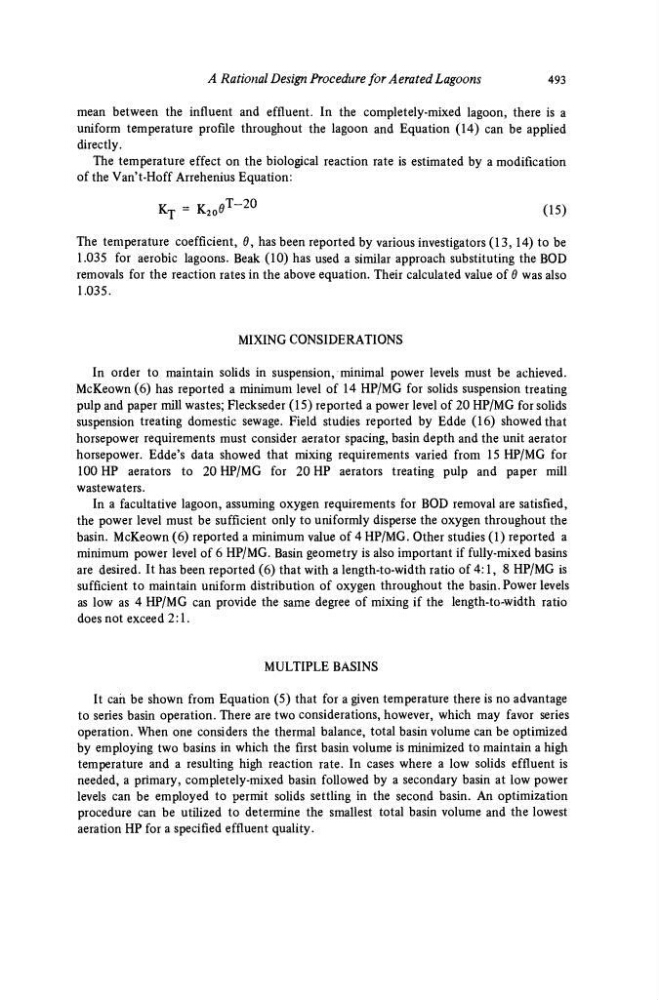
The temperature effect on the biological reaction rate is estimated by a modification
of the Van't-Hoff Arrehenius Equation:
K T = K 2 O 0
T -
2 0
(15)
The temperature coefficient, Θ, has been reported by various investigators (13,14) to be
1.035 for aerobic lagoons. Beak (10) has used a similar approach substituting the BOD
removals for the reaction rates in the above equation. Their calculated value of 0 was also
1.035.
MIXING CONSIDERATIONS
In order to maintain solids in suspension, minimal power levels must be achieved.
McKeown (6) has reported a minimum level of 14 HP/MG for solids suspension treating
pulp and paper mill wastes; Fleckseder (15) reported a power level of 20 HP/MG for solids
suspension treating domestic sewage. Field studies reported by Edde (16) showed that
horsepower requirements must consider aerator spacing, basin depth and the unit aerator
horsepower. Edde's data showed that mixing requirements varied from 15 HP/MG for
100 HP aerators to 20 HP/MG for 20 HP aerators treating pulp and paper mill
wastewaters.
In a facultative lagoon, assuming oxygen requirements for BOD removal are satisfied,
the power level must be sufficient only to uniformly disperse the oxygen throughout the
basin. McKeown (6) reported a minimum value of 4 HP/MG. Other studies (1) reported a
minimum power level of 6 HP/MG. Basin geometry is also important if fully-mixed basins
are desired. It has been reported (6) that with a length-to-width ratio of 4:1, 8 HP/MG is
sufficient to maintain uniform distribution of oxygen throughout the basin. Power levels
as low as 4 HP/MG can provide the same degree of mixing if the length-to-width ratio
does not exceed 2:1.
MULTIPLE BASINS
It can be shown from Equation (5) that for a given temperature there is no advantage
to series basin operation. There are two considerations, however, which may favor series
operation. When one considers the thermal balance, total basin volume can be optimized
by employing two basins in which the first basin volume is minimized to maintain a high
temperature and a resulting high reaction rate. In cases where a low solids effluent is
needed, a primary, completely-mixed basin followed by a secondary basin at low power
levels can be employed to permit solids settling in the second basin. An optimization
procedure can be utilized to determine the smallest total basin volume and the lowest
aeration HP for a specified effluent quality.
493
mean between the influent and effluent. In the completely-mixed lagoon, there is a
uniform temperature profile throughout the lagoon and Equation (14) can be applied
directly.
The temperature effect on the biological reaction rate is estimated by a modification
of the Van't-Hoff Arrehenius Equation:
K T = K 2 O 0
T -
2 0
(15)
The temperature coefficient, Θ, has been reported by various investigators (13,14) to be
1.035 for aerobic lagoons. Beak (10) has used a similar approach substituting the BOD
removals for the reaction rates in the above equation. Their calculated value of 0 was also
1.035.
MIXING CONSIDERATIONS
In order to maintain solids in suspension, minimal power levels must be achieved.
McKeown (6) has reported a minimum level of 14 HP/MG for solids suspension treating
pulp and paper mill wastes; Fleckseder (15) reported a power level of 20 HP/MG for solids
suspension treating domestic sewage. Field studies reported by Edde (16) showed that
horsepower requirements must consider aerator spacing, basin depth and the unit aerator
horsepower. Edde's data showed that mixing requirements varied from 15 HP/MG for
100 HP aerators to 20 HP/MG for 20 HP aerators treating pulp and paper mill
wastewaters.
In a facultative lagoon, assuming oxygen requirements for BOD removal are satisfied,
the power level must be sufficient only to uniformly disperse the oxygen throughout the
basin. McKeown (6) reported a minimum value of 4 HP/MG. Other studies (1) reported a
minimum power level of 6 HP/MG. Basin geometry is also important if fully-mixed basins
are desired. It has been reported (6) that with a length-to-width ratio of 4:1, 8 HP/MG is
sufficient to maintain uniform distribution of oxygen throughout the basin. Power levels
as low as 4 HP/MG can provide the same degree of mixing if the length-to-width ratio
does not exceed 2:1.
MULTIPLE BASINS
It can be shown from Equation (5) that for a given temperature there is no advantage
to series basin operation. There are two considerations, however, which may favor series
operation. When one considers the thermal balance, total basin volume can be optimized
by employing two basins in which the first basin volume is minimized to maintain a high
temperature and a resulting high reaction rate. In cases where a low solids effluent is
needed, a primary, completely-mixed basin followed by a secondary basin at low power
levels can be employed to permit solids settling in the second basin. An optimization
procedure can be utilized to determine the smallest total basin volume and the lowest
aeration HP for a specified effluent quality.