

A Rational Design Procedure for A erated Lagoons
491
Combining Equations (4) and (9):
0 2 /day =
_ S r [a'(l +bxt) + 1.4 ab]
1 +bxt
(10)
In a facultative basin, the oxygen requirements are increased due to the feedback of
BOD from the deposited solids. The oxygen requirements are estimated from the
relationship:
0 2 /day = ß'S T
(11)
The term, β', will depend on the degree of BOD feedback, which in turn depends on the
basin temperature, and can be expected to vary from 0.9 during winter operations to 1.4
under summer conditions. Horsepower requirements should be designed for summer
operation due to higher rates of BOD removal, benthal feedback and lower rates of
oxygen dissolution.
NUTRIENT REQUIREMENTS
Optimal operation of an aerated lagoon requires sufficient quantities of nitrogen and
phosphorus. Many industrial wastewaters are deficient in these nutrients and require their
addition to attain maximum treatment rates. Nutrient requirements in an aerobic basin
can be estimated from the relationship:
N Req. = (0.12xX v /0.77) + 0.07 ( ^ β X y
p Req. = (0.026xX v /0.77) + 0.01 ά_=x) X y
<.eq.
in which X v is expressed in lbs/day.
(12)
(13)
Equations (12) and (13) consider cellular mass as VSS to contain 12.3 per cent nitrogen
and 2.6 per cent phosphorus and that the non-biodegradable residue will contain 7 per
cent nitrogen and 1 per cent phosphorus.
In a facultative lagoon nitrogen and phosphorus are released back into solution during
anaerobic degradation of bottom deposits and the requirements are less than those
estimated from Equations (12) and (13). When nutrients are insufficient the rate
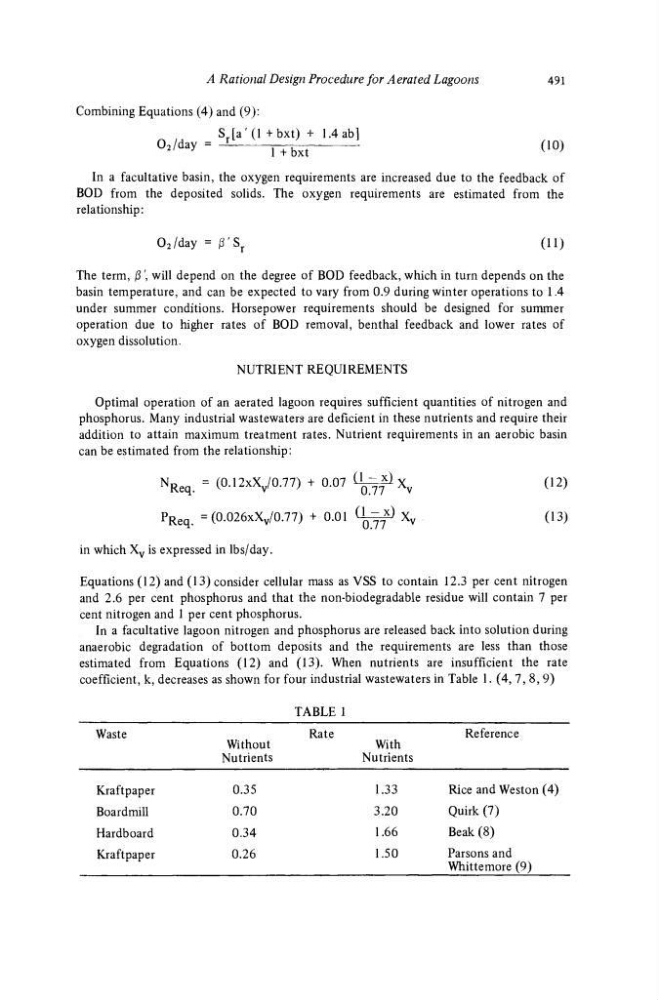
coefficient, k, decreases as shown for four industrial wastewaters in Table 1. (4, 7, 8, 9)
Waste
Kraftpaper
Boardmill
Hardboard
Kraftpaper
Without
Nutrients
0.35
0.70
0.34
0.26
TABLE 1
Rate
With
Nutrients
1.33
3.20
1.66
1.50
Reference
Rice and Weston (4)
Quirk (7)
Beak (8)
Parsons and
Whittemore (9)
491
Combining Equations (4) and (9):
0 2 /day =
_ S r [a'(l +bxt) + 1.4 ab]
1 +bxt
(10)
In a facultative basin, the oxygen requirements are increased due to the feedback of
BOD from the deposited solids. The oxygen requirements are estimated from the
relationship:
0 2 /day = ß'S T
(11)
The term, β', will depend on the degree of BOD feedback, which in turn depends on the
basin temperature, and can be expected to vary from 0.9 during winter operations to 1.4
under summer conditions. Horsepower requirements should be designed for summer
operation due to higher rates of BOD removal, benthal feedback and lower rates of
oxygen dissolution.
NUTRIENT REQUIREMENTS
Optimal operation of an aerated lagoon requires sufficient quantities of nitrogen and
phosphorus. Many industrial wastewaters are deficient in these nutrients and require their
addition to attain maximum treatment rates. Nutrient requirements in an aerobic basin
can be estimated from the relationship:
N Req. = (0.12xX v /0.77) + 0.07 ( ^ β X y
p Req. = (0.026xX v /0.77) + 0.01 ά_=x) X y
<.eq.
in which X v is expressed in lbs/day.
(12)
(13)
Equations (12) and (13) consider cellular mass as VSS to contain 12.3 per cent nitrogen
and 2.6 per cent phosphorus and that the non-biodegradable residue will contain 7 per
cent nitrogen and 1 per cent phosphorus.
In a facultative lagoon nitrogen and phosphorus are released back into solution during
anaerobic degradation of bottom deposits and the requirements are less than those
estimated from Equations (12) and (13). When nutrients are insufficient the rate
coefficient, k, decreases as shown for four industrial wastewaters in Table 1. (4, 7, 8, 9)
Waste
Kraftpaper
Boardmill
Hardboard
Kraftpaper
Without
Nutrients
0.35
0.70
0.34
0.26
TABLE 1
Rate
With
Nutrients
1.33
3.20
1.66
1.50
Reference
Rice and Weston (4)
Quirk (7)
Beak (8)
Parsons and
Whittemore (9)