

488
W.W. Eckenfelder, Jr., CD. Magee and C.E. Adams, Jr.
Combining Equations (3) and (4) defines the soluble effluent BOD as:
o _ 1 +bxt
(5)
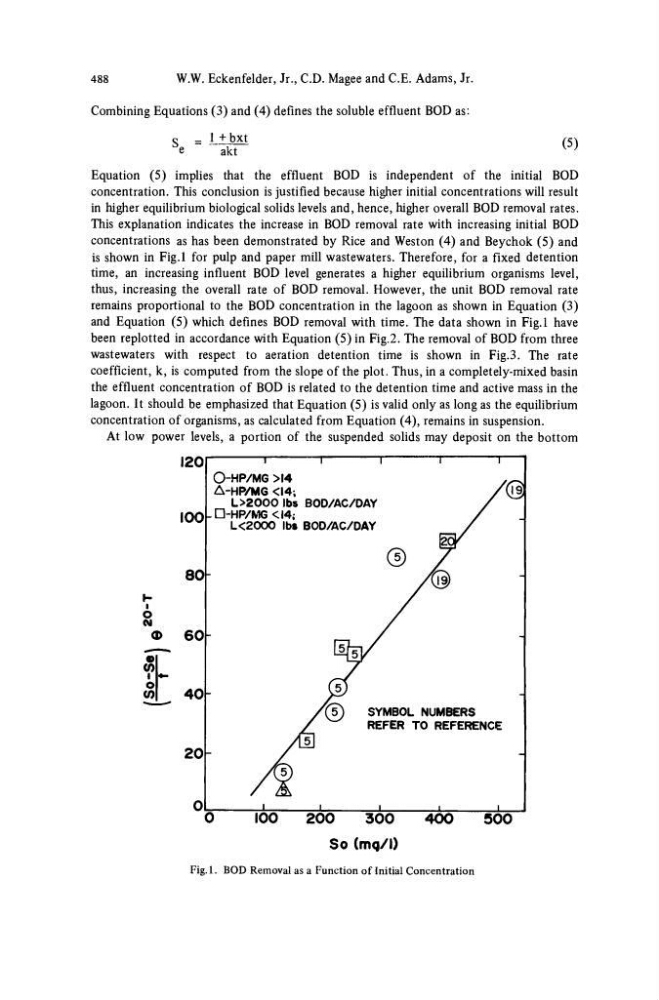
Equation (5) implies that the effluent BOD is independent of the initial BOD
concentration. This conclusion is justified because higher initial concentrations will result
in higher equilibrium biological solids levels and, hence, higher overall BOD removal rates.
This explanation indicates the increase in BOD removal rate with increasing initial BOD
concentrations as has been demonstrated by Rice and Weston (4) and Beychok (5) and
is shown in Fig.l for pulp and paper mill wastewaters. Therefore, for a fixed detention
time, an increasing influent BOD level generates a higher equilibrium organisms level,
thus, increasing the overall rate of BOD removal. However, the unit BOD removal rate
remains proportional to the BOD concentration in the lagoon as shown in Equation (3)
and Equation (5) which defines BOD removal with time. The data shown in Fig.l have
been replotted in accordance with Equation (5) in Fig.2. The removal of BOD from three
wastewaters with respect to aeration detention time is shown in Fig.3. The rate
coefficient, k, is computed from the slope of the plot. Thus, in a completely-mixed basin
the effluent concentration of BOD is related to the detention time and active mass in the
lagoon. It should be emphasized that Equation (5) is valid only as long as the equilibrium
concentration of organisms, as calculated from Equation (4), remains in suspension.
At low power levels, a portion of the suspended solids may deposit on the bottom
120
100
o
M
CO
o
w
80
60l·
40h
20h
|
1
— r
1
O-HP/MG >I4
Δ-HP/MG
LD-HP/MG
©
|
%K
L
®
/d
/®
H
1
Λδ)
SYMBOL NUMBERS
1
/
REFER TO REFERENCE
|
AE\
1
1
1
_J
1
1
J
100
200
300
400
500
So (mq/l)
Fig. 1. BOD Removal as a Function of Initial Concentration
W.W. Eckenfelder, Jr., CD. Magee and C.E. Adams, Jr.
Combining Equations (3) and (4) defines the soluble effluent BOD as:
o _ 1 +bxt
(5)
Equation (5) implies that the effluent BOD is independent of the initial BOD
concentration. This conclusion is justified because higher initial concentrations will result
in higher equilibrium biological solids levels and, hence, higher overall BOD removal rates.
This explanation indicates the increase in BOD removal rate with increasing initial BOD
concentrations as has been demonstrated by Rice and Weston (4) and Beychok (5) and
is shown in Fig.l for pulp and paper mill wastewaters. Therefore, for a fixed detention
time, an increasing influent BOD level generates a higher equilibrium organisms level,
thus, increasing the overall rate of BOD removal. However, the unit BOD removal rate
remains proportional to the BOD concentration in the lagoon as shown in Equation (3)
and Equation (5) which defines BOD removal with time. The data shown in Fig.l have
been replotted in accordance with Equation (5) in Fig.2. The removal of BOD from three
wastewaters with respect to aeration detention time is shown in Fig.3. The rate
coefficient, k, is computed from the slope of the plot. Thus, in a completely-mixed basin
the effluent concentration of BOD is related to the detention time and active mass in the
lagoon. It should be emphasized that Equation (5) is valid only as long as the equilibrium
concentration of organisms, as calculated from Equation (4), remains in suspension.
At low power levels, a portion of the suspended solids may deposit on the bottom
120
100
o
M
CO
o
w
80
60l·
40h
20h
|
1
— r
1
O-HP/MG >I4
Δ-HP/MG
LD-HP/MG
©
|
%K
L
®
/d
/®
H
1
Λδ)
SYMBOL NUMBERS
1
/
REFER TO REFERENCE
|
AE\
1
1
1
_J
1
1
J
100
200
300
400
500
So (mq/l)
Fig. 1. BOD Removal as a Function of Initial Concentration