

A RATIONAL DESIGN PROCEDURE
FOR AERATED LAGOONS
TREATING MUNICIPAL AND
INDUSTRIAL WASTEWATERS
W. WESLEY ECKENFELDER Jr.*, CHERYL D. MAGEE and CARL E. ADAMS Jr.
*Department of Environmental and Water Engineering,
Vanderbilt University, Nashville, Tennessee 37203, U.S.A.
A RATIONAL DESIGN PROCEDURE FOR AERATED LAGOONS
TREATING MUNICIPAL AND INDUSTRIAL WASTEWATERS
Aerated lagoons provide one of the most popular low cost biological treatment
methods for municipal and industrial wastewaters. They are generally classified as either
aerobic or facultative, the distinction being based on power level. An aerobic lagoon is a
high rate system where soluble BOD is converted to cellular protoplasm with some
stabilization occurring. In a facultative lagoon the turbulence levels are not sufficient to
maintain all of the solids in suspension. Depending on the BOD loading and the
suspended solids present in the influent wastewater, some of the solids are deposited in
the bottom of the basin where they undergo anaerobic decomposition. The anaerobic
by-products are in turn oxidized in the upper aerobic layers of the basin.
BOD REMOVAL KINETICS
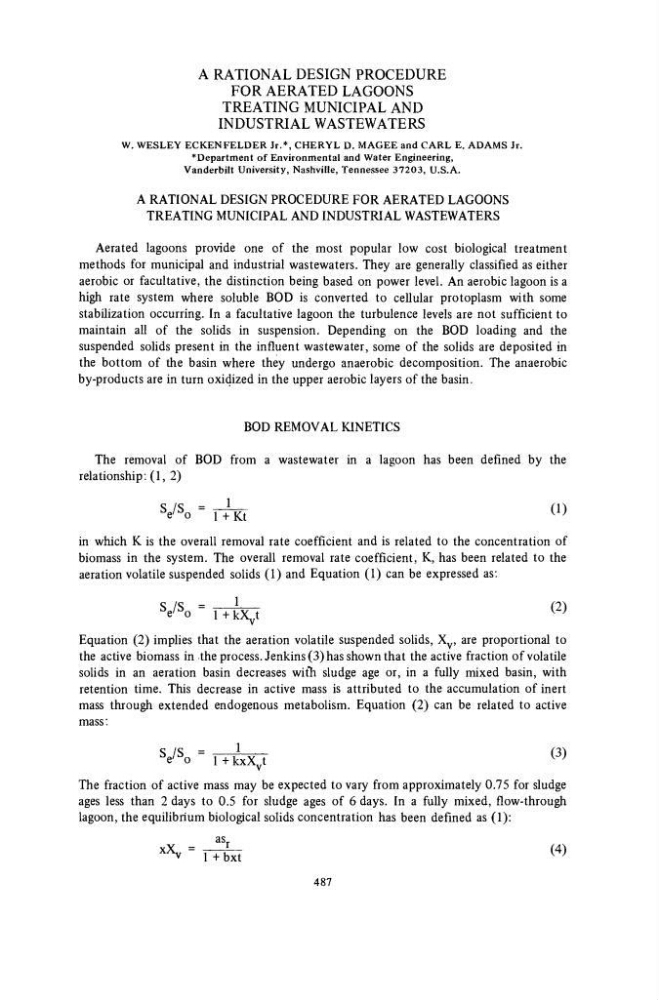
The removal of BOD from a wastewater in a lagoon has been defined by the
relationship: (1,2)
S
A , = iTKt
<»
in which K is the overall removal rate coefficient and is related to the concentration of
biomass in the system. The overall removal rate coefficient, K, has been related to the
aeration volatile suspended solids (1) and Equation (1) can be expressed as:
Equation (2) implies that the aeration volatile suspended solids, X y , are proportional to
the active biomass in the process. Jenkins (3) has shown that the active fraction of volatile
solids in an aeration basin decreases wiih sludge age or, in a fully mixed basin, with
retention time. This decrease in active mass is attributed to the accumulation of inert
mass through extended endogenous metabolism. Equation (2) can be related to active
mass:
V
s
o = ττώςτ
<
3
>
The fraction of active mass may be expected to vary from approximately 0.75 for sludge
ages less than 2 days to 0.5 for sludge ages of 6 days. In a fully mixed, flow-through
lagoon, the equilibrium biological solids concentration has been defined as (1):
xX
v = 4
<
4
>
487
FOR AERATED LAGOONS
TREATING MUNICIPAL AND
INDUSTRIAL WASTEWATERS
W. WESLEY ECKENFELDER Jr.*, CHERYL D. MAGEE and CARL E. ADAMS Jr.
*Department of Environmental and Water Engineering,
Vanderbilt University, Nashville, Tennessee 37203, U.S.A.
A RATIONAL DESIGN PROCEDURE FOR AERATED LAGOONS
TREATING MUNICIPAL AND INDUSTRIAL WASTEWATERS
Aerated lagoons provide one of the most popular low cost biological treatment
methods for municipal and industrial wastewaters. They are generally classified as either
aerobic or facultative, the distinction being based on power level. An aerobic lagoon is a
high rate system where soluble BOD is converted to cellular protoplasm with some
stabilization occurring. In a facultative lagoon the turbulence levels are not sufficient to
maintain all of the solids in suspension. Depending on the BOD loading and the
suspended solids present in the influent wastewater, some of the solids are deposited in
the bottom of the basin where they undergo anaerobic decomposition. The anaerobic
by-products are in turn oxidized in the upper aerobic layers of the basin.
BOD REMOVAL KINETICS
The removal of BOD from a wastewater in a lagoon has been defined by the
relationship: (1,2)
S
A , = iTKt
<»
in which K is the overall removal rate coefficient and is related to the concentration of
biomass in the system. The overall removal rate coefficient, K, has been related to the
aeration volatile suspended solids (1) and Equation (1) can be expressed as:
Equation (2) implies that the aeration volatile suspended solids, X y , are proportional to
the active biomass in the process. Jenkins (3) has shown that the active fraction of volatile
solids in an aeration basin decreases wiih sludge age or, in a fully mixed basin, with
retention time. This decrease in active mass is attributed to the accumulation of inert
mass through extended endogenous metabolism. Equation (2) can be related to active
mass:
V
s
o = ττώςτ
<
3
>
The fraction of active mass may be expected to vary from approximately 0.75 for sludge
ages less than 2 days to 0.5 for sludge ages of 6 days. In a fully mixed, flow-through
lagoon, the equilibrium biological solids concentration has been defined as (1):
xX
v = 4
<
4
>
487