

A Rational Design Procedure for A erated Lagoons
489
Ii
O
CM
Φ
0.7
0.6
0 5
0.4
0.3
0.2
0.1
o
-
*
5
1
L—
50
JA
5;
1
100
\δ)
O
1
1
1
/®
|
-]
-j
-HP/MG>I4
Δ-HP/MG
L>2000lbs BOD/AC/DAYJ
D-HP/MG
L<2000 lbs BOD/AC/DAY
SYMBOL NUMBERS
J
REFER TO REFERENCE]
1
1
1
150
200
25
Se (mg/l)
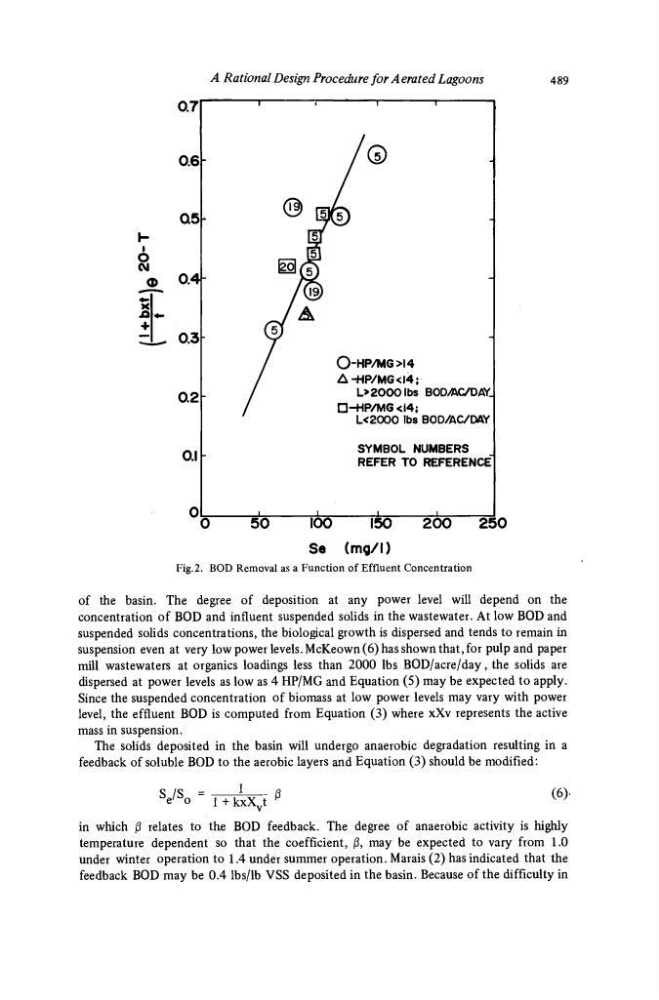
Fig. 2. BOD Removal as a Function of Effluent Concentration
of the basin. The degree of deposition at any power level will depend on the
concentration of BOD and influent suspended solids in the wastewater. At low BOD and
suspended solids concentrations, the biological growth is dispersed and tends to remain in
suspension even at very low power levels. McKeown (6) has shown that, for pulp and paper
mill wastewaters at organics loadings less than 2000 lbs BOD/acre/day, the solids are
dispersed at power levels as low as 4 HP/MG and Equation (5) may be expected to apply.
Since the suspended concentration of biomass at low power levels may vary with power
level, the effluent BOD is computed from Equation (3) where xXv represents the active
mass in suspension.
The solids deposited in the basin will undergo anaerobic degradation resulting in a
feedback of soluble BOD to the aerobic layers and Equation (3) should be modified:
V
S
o =
1
1 + kxX y t
ί
(6)·
in which ß relates to the BOD feedback. The degree of anaerobic activity is highly
temperature dependent so that the coefficient, ί, may be expected to vary from 1.0
under winter operation to 1.4 under summer operation. Marais (2) has indicated that the
feedback BOD may be 0.4 lbs/lb VSS deposited in the basin. Because of the difficulty in
489
Ii
O
CM
Φ
0.7
0.6
0 5
0.4
0.3
0.2
0.1
o
-
*
5
1
L—
50
JA
5;
1
100
\δ)
O
1
1
1
/®
|
-]
-j
-HP/MG>I4
Δ-HP/MG
L>2000lbs BOD/AC/DAYJ
D-HP/MG
L<2000 lbs BOD/AC/DAY
SYMBOL NUMBERS
J
REFER TO REFERENCE]
1
1
1
150
200
25
Se (mg/l)
Fig. 2. BOD Removal as a Function of Effluent Concentration
of the basin. The degree of deposition at any power level will depend on the
concentration of BOD and influent suspended solids in the wastewater. At low BOD and
suspended solids concentrations, the biological growth is dispersed and tends to remain in
suspension even at very low power levels. McKeown (6) has shown that, for pulp and paper
mill wastewaters at organics loadings less than 2000 lbs BOD/acre/day, the solids are
dispersed at power levels as low as 4 HP/MG and Equation (5) may be expected to apply.
Since the suspended concentration of biomass at low power levels may vary with power
level, the effluent BOD is computed from Equation (3) where xXv represents the active
mass in suspension.
The solids deposited in the basin will undergo anaerobic degradation resulting in a
feedback of soluble BOD to the aerobic layers and Equation (3) should be modified:
V
S
o =
1
1 + kxX y t
ί
(6)·
in which ß relates to the BOD feedback. The degree of anaerobic activity is highly
temperature dependent so that the coefficient, ί, may be expected to vary from 1.0
under winter operation to 1.4 under summer operation. Marais (2) has indicated that the
feedback BOD may be 0.4 lbs/lb VSS deposited in the basin. Because of the difficulty in