

Influence of Temperature and Turbulence on Oxygen Transfer in Water
31
4. CONCLUSIONS
The comparative evaluation of the literature and the authors' own measurements have
shown that the temperature influence on the oxygen transfer in water depends on the
individual system. A single overall relationship therefore does not apply. Since the
engineer has to make decisions however without having the opportunity to conduct tests,
the prediction of the temperature influence should be improved by a classification of the
systems.
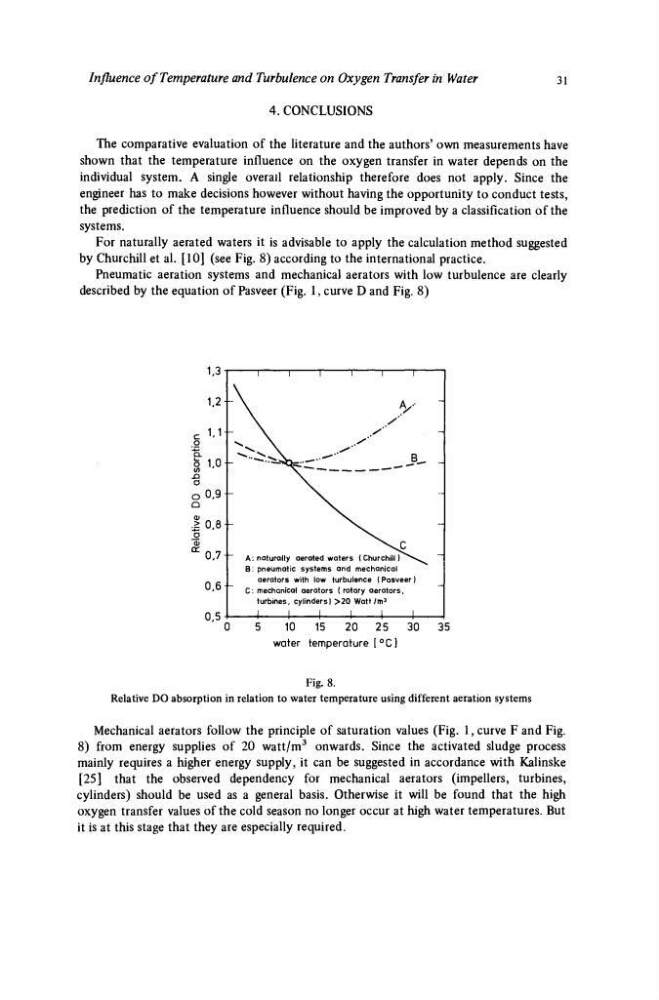
For naturally aerated waters it is advisable to apply the calculation method suggested
by Churchill et al. [10] (see Fig. 8) according to the international practice.
Pneumatic aeration systems and mechanical aerators with low turbulence are clearly
described by the equation of Pasveer (Fig. 1, curve D and Fig. 8)
1,3
U f
1.1
Q.
o 1,0
(Λ
D
o 0 , 9
Q
Φ
"a
* 0 . 7
0,6
0,5
naturally aerated waters {Churchill)
pneumatic systems and mechanical
aerators with low turbulence (Pasveer)
mechanical aerators (rotary aerators,
turbines, cylinders) >20 Watt/m
3
4+
10
15
20
25
30
35
water temperature [ °C]
Fig. 8.
Relative DO absorption in relation to water temperature using different aeration systems
Mechanical aerators follow the principle of saturation values (Fig. 1, curve F and Fig.
8) from energy supplies of 20 watt/m
3 onwards. Since the activated sludge process
mainly requires a higher energy supply, it can be suggested in accordance with Kalinske
[25] that the observed dependency for mechanical aerators (impellers, turbines,
cylinders) should be used as a general basis. Otherwise it will be found that the high
oxygen transfer values of the cold season no longer occur at high water temperatures. But
it is at this stage that they are especially required.
31
4. CONCLUSIONS
The comparative evaluation of the literature and the authors' own measurements have
shown that the temperature influence on the oxygen transfer in water depends on the
individual system. A single overall relationship therefore does not apply. Since the
engineer has to make decisions however without having the opportunity to conduct tests,
the prediction of the temperature influence should be improved by a classification of the
systems.
For naturally aerated waters it is advisable to apply the calculation method suggested
by Churchill et al. [10] (see Fig. 8) according to the international practice.
Pneumatic aeration systems and mechanical aerators with low turbulence are clearly
described by the equation of Pasveer (Fig. 1, curve D and Fig. 8)
1,3
U f
1.1
Q.
o 1,0
(Λ
D
o 0 , 9
Q
Φ
"a
* 0 . 7
0,6
0,5
naturally aerated waters {Churchill)
pneumatic systems and mechanical
aerators with low turbulence (Pasveer)
mechanical aerators (rotary aerators,
turbines, cylinders) >20 Watt/m
3
4+
10
15
20
25
30
35
water temperature [ °C]
Fig. 8.
Relative DO absorption in relation to water temperature using different aeration systems
Mechanical aerators follow the principle of saturation values (Fig. 1, curve F and Fig.
8) from energy supplies of 20 watt/m
3 onwards. Since the activated sludge process
mainly requires a higher energy supply, it can be suggested in accordance with Kalinske
[25] that the observed dependency for mechanical aerators (impellers, turbines,
cylinders) should be used as a general basis. Otherwise it will be found that the high
oxygen transfer values of the cold season no longer occur at high water temperatures. But
it is at this stage that they are especially required.