

30
K.R. Imhoff and D. Albrecht
consumption of the motor 5.1 kw. The aerator cannot be compared with either the
pneumatic or the mechanical devices.
Aeration tests were conducted with the Turbo Oxyder in a pure water body of 200 m
3
at various temperatures. The results are shown in Fig. 6. The energy consumption
equalled 23 watt/m
3 . The shape of the curve resembles the test result B in Fig. 1.
3.5 Tests in still water
With tests in still water the temperature influence without artificially induced
turbulence was investigated. For this purpose, a tank with a surface area of 0.39 m
2 and a
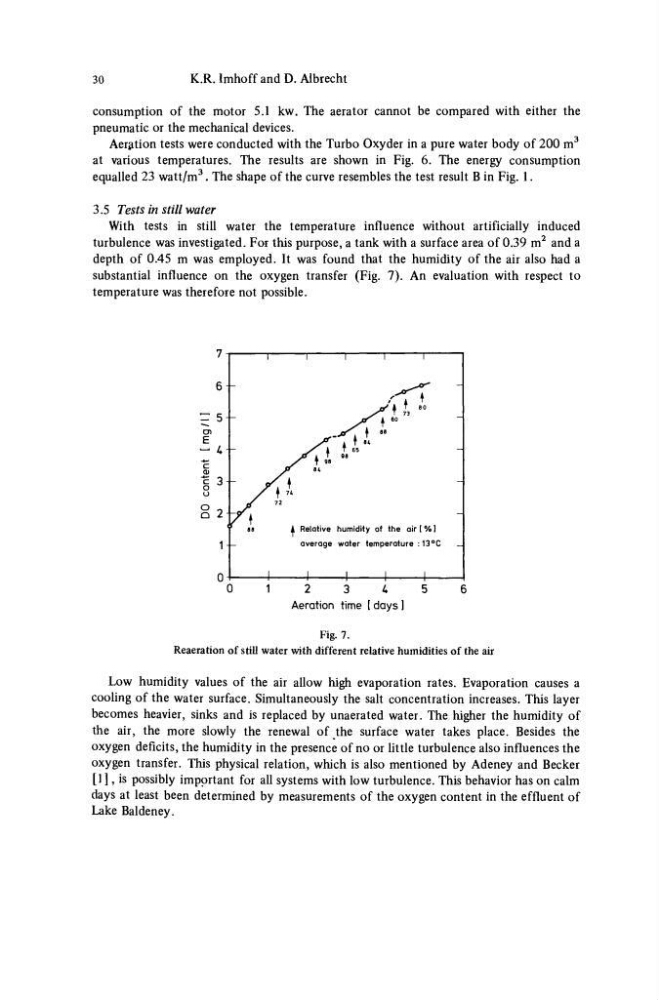
depth of 0.45 m was employed. It was found that the humidity of the air also had a
substantial influence on the oxygen transfer (Fig. 7). An evaluation with respect to
temperature was therefore not possible.
7
6
Ξ
5
en
E
"c
l
3
u
Q 2
1
o .
.
.
.
,
.
0
1
2
3
A
5
6
Aeration time [days]
Fig. 7.
Reaeration of still water with different relative humidities of the air
Low humidity values of the air allow high evaporation rates. Evaporation causes a
cooling of the water surface. Simultaneously the salt concentration increases. This layer
becomes heavier, sinks and is replaced by unaerated water. The higher the humidity of
the air, the more slowly the renewal of the surface water takes place. Besides the
oxygen deficits, the humidity in the presence of no or little turbulence also influences the
oxygen transfer. This physical relation, which is also mentioned by Adeney and Becker
[1], is possibly important for all systems with low turbulence. This behavior has on calm
days at least been determined by measurements of the oxygen content in the effluent of
Lake Baldeney.
Ί
Γ
Ί
Γ
' 4
T
/ A f 80
8Θ
A Relative humidity of the air[%]
average water temperature :13°C
J
L
K.R. Imhoff and D. Albrecht
consumption of the motor 5.1 kw. The aerator cannot be compared with either the
pneumatic or the mechanical devices.
Aeration tests were conducted with the Turbo Oxyder in a pure water body of 200 m
3
at various temperatures. The results are shown in Fig. 6. The energy consumption
equalled 23 watt/m
3 . The shape of the curve resembles the test result B in Fig. 1.
3.5 Tests in still water
With tests in still water the temperature influence without artificially induced
turbulence was investigated. For this purpose, a tank with a surface area of 0.39 m
2 and a
depth of 0.45 m was employed. It was found that the humidity of the air also had a
substantial influence on the oxygen transfer (Fig. 7). An evaluation with respect to
temperature was therefore not possible.
7
6
Ξ
5
en
E
"c
l
3
u
Q 2
1
o .
.
.
.
,
.
0
1
2
3
A
5
6
Aeration time [days]
Fig. 7.
Reaeration of still water with different relative humidities of the air
Low humidity values of the air allow high evaporation rates. Evaporation causes a
cooling of the water surface. Simultaneously the salt concentration increases. This layer
becomes heavier, sinks and is replaced by unaerated water. The higher the humidity of
the air, the more slowly the renewal of the surface water takes place. Besides the
oxygen deficits, the humidity in the presence of no or little turbulence also influences the
oxygen transfer. This physical relation, which is also mentioned by Adeney and Becker
[1], is possibly important for all systems with low turbulence. This behavior has on calm
days at least been determined by measurements of the oxygen content in the effluent of
Lake Baldeney.
Ί
Γ
Ί
Γ
' 4
T
/ A f 80
8Θ
A Relative humidity of the air[%]
average water temperature :13°C
J
L