

446
T. Matsuo
OXYGEN UPTAKE RATE OF ACTIVATED SLUDGE
Some investigators (9), (10), (11) have noticed the effect of apparent viscosity due to
suspended solids on the oxygen uptake rate and have showed qualitatively that the
decrease of the rate was associated with an increase in the viscosity of suspension. Some
data (12), (13) indicate the influence of suspended solids concentration on the oxygen
uptake rate, an increase in suspended solids concentration corresponding to a decrease
in the oxygen uptake rate.
In the following section experiments were conducted to determine the effects of
suspended solids concentration on the specific oxygen uptake rate.
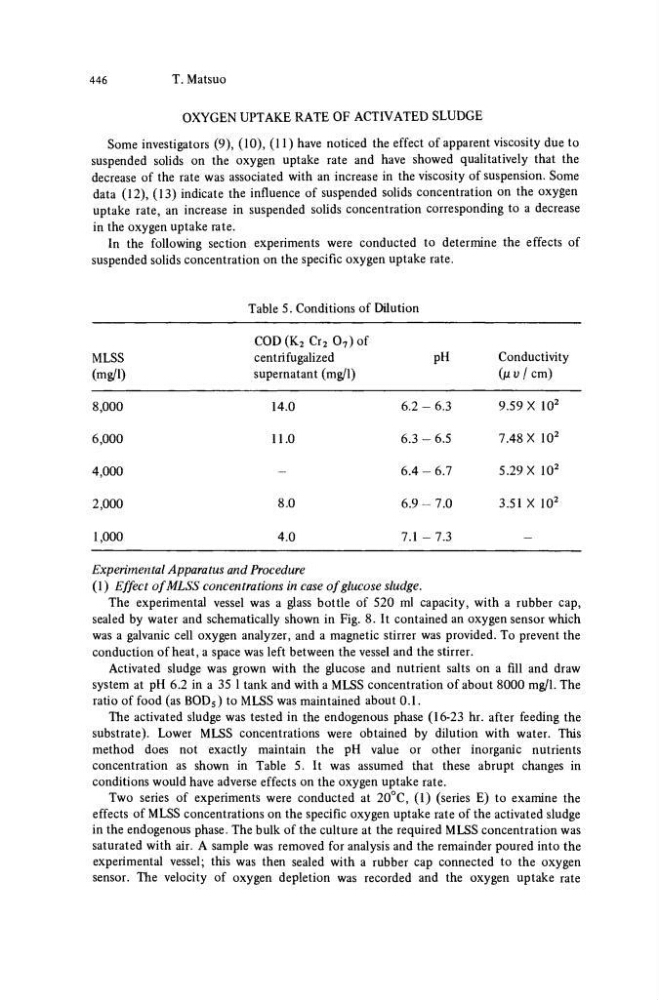
Table 5. Conditions of Dilution
MLSS
(mg/1)
COD(K 2 Cr 2 0 7 )of
centrifugalized
supernatant (mg/1)
P H
Conductivity
(μ v I cm)
8,000
6,000
4,000
2,000
14.0
11.0
8.0
6.2 - 6.3
6.3 - 6.5
6.4 - 6.7
6.9 - 7.0
9.59 X 10
2
7.48 X 10
2
5.29 X 10
2
3.51 X 10
2
1,000
4.0
7.1 - 7 . 3
Experimental Apparatus and Procedure
(1) Effect of MLSS concentrations in case of glucose sludge.
The experimental vessel was a glass bottle of 520 ml capacity, with a rubber cap,
sealed by water and schematically shown in Fig. 8. It contained an oxygen sensor which
was a galvanic cell oxygen analyzer, and a magnetic stirrer was provided. To prevent the
conduction of heat, a space was left between the vessel and the stirrer.
Activated sludge was grown with the glucose and nutrient salts on a fill and draw
system at pH 6.2 in a 35 1 tank and with a MLSS concentration of about 8000 mg/1. The
ratio of food (as BOD 5 ) to MLSS was maintained about 0.1.
The activated sludge was tested in the endogenous phase (16-23 hr. after feeding the
substrate). Lower MLSS concentrations were obtained by dilution with water. This
method does not exactly maintain the pH value or other inorganic nutrients
concentration as shown in Table 5. It was assumed that these abrupt changes in
conditions would have adverse effects on the oxygen uptake rate.
Two series of experiments were conducted at 20°C, (1) (series E) to examine the
effects of MLSS concentrations on the specific oxygen uptake rate of the activated sludge
in the endogenous phase. The bulk of the culture at the required MLSS concentration was
saturated with air. A sample was removed for analysis and the remainder poured into the
experimental vessel; this was then sealed with a rubber cap connected to the oxygen
sensor. The velocity of oxygen depletion was recorded and the oxygen uptake rate
T. Matsuo
OXYGEN UPTAKE RATE OF ACTIVATED SLUDGE
Some investigators (9), (10), (11) have noticed the effect of apparent viscosity due to
suspended solids on the oxygen uptake rate and have showed qualitatively that the
decrease of the rate was associated with an increase in the viscosity of suspension. Some
data (12), (13) indicate the influence of suspended solids concentration on the oxygen
uptake rate, an increase in suspended solids concentration corresponding to a decrease
in the oxygen uptake rate.
In the following section experiments were conducted to determine the effects of
suspended solids concentration on the specific oxygen uptake rate.
Table 5. Conditions of Dilution
MLSS
(mg/1)
COD(K 2 Cr 2 0 7 )of
centrifugalized
supernatant (mg/1)
P H
Conductivity
(μ v I cm)
8,000
6,000
4,000
2,000
14.0
11.0
8.0
6.2 - 6.3
6.3 - 6.5
6.4 - 6.7
6.9 - 7.0
9.59 X 10
2
7.48 X 10
2
5.29 X 10
2
3.51 X 10
2
1,000
4.0
7.1 - 7 . 3
Experimental Apparatus and Procedure
(1) Effect of MLSS concentrations in case of glucose sludge.
The experimental vessel was a glass bottle of 520 ml capacity, with a rubber cap,
sealed by water and schematically shown in Fig. 8. It contained an oxygen sensor which
was a galvanic cell oxygen analyzer, and a magnetic stirrer was provided. To prevent the
conduction of heat, a space was left between the vessel and the stirrer.
Activated sludge was grown with the glucose and nutrient salts on a fill and draw
system at pH 6.2 in a 35 1 tank and with a MLSS concentration of about 8000 mg/1. The
ratio of food (as BOD 5 ) to MLSS was maintained about 0.1.
The activated sludge was tested in the endogenous phase (16-23 hr. after feeding the
substrate). Lower MLSS concentrations were obtained by dilution with water. This
method does not exactly maintain the pH value or other inorganic nutrients
concentration as shown in Table 5. It was assumed that these abrupt changes in
conditions would have adverse effects on the oxygen uptake rate.
Two series of experiments were conducted at 20°C, (1) (series E) to examine the
effects of MLSS concentrations on the specific oxygen uptake rate of the activated sludge
in the endogenous phase. The bulk of the culture at the required MLSS concentration was
saturated with air. A sample was removed for analysis and the remainder poured into the
experimental vessel; this was then sealed with a rubber cap connected to the oxygen
sensor. The velocity of oxygen depletion was recorded and the oxygen uptake rate