

Structure of Turbulence and Oxygen Transfer Mechanism
445
Air Flow Rate
C/A
E/A
Air Flow Rate
10,000 LM
5,000 SM
10,000 LG
5,000 SG
Table 3. Values of
I
1.07
0.97
Table 4. Values of
1
1.00
1.25
1.17
1.40
2
0.91
0.99
0.97
1.10
<*C
%
II
1.10
1.03
3
0.69
0.77
0.79
0.90
III
1.04
1.09
4
0.65
0.70
0.79
0.89
never determined or measured by the "scale" concerned in this experiment. As
mentioned in the discussion of the previous section, the suspended solids concentration,
the size and kind of the solids may be important parameters which characterize the
effects of turbulence.
4. The author's unpublished data using a rotary type viscometer show that the apparent
viscosity of milk sludge is greater than that of glucose sludge. Although this can also
explain qualitative effects on "K L 'a", it can be assumed that suspended solids should
affect both viscosity (coefficient of momentum transfer rate) and "K^/a" (coefficient of
mass transfer rate).
5. As to the effect of suspended solids on the coefficient "Kjja", Mancy and Okun (7)
stated in their discussion of van der Kroon's paper (8) that the primary effect of
suspended solids is a reduction of the liquid hydrodynamics rather than a reduction in the
oxygen diffusivity coefficient. It can now be said that the effects of the suspended solids
concentration is caused by hydrodynamical factors and not by biological or chemical
factors.
6. Again, it is assumed that similar effects of suspended solids would be expected
through the mechanisms of oxygen uptake of activated sludge.
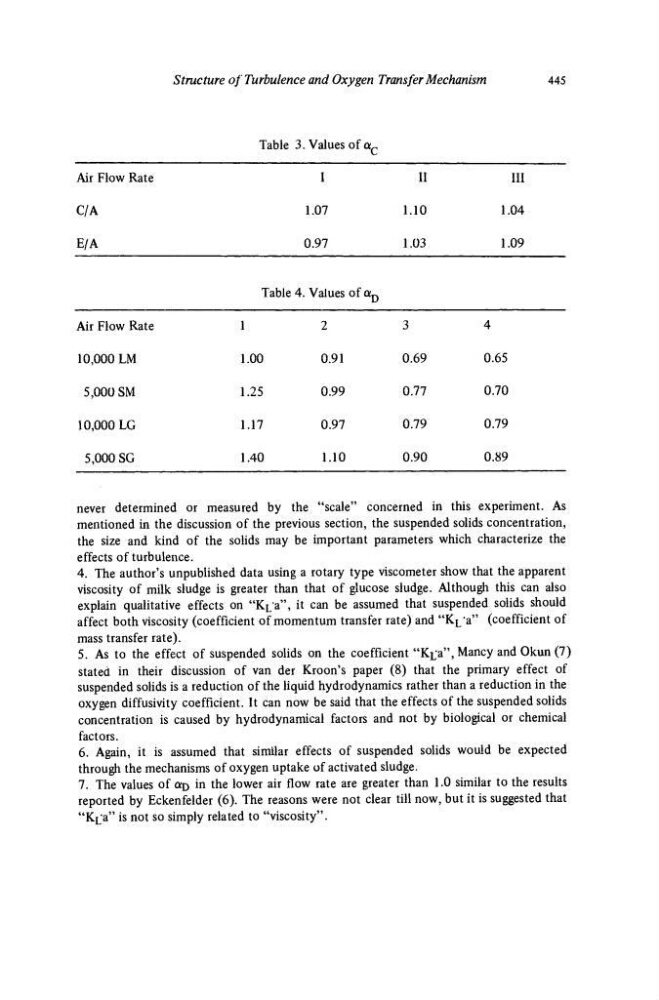
7. The values of a D in the lower air flow rate are greater than 1.0 similar to the results
reported by Eckenfelder (6). The reasons were not clear till now, but it is suggested that
"Kjja" is not so simply related to "viscosity".
445
Air Flow Rate
C/A
E/A
Air Flow Rate
10,000 LM
5,000 SM
10,000 LG
5,000 SG
Table 3. Values of
I
1.07
0.97
Table 4. Values of
1
1.00
1.25
1.17
1.40
2
0.91
0.99
0.97
1.10
<*C
%
II
1.10
1.03
3
0.69
0.77
0.79
0.90
III
1.04
1.09
4
0.65
0.70
0.79
0.89
never determined or measured by the "scale" concerned in this experiment. As
mentioned in the discussion of the previous section, the suspended solids concentration,
the size and kind of the solids may be important parameters which characterize the
effects of turbulence.
4. The author's unpublished data using a rotary type viscometer show that the apparent
viscosity of milk sludge is greater than that of glucose sludge. Although this can also
explain qualitative effects on "K L 'a", it can be assumed that suspended solids should
affect both viscosity (coefficient of momentum transfer rate) and "K^/a" (coefficient of
mass transfer rate).
5. As to the effect of suspended solids on the coefficient "Kjja", Mancy and Okun (7)
stated in their discussion of van der Kroon's paper (8) that the primary effect of
suspended solids is a reduction of the liquid hydrodynamics rather than a reduction in the
oxygen diffusivity coefficient. It can now be said that the effects of the suspended solids
concentration is caused by hydrodynamical factors and not by biological or chemical
factors.
6. Again, it is assumed that similar effects of suspended solids would be expected
through the mechanisms of oxygen uptake of activated sludge.
7. The values of a D in the lower air flow rate are greater than 1.0 similar to the results
reported by Eckenfelder (6). The reasons were not clear till now, but it is suggested that
"Kjja" is not so simply related to "viscosity".