

444
T. Matsuo
determined by the non-steady state method.
Condition of experiment: In series C, the conditions of air flow rate and of width
of the baffle plates were the same as those of series A. In series D, two kinds of activated
sludge were examined viz., a milk sludge grown with skim milk on a fill and draw system,
and the other was a glucose sludge grown with the glucose on a fill and draw system. The
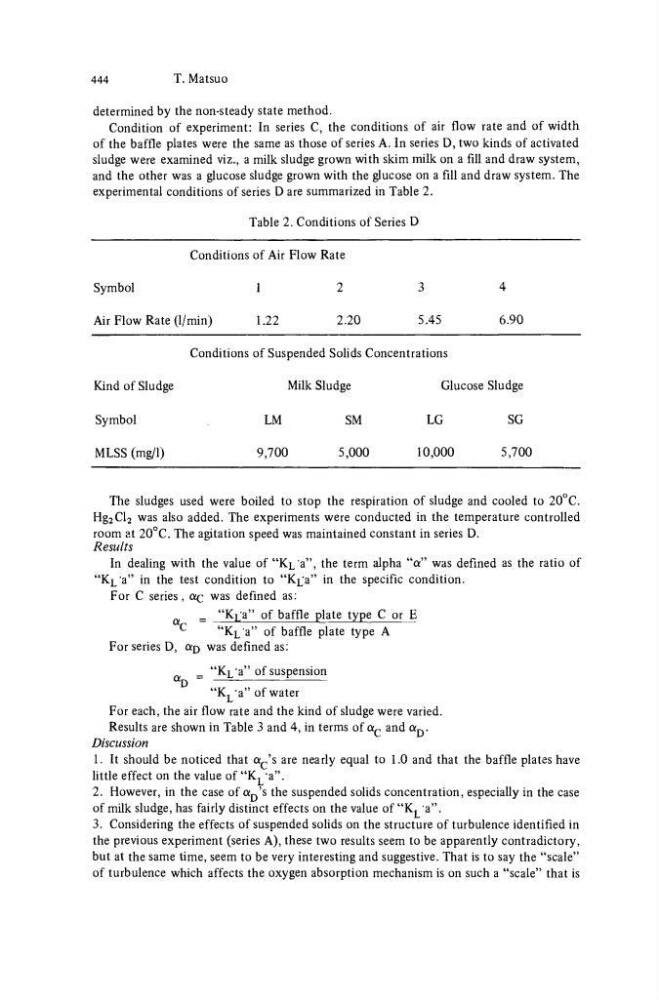
experimental conditions of series D are summarized in Table 2.
Table 2. Conditions of Series D
Conditions of Air Flow Rate
Symbol
1
2
3
4
Air Flow Rate (1/min)
1.22
2.20
5.45
6.90
Conditions of Suspended Solids Concentrations
Kind of Sludge
Milk Sludge
Glucose Sludge
Symbol
LM
SM
LG
SG
MLSS(mg/l)
9,700
5,000
10,000
5,700
The sludges used were boiled to stop the respiration of sludge and cooled to 20°C.
Hg 2 Cl 2 was also added. The experiments were conducted in the temperature controlled
room at 20°C. The agitation speed was maintained constant in series D.
Results
In dealing with the value of "Kj_/a", the term alpha "a" was defined as the ratio of
"Kj/a" in the test condition to "K L 'a" in the specific condition.
For C series, OLQ was defined as:
_ "Kjja" of baffle plate type C or E
c
"K L a" of baffle plate type A
For series D, C*D was defined as:
_ "KL'a" of suspension
a D
"K "a" of water
For each, the air flow rate and the kind of sludge were varied.
Results are shown in Table 3 and 4, in terms of a c and a D .
Discussion
1. It should be noticed that a 's are nearly equal to 1.0 and that the baffle plates have
little effect on the value of "K L a".
2. However, in the case of a D 's the suspended solids concentration, especially in the case
of milk sludge, has fairly distinct effects on the value of "K *a".
3. Considering the effects of suspended solids on the structure of turbulence identified in
the previous experiment (series A), these two results seem to be apparently contradictory,
but at the same time, seem to be very interesting and suggestive. That is to say the "scale"
of turbulence which affects the oxygen absorption mechanism is on such a "scale" that is
T. Matsuo
determined by the non-steady state method.
Condition of experiment: In series C, the conditions of air flow rate and of width
of the baffle plates were the same as those of series A. In series D, two kinds of activated
sludge were examined viz., a milk sludge grown with skim milk on a fill and draw system,
and the other was a glucose sludge grown with the glucose on a fill and draw system. The
experimental conditions of series D are summarized in Table 2.
Table 2. Conditions of Series D
Conditions of Air Flow Rate
Symbol
1
2
3
4
Air Flow Rate (1/min)
1.22
2.20
5.45
6.90
Conditions of Suspended Solids Concentrations
Kind of Sludge
Milk Sludge
Glucose Sludge
Symbol
LM
SM
LG
SG
MLSS(mg/l)
9,700
5,000
10,000
5,700
The sludges used were boiled to stop the respiration of sludge and cooled to 20°C.
Hg 2 Cl 2 was also added. The experiments were conducted in the temperature controlled
room at 20°C. The agitation speed was maintained constant in series D.
Results
In dealing with the value of "Kj_/a", the term alpha "a" was defined as the ratio of
"Kj/a" in the test condition to "K L 'a" in the specific condition.
For C series, OLQ was defined as:
_ "Kjja" of baffle plate type C or E
c
"K L a" of baffle plate type A
For series D, C*D was defined as:
_ "KL'a" of suspension
a D
"K "a" of water
For each, the air flow rate and the kind of sludge were varied.
Results are shown in Table 3 and 4, in terms of a c and a D .
Discussion
1. It should be noticed that a 's are nearly equal to 1.0 and that the baffle plates have
little effect on the value of "K L a".
2. However, in the case of a D 's the suspended solids concentration, especially in the case
of milk sludge, has fairly distinct effects on the value of "K *a".
3. Considering the effects of suspended solids on the structure of turbulence identified in
the previous experiment (series A), these two results seem to be apparently contradictory,
but at the same time, seem to be very interesting and suggestive. That is to say the "scale"
of turbulence which affects the oxygen absorption mechanism is on such a "scale" that is