

428
S.D. Bokil and J.K. Bewtra
x
CL
8 r7 h
Washed-0-05M Phosphate
fcs
Q
^ * o- ,ρ
ο
ο - "
-
\ \ Ν
Washed-Tap Water
X \ *
f
A
\ \^L
A
1
J
1
1
Buffer - Blended
-Blended
Λ χ / ^ - C o n t r o l
/
1
^L
Blended-Unwashed
1
1
6
8
DAYS
10
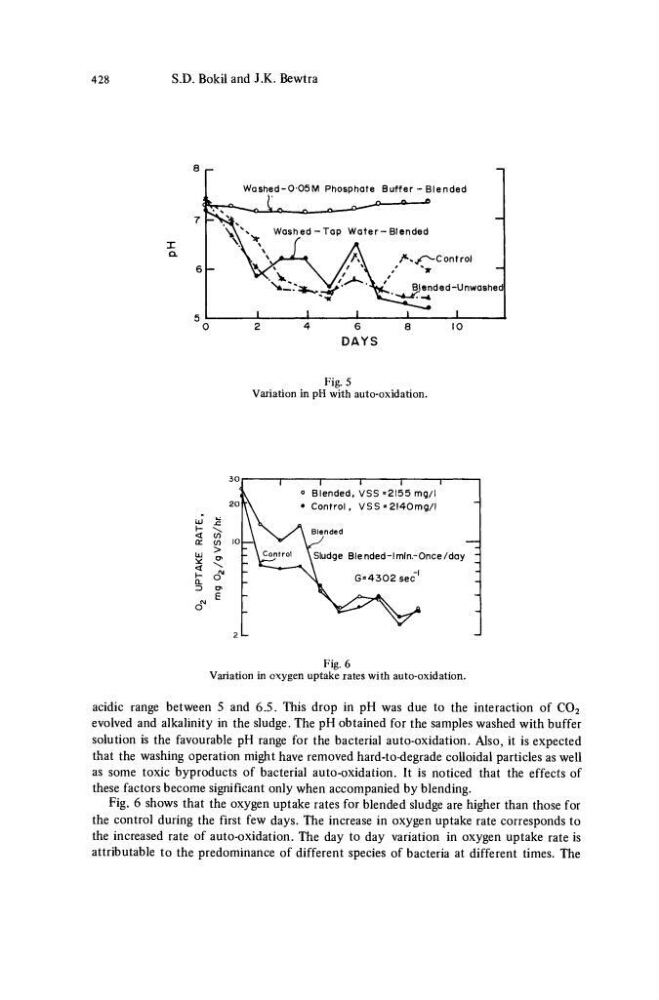
Fig. 5
Variation in pH with auto-oxidation.
1
1
1
1
o Blended, VSS =2155 mg/l
• Control, V S S = 2 l 4 0 m g / l
Blended
Sludge Blended-lmin.-Once/day H
Fig. 6
Variation in oxygen uptake rates with auto-oxidation.
acidic range between 5 and 6.5. This drop in pH was due to the interaction of C0 2
evolved and alkalinity in the sludge. The pH obtained for the samples washed with buffer
solution is the favourable pH range for the bacterial auto-oxidation. Also, it is expected
that the washing operation might have removed hard-to-degrade colloidal particles as well
as some toxic byproducts of bacterial auto-oxidation. It is noticed that the effects of
these factors become significant only when accompanied by blending.
Fig. 6 shows that the oxygen uptake rates for blended sludge are higher than those for
the control during the first few days. The increase in oxygen uptake rate corresponds to
the increased rate of auto-oxidation. The day to day variation in oxygen uptake rate is
attributable to the predominance of different species of bacteria at different times. The
S.D. Bokil and J.K. Bewtra
x
CL
8 r7 h
Washed-0-05M Phosphate
fcs
Q
^ * o- ,ρ
ο
ο - "
-
\ \ Ν
Washed-Tap Water
X \ *
f
A
\ \^L
A
1
J
1
1
Buffer - Blended
-Blended
Λ χ / ^ - C o n t r o l
/
1
^L
Blended-Unwashed
1
1
6
8
DAYS
10
Fig. 5
Variation in pH with auto-oxidation.
1
1
1
1
o Blended, VSS =2155 mg/l
• Control, V S S = 2 l 4 0 m g / l
Blended
Sludge Blended-lmin.-Once/day H
Fig. 6
Variation in oxygen uptake rates with auto-oxidation.
acidic range between 5 and 6.5. This drop in pH was due to the interaction of C0 2
evolved and alkalinity in the sludge. The pH obtained for the samples washed with buffer
solution is the favourable pH range for the bacterial auto-oxidation. Also, it is expected
that the washing operation might have removed hard-to-degrade colloidal particles as well
as some toxic byproducts of bacterial auto-oxidation. It is noticed that the effects of
these factors become significant only when accompanied by blending.
Fig. 6 shows that the oxygen uptake rates for blended sludge are higher than those for
the control during the first few days. The increase in oxygen uptake rate corresponds to
the increased rate of auto-oxidation. The day to day variation in oxygen uptake rate is
attributable to the predominance of different species of bacteria at different times. The