

Influence of Mechanical Blending on Aerobic Digestion
427
100
80 h
| 60
<
Έ
LU 40!
rr
en
c/)
>
2 0
Washed-Blended
k « 0 0 4 5 4 day"
1
Unwashed-Blended
kj-0-0334 day""
1
VSS,mg/l
SS,mg/l
8 6 4
2 4 0 2
821
2 2 4 4
819
2169
3
90
LU
e>
Q
3 7 0
- 1
SETTLED S
ai
o
3 0
h—
-
P~
—*—
* ^ s j .
Sludge Washed with 0-05M
J
V
ik
Phosphate Buffer
\Unwashed\ s i u d g e Blended-lmln.Ί
Vr-^ Blended V
I
\ · \ #
\
Once/day
-j
\
\ ^
Control V
G-4580 sec"
-J
\.
\
Aeration Rate-0-30scfm J
Washed-Blended ^
8
° ^ f r - 4
lt
t||
-1
i
I -
-1
1
1
1
6
DAYS
10
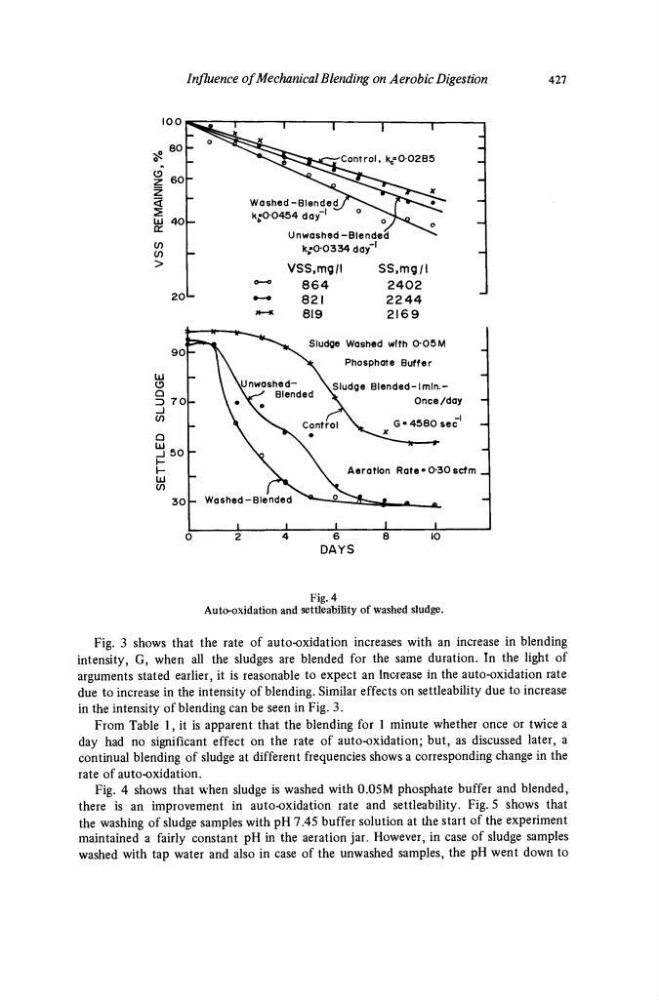
Fig. 4
Auto-oxidation and settleability of washed sludge.
Fig. 3 shows that the rate of auto-oxidation increases with an increase in blending
intensity, G, when all the sludges are blended for the same duration. In the light of
arguments stated earlier, it is reasonable to expect an increase in the auto-oxidation rate
due to increase in the intensity of blending. Similar effects on settleability due to increase
in the intensity of blending can be seen in Fig. 3.
From Table 1, it is apparent that the blending for 1 minute whether once or twice a
day had no significant effect on the rate of auto-oxidation; but, as discussed later, a
continual blending of sludge at different frequencies shows a corresponding change in the
rate of auto-oxidation.
Fig. 4 shows that when sludge is washed with 0.05M phosphate buffer and blended,
there is an improvement in auto-oxidation rate and settleability. Fig. 5 shows that
the washing of sludge samples with pH 7.45 buffer solution at the start of the experiment
maintained a fairly constant pH in the aeration jar. However, in case of sludge samples
washed with tap water and also in case of the unwashed samples, the pH went down to
427
100
80 h
| 60
<
Έ
LU 40!
rr
en
c/)
>
2 0
Washed-Blended
k « 0 0 4 5 4 day"
1
Unwashed-Blended
kj-0-0334 day""
1
VSS,mg/l
SS,mg/l
8 6 4
2 4 0 2
821
2 2 4 4
819
2169
3
90
LU
e>
Q
3 7 0
- 1
SETTLED S
ai
o
3 0
h—
-
P~
—*—
* ^ s j .
Sludge Washed with 0-05M
J
V
ik
Phosphate Buffer
\Unwashed\ s i u d g e Blended-lmln.Ί
Vr-^ Blended V
I
\ · \ #
\
Once/day
-j
\
\ ^
Control V
G-4580 sec"
-J
\.
\
Aeration Rate-0-30scfm J
Washed-Blended ^
8
° ^ f r - 4
lt
t||
-1
i
I -
-1
1
1
1
6
DAYS
10
Fig. 4
Auto-oxidation and settleability of washed sludge.
Fig. 3 shows that the rate of auto-oxidation increases with an increase in blending
intensity, G, when all the sludges are blended for the same duration. In the light of
arguments stated earlier, it is reasonable to expect an increase in the auto-oxidation rate
due to increase in the intensity of blending. Similar effects on settleability due to increase
in the intensity of blending can be seen in Fig. 3.
From Table 1, it is apparent that the blending for 1 minute whether once or twice a
day had no significant effect on the rate of auto-oxidation; but, as discussed later, a
continual blending of sludge at different frequencies shows a corresponding change in the
rate of auto-oxidation.
Fig. 4 shows that when sludge is washed with 0.05M phosphate buffer and blended,
there is an improvement in auto-oxidation rate and settleability. Fig. 5 shows that
the washing of sludge samples with pH 7.45 buffer solution at the start of the experiment
maintained a fairly constant pH in the aeration jar. However, in case of sludge samples
washed with tap water and also in case of the unwashed samples, the pH went down to