

426
S.D. Bokil and J.K. Bewtra
particles thereby increasing the surface area as seen in Fig. 9, (ii) decrease in the
diffusional resistance, in or out, to the movement of soluble substances for bioparticles of
smaller size as compared to bigger parent floe, (iii) solubilization of the certain organics
present in the sludge as a result of endogenous respiration, and (iv) more frequent renewal
of contacts between the surfaces of active microorganisms and the surrounding medium.
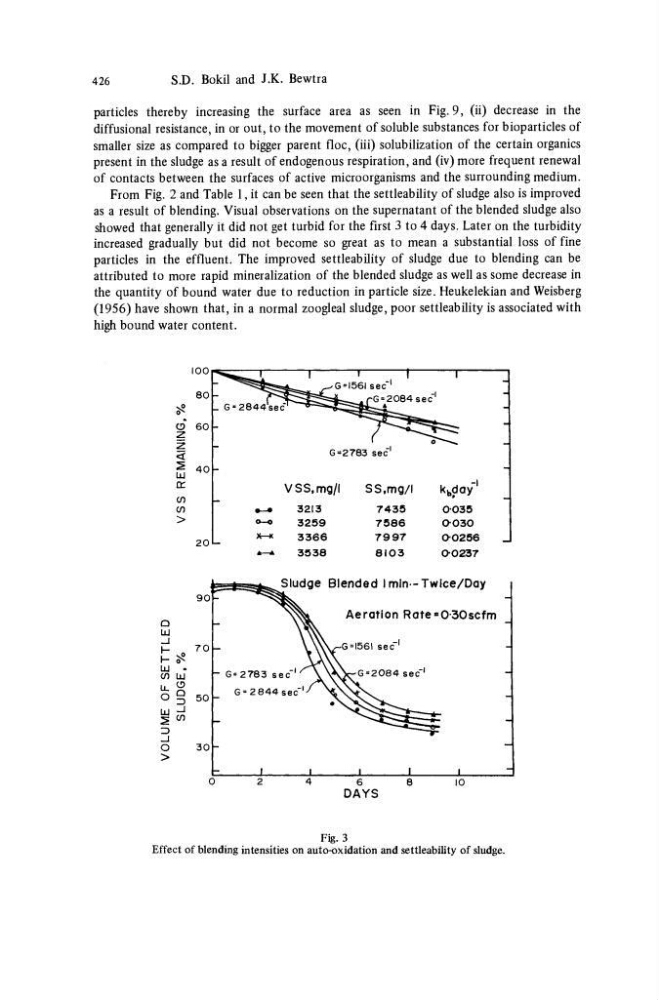
From Fig. 2 and Table 1, it can be seen that the settleability of sludge also is improved
as a result of blending. Visual observations on the supernatant of the blended sludge also
showed that generally it did not get turbid for the first 3 to 4 days. Later on the turbidity
increased gradually but did not become so great as to mean a substantial loss of fine
particles in the effluent. The improved settleability of sludge due to blending can be
attributed to more rapid mineralization of the blended sludge as well as some decrease in
the quantity of bound water due to reduction in particle size. Heukelekian and Weisberg
(1956) have shown that, in a normal zoogleal sludge, poor settleability is associated with
high bound water content.
*!
z.
<
2
LLI
DC
CO
CO
>
100
8 0
6 0
4 0
2 0
-
_ G =
-
^ Ζ Ϊ
1
r
^ ^ ^ ^ ^ ^ ^ 6 = 1561 sec"
1
f ^ f S f e i ^ i - - ^ rG = 2084
2 8 4 4 s e c ' ^ f r ^ ^ ^ ^ f e ^ j ^
G=2783 sec
1
VSS,mg/l
SS,mg/l
· - *
3213
7 4 3 5
° - °
3 2 5 9
7 5 8 6
x-x
3 3 6 6
7 9 9 7
* - *
3 5 3 8
8 1 0 3
sec"
o
— i
k b day
H
0 0 3 5
0 - 0 3 0
0 0 2 5 6
0 - 0 2 3 7
^ H
J
-
Q
UJ
CO
LL
o
UJ
Έ
-J
O
>
0
s
UJ
CD
Q
=)
- J
CO
9 0
7 0
5 0
3 0
^ ^ ^ ^ S l u d g e
" ^
^ ^ N ^ f c v
—
\\8v
T V
- G = 2 7 8 3 s e c "
, / J V
G = 2 8 4 4 s e c " ' / ^
-
Z
1
L _
Blended 1 min—Twice/Day
ι
H
Aeration Rate«0-30scfm J
V^~G = I56I sec"
1
A
\ ^ \ r
G s 2 0 8 4 sec"
1
- j
# V v V '
s s ^
1
A
i
i
i
d
6
DAYS
10
Fig. 3
Effect of blending intensities on auto-oxidation and settleability of sludge.
S.D. Bokil and J.K. Bewtra
particles thereby increasing the surface area as seen in Fig. 9, (ii) decrease in the
diffusional resistance, in or out, to the movement of soluble substances for bioparticles of
smaller size as compared to bigger parent floe, (iii) solubilization of the certain organics
present in the sludge as a result of endogenous respiration, and (iv) more frequent renewal
of contacts between the surfaces of active microorganisms and the surrounding medium.
From Fig. 2 and Table 1, it can be seen that the settleability of sludge also is improved
as a result of blending. Visual observations on the supernatant of the blended sludge also
showed that generally it did not get turbid for the first 3 to 4 days. Later on the turbidity
increased gradually but did not become so great as to mean a substantial loss of fine
particles in the effluent. The improved settleability of sludge due to blending can be
attributed to more rapid mineralization of the blended sludge as well as some decrease in
the quantity of bound water due to reduction in particle size. Heukelekian and Weisberg
(1956) have shown that, in a normal zoogleal sludge, poor settleability is associated with
high bound water content.
*!
z.
<
2
LLI
DC
CO
CO
>
100
8 0
6 0
4 0
2 0
-
_ G =
-
^ Ζ Ϊ
1
r
^ ^ ^ ^ ^ ^ ^ 6 = 1561 sec"
1
f ^ f S f e i ^ i - - ^ rG = 2084
2 8 4 4 s e c ' ^ f r ^ ^ ^ ^ f e ^ j ^
G=2783 sec
1
VSS,mg/l
SS,mg/l
· - *
3213
7 4 3 5
° - °
3 2 5 9
7 5 8 6
x-x
3 3 6 6
7 9 9 7
* - *
3 5 3 8
8 1 0 3
sec"
o
— i
k b day
H
0 0 3 5
0 - 0 3 0
0 0 2 5 6
0 - 0 2 3 7
^ H
J
-
Q
UJ
CO
LL
o
UJ
Έ
-J
O
>
0
s
UJ
CD
Q
=)
- J
CO
9 0
7 0
5 0
3 0
^ ^ ^ ^ S l u d g e
" ^
^ ^ N ^ f c v
—
\\8v
T V
- G = 2 7 8 3 s e c "
, / J V
G = 2 8 4 4 s e c " ' / ^
-
Z
1
L _
Blended 1 min—Twice/Day
ι
H
Aeration Rate«0-30scfm J
V^~G = I56I sec"
1
A
\ ^ \ r
G s 2 0 8 4 sec"
1
- j
# V v V '
s s ^
1
A
i
i
i
d
6
DAYS
10
Fig. 3
Effect of blending intensities on auto-oxidation and settleability of sludge.