

Influence of Mechanical Blending on A erobic Digestion
4 29
environment in the aerobic digestion jar changes from day to day with respect to
substrate, pH, and chemical components that are formed or degraded, and this results in a
succession of dominant species. Similar variation in oxygen consumption and different
predominance of bacteria in BOD bottle is reported by Young and Clark (1965). Plate
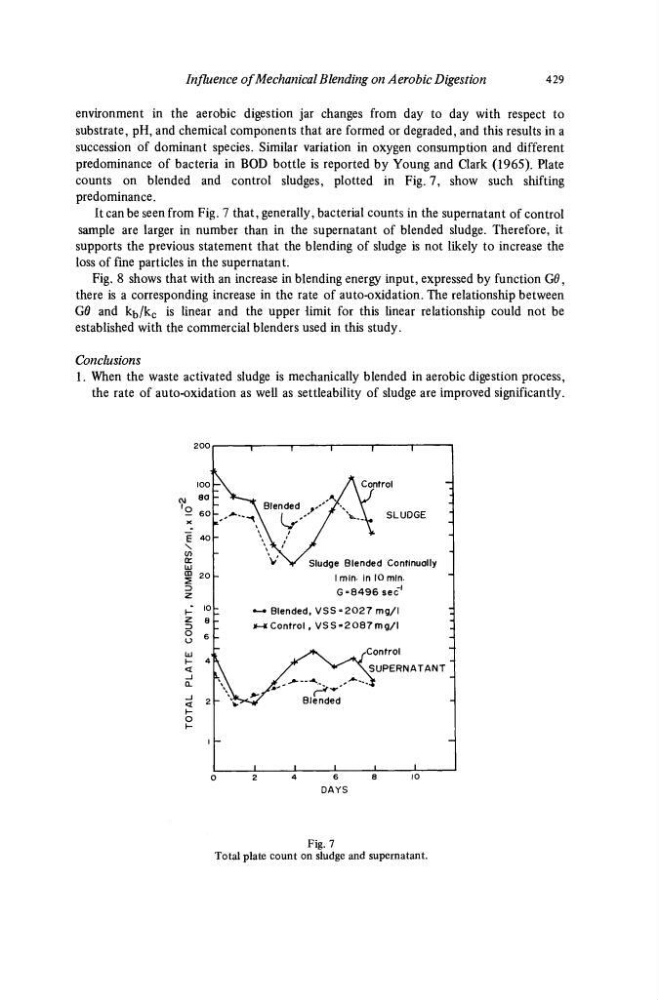
counts on blended and control sludges, plotted in Fig. 7, show such shifting
predominance.
It can be seen from Fig. 7 that, generally, bacterial counts in the supernatant of control
sample are larger in number than in the supernatant of blended sludge. Therefore, it
supports the previous statement that the blending of sludge is not likely to increase the
loss of fine particles in the supernatant.
Fig. 8 shows that with an increase in blending energy input, expressed by function G0,
there is a corresponding increase in the rate of auto-oxidation. The relationship between
G0 and kfc/k c is linear and the upper limit for this linear relationship could not be
established with the commercial blenders used in this study.
Conclusions
1. When the waste activated sludge is mechanically blended in aerobic digestion process,
the rate of auto-oxidation as well as settleability of sludge are improved significantly.
IOO
80
60
40
2 0
10
8
6
4'
2
1
-
~
:
-
-
- 1
1
1
1
1
A Control
H
*-**'
'**/ \JJ
J
Λ Blended % S J*\
\
Ί
- Λ
1 / '
/
V - \ .
SLUDGE
j
\ \ ' /
\
V ' v ^ Sludge Blended Continually
1 min- in 10 minΊ
G = 8496 sec'
—· Blended, VSS = 2027mg/l
d
*-* Control, VSS -2087m g/l
j
H
^K
Xontrol
|
yT
^"^vSUPERNATANT 1
x^f
Blended
H
\
1
1
1
1
6
DAYS
Fig. 7
Total plate count on sludge and supernatant.
4 29
environment in the aerobic digestion jar changes from day to day with respect to
substrate, pH, and chemical components that are formed or degraded, and this results in a
succession of dominant species. Similar variation in oxygen consumption and different
predominance of bacteria in BOD bottle is reported by Young and Clark (1965). Plate
counts on blended and control sludges, plotted in Fig. 7, show such shifting
predominance.
It can be seen from Fig. 7 that, generally, bacterial counts in the supernatant of control
sample are larger in number than in the supernatant of blended sludge. Therefore, it
supports the previous statement that the blending of sludge is not likely to increase the
loss of fine particles in the supernatant.
Fig. 8 shows that with an increase in blending energy input, expressed by function G0,
there is a corresponding increase in the rate of auto-oxidation. The relationship between
G0 and kfc/k c is linear and the upper limit for this linear relationship could not be
established with the commercial blenders used in this study.
Conclusions
1. When the waste activated sludge is mechanically blended in aerobic digestion process,
the rate of auto-oxidation as well as settleability of sludge are improved significantly.
IOO
80
60
40
2 0
10
8
6
4'
2
1
-
~
:
-
-
- 1
1
1
1
1
A Control
H
*-**'
'**/ \JJ
J
Λ Blended % S J*\
\
Ί
- Λ
1 / '
/
V - \ .
SLUDGE
j
\ \ ' /
\
V ' v ^ Sludge Blended Continually
1 min- in 10 minΊ
G = 8496 sec'
—· Blended, VSS = 2027mg/l
d
*-* Control, VSS -2087m g/l
j
H
^K
Xontrol
|
yT
^"^vSUPERNATANT 1
x^f
Blended
H
\
1
1
1
1
6
DAYS
Fig. 7
Total plate count on sludge and supernatant.