

Design Optimization for Activated Sludge and Extended Aeration Plants
383
0 1
i
i
i
i
i
i
I
i
I
0
4
8
12
16
2 0
2 4
28
3 2
36
SLUDGE AGE (days)
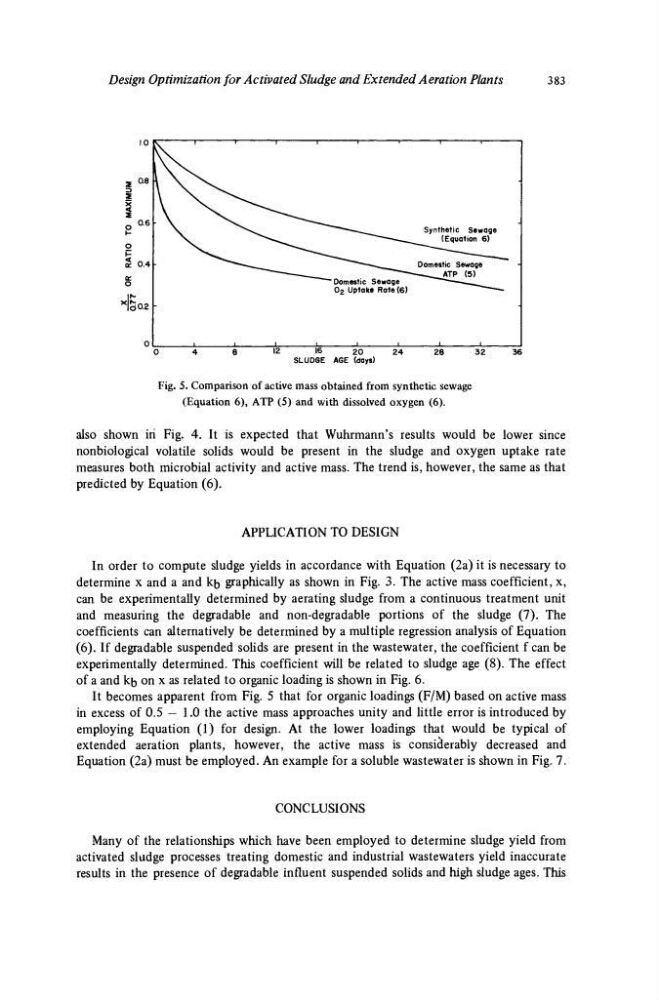
Fig. 5. Comparison of active mass obtained from synthetic sewage
(Equation 6), ATP (5) and with dissolved oxygen (6).
also shown in Fig. 4. It is expected that Wuhrmann's results would be lower since
nonbiological volatile solids would be present in the sludge and oxygen uptake rate
measures both microbial activity and active mass. The trend is, however, the same as that
predicted by Equation (6).
APPLICATION TO DESIGN
In order to compute sludge yields in accordance with Equation (2a) it is necessary to
determine x and a and kb graphically as shown in Fig. 3. The active mass coefficient, x,
can be experimentally determined by aerating sludge from a continuous treatment unit
and measuring the degradable and non-degradable portions of the sludge (7). The
coefficients can alternatively be determined by a multiple regression analysis of Equation
(6). If degradable suspended solids are present in the wastewater, the coefficient f can be
experimentally determined. This coefficient will be related to sludge age (8). The effect
of a and kb on x as related to organic loading is shown in Fig. 6.
It becomes apparent from Fig. 5 that for organic loadings (F/M) based on active mass
in excess of 0.5 - 1.0 the active mass approaches unity and little error is introduced by
employing Equation (1) for design. At the lower loadings that would be typical of
extended aeration plants, however, the active mass is considerably decreased and
Equation (2a) must be employed. An example for a soluble wastewater is shown in Fig. 7.
CONCLUSIONS
Many of the relationships which have been employed to determine sludge yield from
activated sludge processes treating domestic and industrial wastewaters yield inaccurate
results in the presence of degradable influent suspended solids and high sludge ages. This
383
0 1
i
i
i
i
i
i
I
i
I
0
4
8
12
16
2 0
2 4
28
3 2
36
SLUDGE AGE (days)
Fig. 5. Comparison of active mass obtained from synthetic sewage
(Equation 6), ATP (5) and with dissolved oxygen (6).
also shown in Fig. 4. It is expected that Wuhrmann's results would be lower since
nonbiological volatile solids would be present in the sludge and oxygen uptake rate
measures both microbial activity and active mass. The trend is, however, the same as that
predicted by Equation (6).
APPLICATION TO DESIGN
In order to compute sludge yields in accordance with Equation (2a) it is necessary to
determine x and a and kb graphically as shown in Fig. 3. The active mass coefficient, x,
can be experimentally determined by aerating sludge from a continuous treatment unit
and measuring the degradable and non-degradable portions of the sludge (7). The
coefficients can alternatively be determined by a multiple regression analysis of Equation
(6). If degradable suspended solids are present in the wastewater, the coefficient f can be
experimentally determined. This coefficient will be related to sludge age (8). The effect
of a and kb on x as related to organic loading is shown in Fig. 6.
It becomes apparent from Fig. 5 that for organic loadings (F/M) based on active mass
in excess of 0.5 - 1.0 the active mass approaches unity and little error is introduced by
employing Equation (1) for design. At the lower loadings that would be typical of
extended aeration plants, however, the active mass is considerably decreased and
Equation (2a) must be employed. An example for a soluble wastewater is shown in Fig. 7.
CONCLUSIONS
Many of the relationships which have been employed to determine sludge yield from
activated sludge processes treating domestic and industrial wastewaters yield inaccurate
results in the presence of degradable influent suspended solids and high sludge ages. This