

Biological Storage in the Mathematical Analysis of Activated Sludge Behaviour
369
i j L o s . r L s - d ^ L s j - M ^ .
( 5 )
^ T ^ L ^ + r L s - d + O L s l - M i ^ - ^ - M a
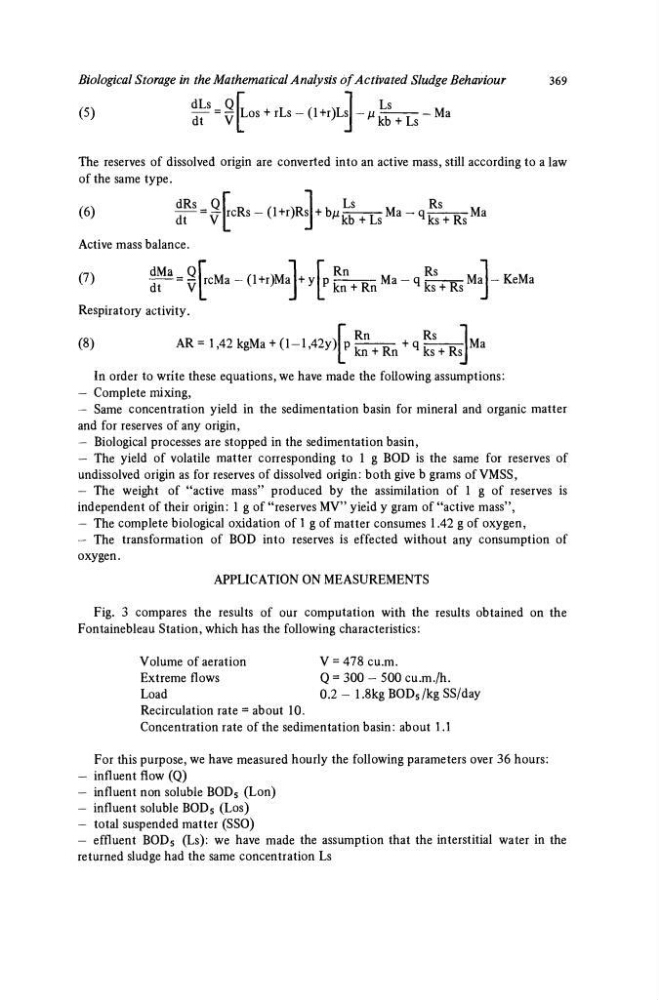
The reserves of dissolved origin are converted into an active mass, still according to a law
of the same type.
dRs QP
dT
=
v[
c
(6)
^ ^ | r e R , _ ( i + r ) R a + b M g T U M . - . q ^ J M .
Active mass balance.
\\
I I Rn
Pc
Ma -KeMa
I
x
' j - r κη + κη
* KS + KS
Respiratory activity.
(7)
^ = 2 ^ a _ ( 1 + r ) M a ] + y [ p k ^ - n M a - q ^ M a ] -
(8)
AR=l,42kgMa + ( l - l , 4 2 y ) | p £ ^ n + q ! ^ l M a
In order to write these equations, we have made the following assumptions:
- Complete mixing,
- Same concentration yield in the sedimentation basin for mineral and organic matter
and for reserves of any origin,
- Biological processes are stopped in the sedimentation basin,
- The yield of volatile matter corresponding to 1 g BOD is the same for reserves of
undissolved origin as for reserves of dissolved origin: both give b grams of VMSS,
- The weight of "active mass" produced by the assimilation of 1 g of reserves is
independent of their origin: 1 g of "reserves MV" yield y gram of "active mass",
- The complete biological oxidation of 1 g of matter consumes 1.42 g of oxygen,
- The transformation of BOD into reserves is effected without any consumption of
oxygen.
APPLICATION ON MEASUREMENTS
Fig. 3 compares the results of our computation with the results obtained on the
Fontainebleau Station, which has the following characteristics:
Volume of aeration
V = 478 cu.m.
Extreme flows
Q = 300 - 500 cu.m./h.
Load
0.2 - 1.8kg BOD 5 /kg SS/day
Recirculation rate = about 10.
Concentration rate of the sedimentation basin: about 1.1
For this purpose, we have measured hourly the following parameters over 36 hours:
- influent flow (Q)
- influent non soluble BOD 5 (Lon)
- influent soluble BOD 5 (Los)
- total suspended matter (SSO)
- effluent BOD 5 (Ls): we have made the assumption that the interstitial water in the
returned sludge had the same concentration Ls
369
i j L o s . r L s - d ^ L s j - M ^ .
( 5 )
^ T ^ L ^ + r L s - d + O L s l - M i ^ - ^ - M a
The reserves of dissolved origin are converted into an active mass, still according to a law
of the same type.
dRs QP
dT
=
v[
c
(6)
^ ^ | r e R , _ ( i + r ) R a + b M g T U M . - . q ^ J M .
Active mass balance.
\\
I I Rn
Pc
Ma -KeMa
I
x
' j - r κη + κη
* KS + KS
Respiratory activity.
(7)
^ = 2 ^ a _ ( 1 + r ) M a ] + y [ p k ^ - n M a - q ^ M a ] -
(8)
AR=l,42kgMa + ( l - l , 4 2 y ) | p £ ^ n + q ! ^ l M a
In order to write these equations, we have made the following assumptions:
- Complete mixing,
- Same concentration yield in the sedimentation basin for mineral and organic matter
and for reserves of any origin,
- Biological processes are stopped in the sedimentation basin,
- The yield of volatile matter corresponding to 1 g BOD is the same for reserves of
undissolved origin as for reserves of dissolved origin: both give b grams of VMSS,
- The weight of "active mass" produced by the assimilation of 1 g of reserves is
independent of their origin: 1 g of "reserves MV" yield y gram of "active mass",
- The complete biological oxidation of 1 g of matter consumes 1.42 g of oxygen,
- The transformation of BOD into reserves is effected without any consumption of
oxygen.
APPLICATION ON MEASUREMENTS
Fig. 3 compares the results of our computation with the results obtained on the
Fontainebleau Station, which has the following characteristics:
Volume of aeration
V = 478 cu.m.
Extreme flows
Q = 300 - 500 cu.m./h.
Load
0.2 - 1.8kg BOD 5 /kg SS/day
Recirculation rate = about 10.
Concentration rate of the sedimentation basin: about 1.1
For this purpose, we have measured hourly the following parameters over 36 hours:
- influent flow (Q)
- influent non soluble BOD 5 (Lon)
- influent soluble BOD 5 (Los)
- total suspended matter (SSO)
- effluent BOD 5 (Ls): we have made the assumption that the interstitial water in the
returned sludge had the same concentration Ls