

370
J.C. Jacquart, D. Lefort and J.M. Rovel
— total suspended matter in mixed liquor (SS)
- respiratory activity of the mixed liquor (AR)
and found that on average:
the ratio of volatile matter or total dry matter was 82% and 80% in the influent and
mixed liquor respectively.
b = 1.1 (ratio of insoluble BOD to suspended matter in influent)
and we retained a value for y = 0.35 g/g
4
f 4o
1 30
\
MEASURED
/
/ \
> . LOAD
S
RESPIRATORY
♦
*«.
A C T I V I T Y
f
20
/ S
»y
··/
\ "*
^ ^
.
/ y/
+
^ ♦ ^
.
/
y/
+
^——r+
ΓΆΤΓΊΤ
/
Λ ,
CALCULATED
R
AC
TIME
7
12
18
2k
6
12
18
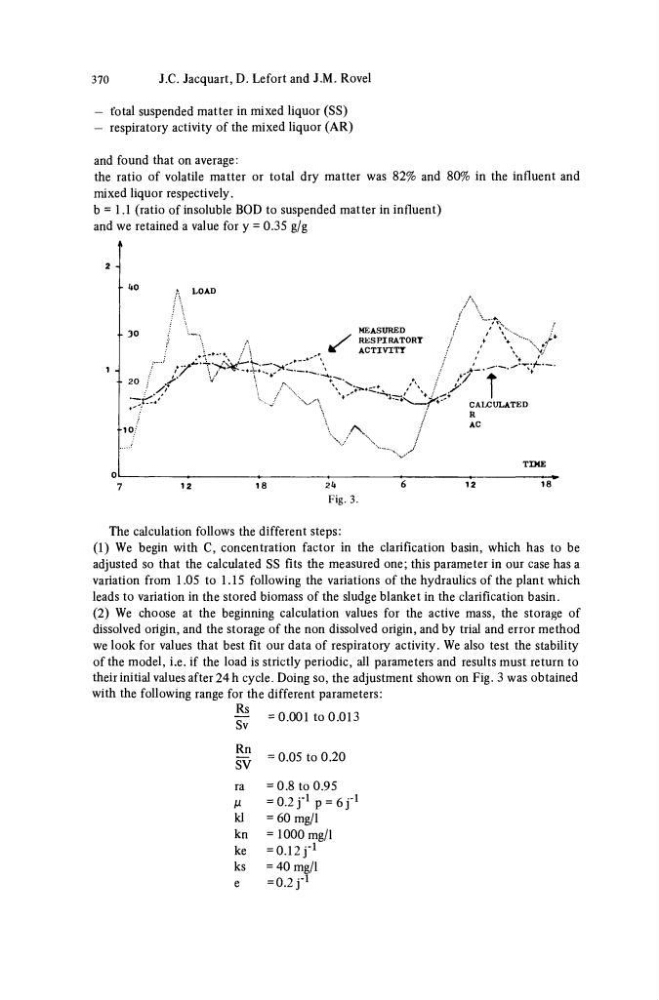
Fig. 3.
The calculation follows the different steps:
(1) We begin with C, concentration factor in the clarification basin, which has to be
adjusted so that the calculated SS fits the measured one; this parameter in our case has a
variation from 1.05 to 1.15 following the variations of the hydraulics of the plant which
leads to variation in the stored biomass of the sludge blanket in the clarification basin.
(2) We choose at the beginning calculation values for the active mass, the storage of
dissolved origin, and the storage of the non dissolved origin, and by trial and error method
we look for values that best fit our data of respiratory activity. We also test the stability
of the model, i.e. if the load is strictly periodic, all parameters and results must return to
their initial values after 24 h cycle. Doing so, the adjustment shown on Fig. 3 was obtained
with the following range for the different parameters:
Rs
Sv
0.001 to 0.013
Rn
SV
ra
M
kl
kn
ke
ks
e
= 0.05 to 0.20
= 0.8 to 0.95
= 0.2j1 p = 6j"
1
= 60 mg/1
= 1000mg/l
= 0.12 j "
1
= 40 mg/1
= 0.2j"
1
J.C. Jacquart, D. Lefort and J.M. Rovel
— total suspended matter in mixed liquor (SS)
- respiratory activity of the mixed liquor (AR)
and found that on average:
the ratio of volatile matter or total dry matter was 82% and 80% in the influent and
mixed liquor respectively.
b = 1.1 (ratio of insoluble BOD to suspended matter in influent)
and we retained a value for y = 0.35 g/g
4
f 4o
1 30
\
MEASURED
/
/ \
> . LOAD
S
RESPIRATORY
♦
*«.
A C T I V I T Y
f
20
/ S
»y
··/
\ "*
^ ^
.
/ y/
+
^ ♦ ^
.
/
y/
+
^——r+
ΓΆΤΓΊΤ
/
Λ ,
CALCULATED
R
AC
TIME
7
12
18
2k
6
12
18
Fig. 3.
The calculation follows the different steps:
(1) We begin with C, concentration factor in the clarification basin, which has to be
adjusted so that the calculated SS fits the measured one; this parameter in our case has a
variation from 1.05 to 1.15 following the variations of the hydraulics of the plant which
leads to variation in the stored biomass of the sludge blanket in the clarification basin.
(2) We choose at the beginning calculation values for the active mass, the storage of
dissolved origin, and the storage of the non dissolved origin, and by trial and error method
we look for values that best fit our data of respiratory activity. We also test the stability
of the model, i.e. if the load is strictly periodic, all parameters and results must return to
their initial values after 24 h cycle. Doing so, the adjustment shown on Fig. 3 was obtained
with the following range for the different parameters:
Rs
Sv
0.001 to 0.013
Rn
SV
ra
M
kl
kn
ke
ks
e
= 0.05 to 0.20
= 0.8 to 0.95
= 0.2j1 p = 6j"
1
= 60 mg/1
= 1000mg/l
= 0.12 j "
1
= 40 mg/1
= 0.2j"
1