

368
J.C. Jacquart, D. Lefort and J.M. Rovel
least in the case of non-permanent regimes, neglect at least one basic phenomenon and
that it could be the above mentioned ability of bacterial cells to store some of the
available food when the load increased, and to degrade it only when this happens to
decrease. This phenomenon is reinforced by the possibility for the "bio floe" to hold
colloidal suspended matter, which should be as a first step solubilised by extracellular
enzymes and then become available as food.
PROPOSED MODEL
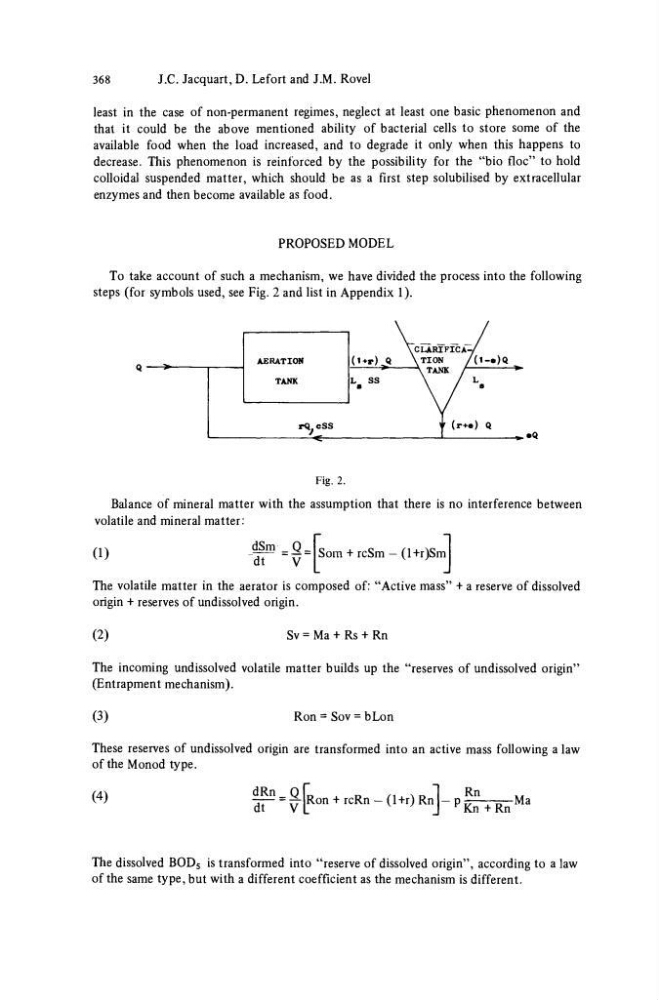
To take account of such a mechanism, we have divided the process into the following
steps (for symbols used, see Fig. 2 and list in Appendix 1).
AERATION
TANK
rQ cSS
(n-iO^Q
L SS
•
VcLARIFICA-/
\TION
/ ( 1 - # ) Q
\ TANK /
"*■
\
/
L
\
/
β
Ψ (r+β) Q
'
»
■
Fig. 2.
Balance of mineral matter with the assumption that there is no interference between
volatile and mineral matter:
(1)
dSm _ 0 = Γ
dt " v I;
Som + rcSm-(l+r)Sm
The volatile matter in the aerator is composed of: "Active mass" + a reserve of dissolved
origin + reserves of undissolved origin.
(2)
Sv = Ma + Rs + Rn
The incoming undissolved volatile matter builds up the "reserves of undissolved origin"
(Entrapment mechanism).
(3)
Ron = Sov = bLon
These reserves of undissolved origin are transformed into an active mass following a law
of the Monod type.
(4)
dRn _ Q Γ
dT
=
vL
F Ron + rcRn-(l+r)Rn
"I
Rn
l
Jp
iöTT Rn
Ma
The dissolved BOD 5 is transformed into "reserve of dissolved origin", according to a law
of the same type, but with a different coefficient as the mechanism is different.
J.C. Jacquart, D. Lefort and J.M. Rovel
least in the case of non-permanent regimes, neglect at least one basic phenomenon and
that it could be the above mentioned ability of bacterial cells to store some of the
available food when the load increased, and to degrade it only when this happens to
decrease. This phenomenon is reinforced by the possibility for the "bio floe" to hold
colloidal suspended matter, which should be as a first step solubilised by extracellular
enzymes and then become available as food.
PROPOSED MODEL
To take account of such a mechanism, we have divided the process into the following
steps (for symbols used, see Fig. 2 and list in Appendix 1).
AERATION
TANK
rQ cSS
(n-iO^Q
L SS
•
VcLARIFICA-/
\TION
/ ( 1 - # ) Q
\ TANK /
"*■
\
/
L
\
/
β
Ψ (r+β) Q
'
»
■
Fig. 2.
Balance of mineral matter with the assumption that there is no interference between
volatile and mineral matter:
(1)
dSm _ 0 = Γ
dt " v I;
Som + rcSm-(l+r)Sm
The volatile matter in the aerator is composed of: "Active mass" + a reserve of dissolved
origin + reserves of undissolved origin.
(2)
Sv = Ma + Rs + Rn
The incoming undissolved volatile matter builds up the "reserves of undissolved origin"
(Entrapment mechanism).
(3)
Ron = Sov = bLon
These reserves of undissolved origin are transformed into an active mass following a law
of the Monod type.
(4)
dRn _ Q Γ
dT
=
vL
F Ron + rcRn-(l+r)Rn
"I
Rn
l
Jp
iöTT Rn
Ma
The dissolved BOD 5 is transformed into "reserve of dissolved origin", according to a law
of the same type, but with a different coefficient as the mechanism is different.