

AN ATTEMPT TO TAKE ACCOUNT OF
BIOLOGICAL STORAGE IN THE
MATHEMATICAL ANALYSIS OF
ACTIVATED SLUDGE BEHAVIOUR
J.C. JACQUART, D. LEFORT and J.M. ROVEL*
* 1 Promenade Mona Lisa, 78 Versailles, Grand Siecle, France
The ability for bacterial cells to store nutrients when the ratio of food to
microorganism is high and to use these stored materials when food is less abundant is a
well known mechanism (1). Nevertheless the mathematical models proposed in the
current literature (2 to 5) completely neglect this possibility even when they try to
describe the non-permanent state observed in any activated sludge treatment plant.
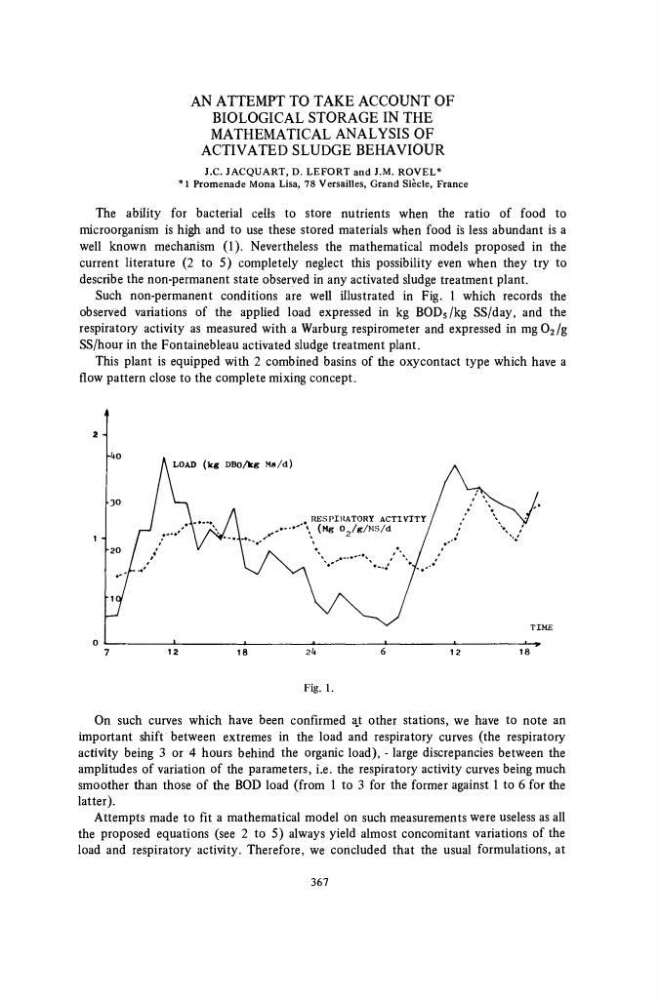
Such non-permanent conditions are well illustrated in Fig. 1 which records the
observed variations of the applied load expressed in kg BOD 5 /kg SS/day, and the
respiratory activity as measured with a Warburg respirometer and expressed in mg0 2 /g
SS/hour in the Fontainebleau activated sludge treatment plant.
This plant is equipped with 2 combined basins of the oxycontact type which have a
flow pattern close to the complete mixing concept.
Fig. 1.
On such curves which have been confirmed at other stations, we have to note an
important shift between extremes in the load and respiratory curves (the respiratory
activity being 3 or 4 hours behind the organic load), - large discrepancies between the
amplitudes of variation of the parameters, i.e. the respiratory activity curves being much
smoother than those of the BOD load (from 1 to 3 for the former against 1 to 6 for the
latter).
Attempts made to fit a mathematical model on such measurements were useless as all
the proposed equations (see 2 to 5) always yield almost concomitant variations of the
load and respiratory activity. Therefore, we concluded that the usual formulations, at
367
BIOLOGICAL STORAGE IN THE
MATHEMATICAL ANALYSIS OF
ACTIVATED SLUDGE BEHAVIOUR
J.C. JACQUART, D. LEFORT and J.M. ROVEL*
* 1 Promenade Mona Lisa, 78 Versailles, Grand Siecle, France
The ability for bacterial cells to store nutrients when the ratio of food to
microorganism is high and to use these stored materials when food is less abundant is a
well known mechanism (1). Nevertheless the mathematical models proposed in the
current literature (2 to 5) completely neglect this possibility even when they try to
describe the non-permanent state observed in any activated sludge treatment plant.
Such non-permanent conditions are well illustrated in Fig. 1 which records the
observed variations of the applied load expressed in kg BOD 5 /kg SS/day, and the
respiratory activity as measured with a Warburg respirometer and expressed in mg0 2 /g
SS/hour in the Fontainebleau activated sludge treatment plant.
This plant is equipped with 2 combined basins of the oxycontact type which have a
flow pattern close to the complete mixing concept.
Fig. 1.
On such curves which have been confirmed at other stations, we have to note an
important shift between extremes in the load and respiratory curves (the respiratory
activity being 3 or 4 hours behind the organic load), - large discrepancies between the
amplitudes of variation of the parameters, i.e. the respiratory activity curves being much
smoother than those of the BOD load (from 1 to 3 for the former against 1 to 6 for the
latter).
Attempts made to fit a mathematical model on such measurements were useless as all
the proposed equations (see 2 to 5) always yield almost concomitant variations of the
load and respiratory activity. Therefore, we concluded that the usual formulations, at
367