

360
D. Jenkins and D. Orhon
■5 i-2
• DH activity
□ Viability
O
4
8
12
16
20
24
Contact removal rate, qc, day
-1
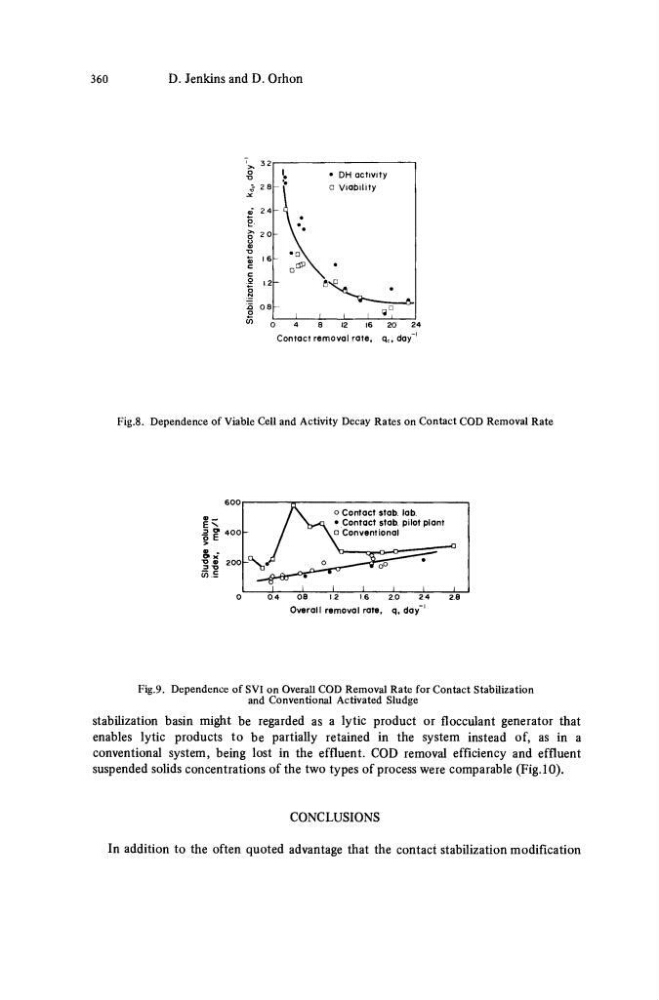
Fig.8. Dependence of Viable Cell and Activity Decay Rates on Contact COD Removal Rate
o Contact stab. lab.
• Contact stab, pilot plant
□ Conventional
0 8
1.2
1.6
2 0
2 4
Overall removal rate, q, day
-1
Fig.9. Dependence of SVI on Overall COD Removal Rate for Contact Stabilization
and Conventional Activated Sludge
stabilization basin might be regarded as a lytic product or flocculant generator that
enables lytic products to be partially retained in the system instead of, as in a
conventional system, being lost in the effluent. COD removal efficiency and effluent
suspended solids concentrations of the two types of process were comparable (Fig. 10).
CONCLUSIONS
In addition to the often quoted advantage that the contact stabilization modification
D. Jenkins and D. Orhon
■5 i-2
• DH activity
□ Viability
O
4
8
12
16
20
24
Contact removal rate, qc, day
-1
Fig.8. Dependence of Viable Cell and Activity Decay Rates on Contact COD Removal Rate
o Contact stab. lab.
• Contact stab, pilot plant
□ Conventional
0 8
1.2
1.6
2 0
2 4
Overall removal rate, q, day
-1
Fig.9. Dependence of SVI on Overall COD Removal Rate for Contact Stabilization
and Conventional Activated Sludge
stabilization basin might be regarded as a lytic product or flocculant generator that
enables lytic products to be partially retained in the system instead of, as in a
conventional system, being lost in the effluent. COD removal efficiency and effluent
suspended solids concentrations of the two types of process were comparable (Fig. 10).
CONCLUSIONS
In addition to the often quoted advantage that the contact stabilization modification