

Contact Stabilization Activated Sludge Process
361
100
p 8 0
Φ >
| |
60
1 · 40
5 5 ? 20
o
60
50
J
E
30
uj w 20
10
0
-P
_a
Q
°
o
o
o Contact stab, lab
• Contact stab, pilot plant
a Conventional
°
a
D
°° °.
• o ·
·
•
1
1
1
a
o
·
•
1
1
1
0 4
0.8
1.2
1.6
2 0
2.4
Overall removal rate, q,day~'
a
D
1
2.8
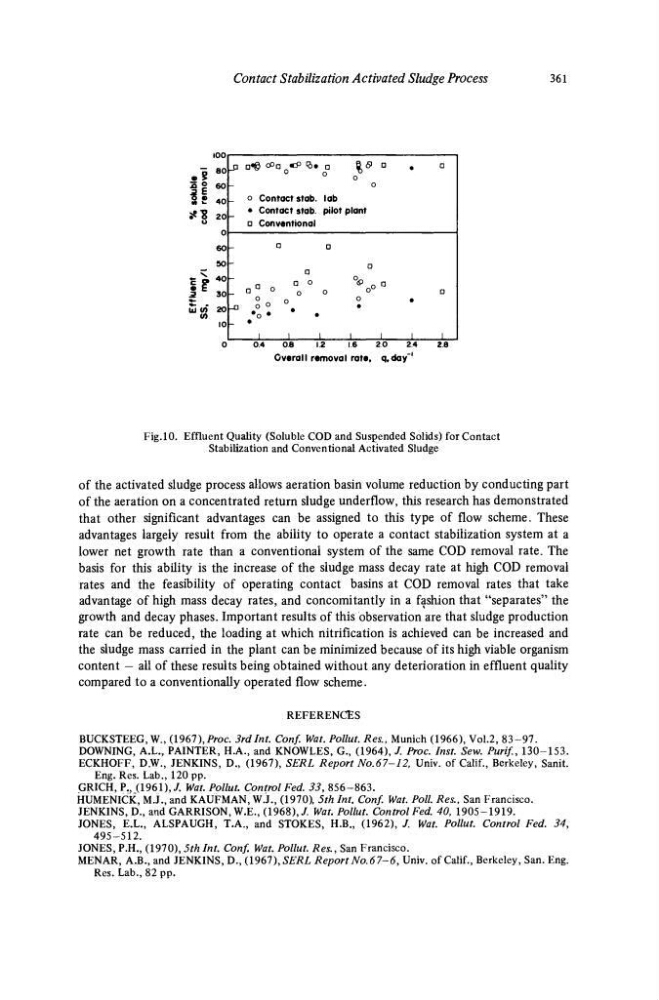
Fig. 10. Effluent Quality (Soluble COD and Suspended Solids) for Contact
Stabilization and Conventional Activated Sludge
of the activated sludge process allows aeration basin volume reduction by conducting part
of the aeration on a concentrated return sludge underflow, this research has demonstrated
that other significant advantages can be assigned to this type of flow scheme. These
advantages largely result from the ability to operate a contact stabilization system at a
lower net growth rate than a conventional system of the same COD removal rate. The
basis for this ability is the increase of the sludge mass decay rate at high COD removal
rates and the feasibility of operating contact basins at COD removal rates that take
advantage of high mass decay rates, and concomitantly in a fashion that "separates" the
growth and decay phases. Important results of this observation are that sludge production
rate can be reduced, the loading at which nitrification is achieved can be increased and
the sludge mass carried in the plant can be minimized because of its high viable organism
content - all of these results being obtained without any deterioration in effluent quality
compared to a conventionally operated flow scheme.
REFERENCES
BUCKSTEEG, W., (1967), Proc. 3rd Int. Conf. Wat. Pollut. Res., Munich (1966), Vol.2, 8 3 - 9 7 .
DOWNING, A.L., PAINTER, H.A., and KNOWLES, G., (1964), / Proc. Inst. Sew. Purif, 130-153.
ECKHOFF, D.W., JENKINS, D., (1967), SERL Report No.67-12, Univ. of Calif., Berkeley, Sanit.
Eng. Res. Lab., 120 pp.
GRICH, P., (1961),/. Wat. Pollut Control Fed. 33, 856-863.
HUMENICK, M.J., and KAUFMAN, W.J., (1970), 5th Int. Conf. Wat. Poll. Res., San Francisco.
JENKINS, D., and GARRISON, W.E., (1968),/. Wat. Pollut. Control Fed. 40, 1905-1919.
JONES, EX., ALSPAUGH, T.A., and STOKES, H.B., (1962), / Wat. Pollut. Control Fed. 34,
495-512.
JONES, P.H., (1970), 5th Int. Conf. Wat. Pollut. Res., San Francisco.
MENAR, A.B., and JENKINS, D., (1967),SERL Report No. 6 7-6, Univ. of Calif., Berkeley, San. Eng.
Res. Lab., 82 pp.
361
100
p 8 0
Φ >
| |
60
1 · 40
5 5 ? 20
o
60
50
J
E
30
uj w 20
10
0
-P
_a
Q
°
o
o
o Contact stab, lab
• Contact stab, pilot plant
a Conventional
°
a
D
°° °.
• o ·
·
•
1
1
1
a
o
·
•
1
1
1
0 4
0.8
1.2
1.6
2 0
2.4
Overall removal rate, q,day~'
a
D
1
2.8
Fig. 10. Effluent Quality (Soluble COD and Suspended Solids) for Contact
Stabilization and Conventional Activated Sludge
of the activated sludge process allows aeration basin volume reduction by conducting part
of the aeration on a concentrated return sludge underflow, this research has demonstrated
that other significant advantages can be assigned to this type of flow scheme. These
advantages largely result from the ability to operate a contact stabilization system at a
lower net growth rate than a conventional system of the same COD removal rate. The
basis for this ability is the increase of the sludge mass decay rate at high COD removal
rates and the feasibility of operating contact basins at COD removal rates that take
advantage of high mass decay rates, and concomitantly in a fashion that "separates" the
growth and decay phases. Important results of this observation are that sludge production
rate can be reduced, the loading at which nitrification is achieved can be increased and
the sludge mass carried in the plant can be minimized because of its high viable organism
content - all of these results being obtained without any deterioration in effluent quality
compared to a conventionally operated flow scheme.
REFERENCES
BUCKSTEEG, W., (1967), Proc. 3rd Int. Conf. Wat. Pollut. Res., Munich (1966), Vol.2, 8 3 - 9 7 .
DOWNING, A.L., PAINTER, H.A., and KNOWLES, G., (1964), / Proc. Inst. Sew. Purif, 130-153.
ECKHOFF, D.W., JENKINS, D., (1967), SERL Report No.67-12, Univ. of Calif., Berkeley, Sanit.
Eng. Res. Lab., 120 pp.
GRICH, P., (1961),/. Wat. Pollut Control Fed. 33, 856-863.
HUMENICK, M.J., and KAUFMAN, W.J., (1970), 5th Int. Conf. Wat. Poll. Res., San Francisco.
JENKINS, D., and GARRISON, W.E., (1968),/. Wat. Pollut. Control Fed. 40, 1905-1919.
JONES, EX., ALSPAUGH, T.A., and STOKES, H.B., (1962), / Wat. Pollut. Control Fed. 34,
495-512.
JONES, P.H., (1970), 5th Int. Conf. Wat. Pollut. Res., San Francisco.
MENAR, A.B., and JENKINS, D., (1967),SERL Report No. 6 7-6, Univ. of Calif., Berkeley, San. Eng.
Res. Lab., 82 pp.