

296
R.D. Pomeroy and J.D. Parkhurst
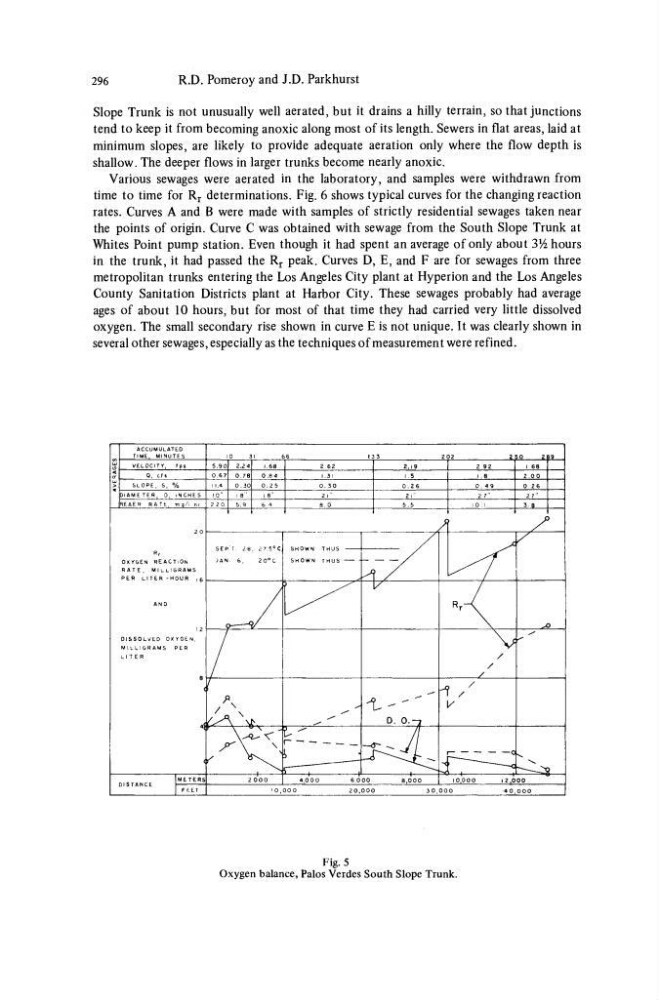
Slope Trunk is not unusually well aerated, but it drains a hilly terrain, so that junctions
tend to keep it from becoming anoxic along most of its length. Sewers in flat areas, laid at
minimum slopes, are likely to provide adequate aeration only where the flow depth is
shallow. The deeper flows in larger trunks become nearly anoxic.
Various sewages were aerated in the laboratory, and samples were withdrawn from
time to time for R r determinations. Fig. 6 shows typical curves for the changing reaction
rates. Curves A and B were made with samples of strictly residential sewages taken near
the points of origin. Curve C was obtained with sewage from the South Slope Trunk at
Whites Point pump station. Even though it had spent an average of only about 3Vi hours
in the trunk, it had passed the R r peak. Curves D, E, and F are for sewages from three
metropolitan trunks entering the Los Angeles City plant at Hyperion and the Los Angeles
County Sanitation Districts plant at Harbor City. These sewages probably had average
ages of about 10 hours, but for most of that time they had carried very little dissolved
oxygen. The small secondary rise shown in curve E is not unique. It was clearly shown in
several other sewages, especially as the techniques of measurement were refined.
Fig. 5
Oxygen balance, Palos Verdes South Slope Trunk.
R.D. Pomeroy and J.D. Parkhurst
Slope Trunk is not unusually well aerated, but it drains a hilly terrain, so that junctions
tend to keep it from becoming anoxic along most of its length. Sewers in flat areas, laid at
minimum slopes, are likely to provide adequate aeration only where the flow depth is
shallow. The deeper flows in larger trunks become nearly anoxic.
Various sewages were aerated in the laboratory, and samples were withdrawn from
time to time for R r determinations. Fig. 6 shows typical curves for the changing reaction
rates. Curves A and B were made with samples of strictly residential sewages taken near
the points of origin. Curve C was obtained with sewage from the South Slope Trunk at
Whites Point pump station. Even though it had spent an average of only about 3Vi hours
in the trunk, it had passed the R r peak. Curves D, E, and F are for sewages from three
metropolitan trunks entering the Los Angeles City plant at Hyperion and the Los Angeles
County Sanitation Districts plant at Harbor City. These sewages probably had average
ages of about 10 hours, but for most of that time they had carried very little dissolved
oxygen. The small secondary rise shown in curve E is not unique. It was clearly shown in
several other sewages, especially as the techniques of measurement were refined.
Fig. 5
Oxygen balance, Palos Verdes South Slope Trunk.