

Self Purification in Sewers
295
8L
8S
IOC
101
IOE
IOA
I2H
151
I5D
I5F
ΙΘΒ
I8D
2IGR
24C
27E '
2 7 J
30P i
36C
"36H
36K"
48Θ
4 8 0
4 8 H
60C
60B
6 0 0
60F
6 0 J F
I20JA
I20LA
•
•
/
•
.·;-:
.·
t V
• •
• .*
1
«
• · *
•A
1
•
•
•
>
•
.·
► ·.
•
•
.7
,· ·
V •
·*·* 1
•
•
•V.
.· ·
>.·
•
•
;*.
•
•
,·.·
•
• •
«
«
>.
•
··:
•
•
•
»
•
»
•
r ·
•
•
;
• t i •
0
4
8
12
16
OXYGEN REACTION RATE AT 20° C, MG PER L-HR
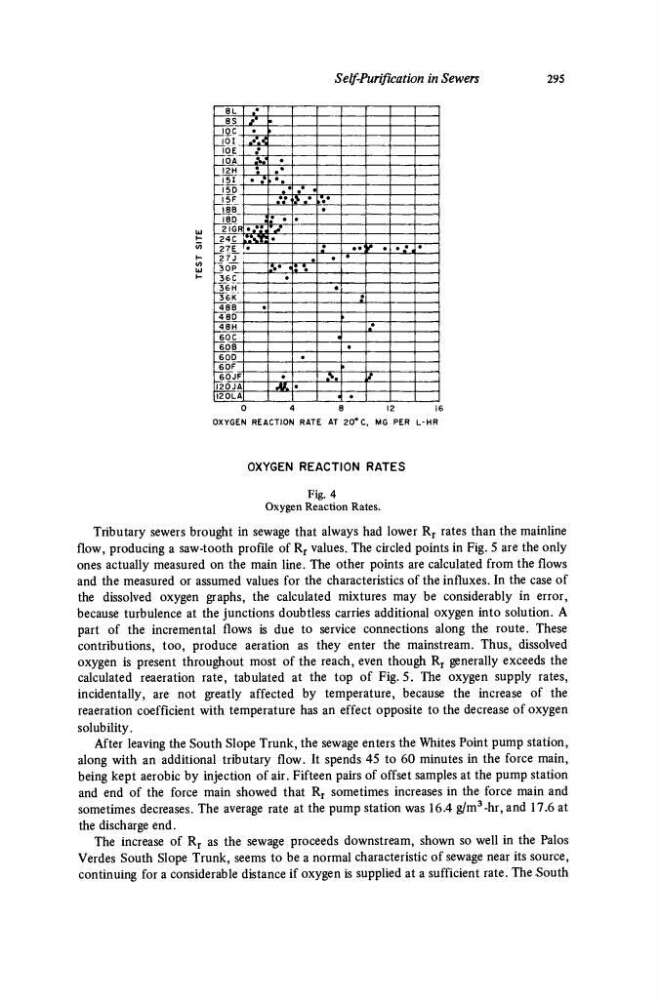
OXYGEN REACTION RATES
Fig. 4
Oxygen Reaction Rates.
Tributary sewers brought in sewage that always had lower R r rates than the mainline
flow, producing a saw-tooth profile of R r values. The circled points in Fig. 5 are the only
ones actually measured on the main line. The other points are calculated from the flows
and the measured or assumed values for the characteristics of the influxes. In the case of
the dissolved oxygen graphs, the calculated mixtures may be considerably in error,
because turbulence at the junctions doubtless carries additional oxygen into solution. A
part of the incremental flows is due to service connections along the route. These
contributions, too, produce aeration as they enter the mainstream. Thus, dissolved
oxygen is present throughout most of the reach, even though R r generally exceeds the
calculated reaeration rate, tabulated at the top of Fig. 5. The oxygen supply rates,
incidentally, are not greatly affected by temperature, because the increase of the
reaeration coefficient with temperature has an effect opposite to the decrease of oxygen
solubility.
After leaving the South Slope Trunk, the sewage enters the Whites Point pump station,
along with an additional tributary flow. It spends 45 to 60 minutes in the force main,
being kept aerobic by injection of air. Fifteen pairs of offset samples at the pump station
and end of the force main showed that R r sometimes increases in the force main and
sometimes decreases. The average rate at the pump station was 16.4 g/m
3 -hr, and 17.6 at
the discharge end.
The increase of R r as the sewage proceeds downstream, shown so well in the Palos
Verdes South Slope Trunk, seems to be a normal characteristic of sewage near its source,
continuing for a considerable distance if oxygen is supplied at a sufficient rate. The South
295
8L
8S
IOC
101
IOE
IOA
I2H
151
I5D
I5F
ΙΘΒ
I8D
2IGR
24C
27E '
2 7 J
30P i
36C
"36H
36K"
48Θ
4 8 0
4 8 H
60C
60B
6 0 0
60F
6 0 J F
I20JA
I20LA
•
•
/
•
.·;-:
.·
t V
• •
• .*
1
«
• · *
•A
1
•
•
•
>
•
.·
► ·.
•
•
.7
,· ·
V •
·*·* 1
•
•
•V.
.· ·
>.·
•
•
;*.
•
•
,·.·
•
• •
«
«
>.
•
··:
•
•
•
»
•
»
•
r ·
•
•
;
• t i •
0
4
8
12
16
OXYGEN REACTION RATE AT 20° C, MG PER L-HR
OXYGEN REACTION RATES
Fig. 4
Oxygen Reaction Rates.
Tributary sewers brought in sewage that always had lower R r rates than the mainline
flow, producing a saw-tooth profile of R r values. The circled points in Fig. 5 are the only
ones actually measured on the main line. The other points are calculated from the flows
and the measured or assumed values for the characteristics of the influxes. In the case of
the dissolved oxygen graphs, the calculated mixtures may be considerably in error,
because turbulence at the junctions doubtless carries additional oxygen into solution. A
part of the incremental flows is due to service connections along the route. These
contributions, too, produce aeration as they enter the mainstream. Thus, dissolved
oxygen is present throughout most of the reach, even though R r generally exceeds the
calculated reaeration rate, tabulated at the top of Fig. 5. The oxygen supply rates,
incidentally, are not greatly affected by temperature, because the increase of the
reaeration coefficient with temperature has an effect opposite to the decrease of oxygen
solubility.
After leaving the South Slope Trunk, the sewage enters the Whites Point pump station,
along with an additional tributary flow. It spends 45 to 60 minutes in the force main,
being kept aerobic by injection of air. Fifteen pairs of offset samples at the pump station
and end of the force main showed that R r sometimes increases in the force main and
sometimes decreases. The average rate at the pump station was 16.4 g/m
3 -hr, and 17.6 at
the discharge end.
The increase of R r as the sewage proceeds downstream, shown so well in the Palos
Verdes South Slope Trunk, seems to be a normal characteristic of sewage near its source,
continuing for a considerable distance if oxygen is supplied at a sufficient rate. The South