

292
R.D. Pomeroy and J.D. Parkhurst
Reaction Rate of Oxygen in Sewage-Laboratory Tests
In field work, a sample is taken from a sewer in a "D.O. pot" of the design shown by
Parkhurst and Pomeroy [1]. After brief aeration, the diaphragm, carrying the mixer,
thermometer and oxygen probe, is put in place, and oxygen concentrations are read over
a suitable interval of time, yielding data for calculating R r . In some of the laboratory
determinations, use was made of a liter beaker and a tight rubber diaphragm, with a
water-powered magnetic stirrer underneath so that the whole assembly could be placed in
a water bath. Comparative tests showed that the speed of mixing does not make any
measurable difference as long as it is sufficient to keep the organic solids suspended, and
provided also that the water velocity past the probes is sufficient for reliable oxygen
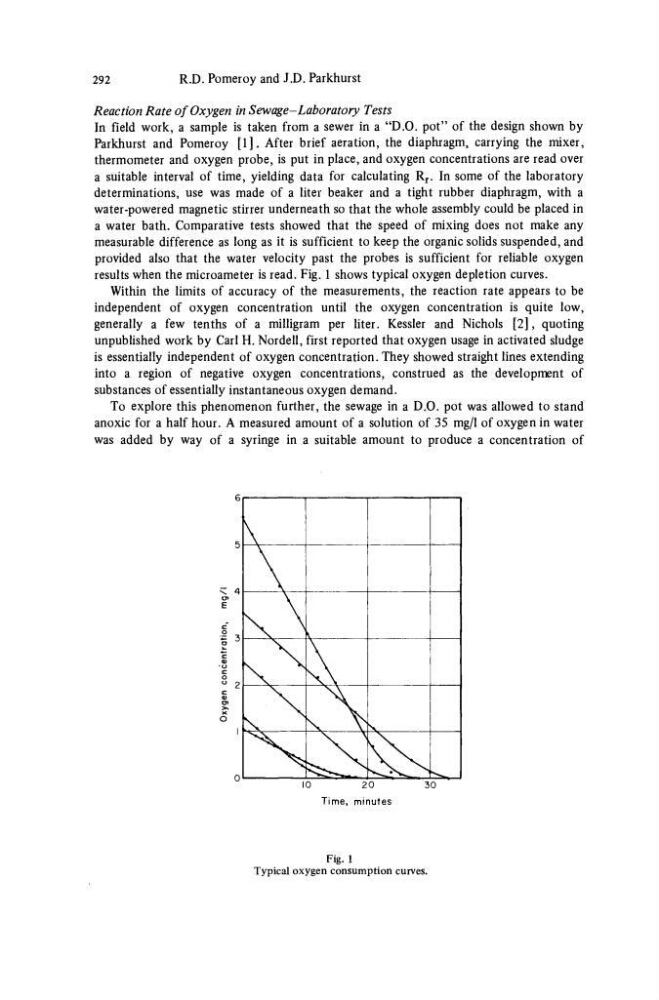
results when the microameter is read. Fig. 1 shows typical oxygen depletion curves.
Within the limits of accuracy of the measurements, the reaction rate appears to be
independent of oxygen concentration until the oxygen concentration is quite low,
generally a few tenths of a milligram per liter. Kessler and Nichols [2], quoting
unpublished work by Carl H. Nordell, first reported that oxygen usage in activated sludge
is essentially independent of oxygen concentration. They showed straight lines extending
into a region of negative oxygen concentrations, construed as the development of
substances of essentially instantaneous oxygen demand.
To explore this phenomenon further, the sewage in a D.O. pot was allowed to stand
anoxic for a half hour. A measured amount of a solution of 35 mg/1 of oxygen in water
was added by way of a syringe in a suitable amount to produce a concentration of
Fig. 1
Typical oxygen consumption curves.
R.D. Pomeroy and J.D. Parkhurst
Reaction Rate of Oxygen in Sewage-Laboratory Tests
In field work, a sample is taken from a sewer in a "D.O. pot" of the design shown by
Parkhurst and Pomeroy [1]. After brief aeration, the diaphragm, carrying the mixer,
thermometer and oxygen probe, is put in place, and oxygen concentrations are read over
a suitable interval of time, yielding data for calculating R r . In some of the laboratory
determinations, use was made of a liter beaker and a tight rubber diaphragm, with a
water-powered magnetic stirrer underneath so that the whole assembly could be placed in
a water bath. Comparative tests showed that the speed of mixing does not make any
measurable difference as long as it is sufficient to keep the organic solids suspended, and
provided also that the water velocity past the probes is sufficient for reliable oxygen
results when the microameter is read. Fig. 1 shows typical oxygen depletion curves.
Within the limits of accuracy of the measurements, the reaction rate appears to be
independent of oxygen concentration until the oxygen concentration is quite low,
generally a few tenths of a milligram per liter. Kessler and Nichols [2], quoting
unpublished work by Carl H. Nordell, first reported that oxygen usage in activated sludge
is essentially independent of oxygen concentration. They showed straight lines extending
into a region of negative oxygen concentrations, construed as the development of
substances of essentially instantaneous oxygen demand.
To explore this phenomenon further, the sewage in a D.O. pot was allowed to stand
anoxic for a half hour. A measured amount of a solution of 35 mg/1 of oxygen in water
was added by way of a syringe in a suitable amount to produce a concentration of
Fig. 1
Typical oxygen consumption curves.