

SELF PURIFICATION IN SEWERS
R.D. POMEROY* and J.D. PARKHURST**
♦President, Pomeroy, Johnston and Bailey, 660 South Fair Oaks Avenue,
Pasadena, California 91105, USA. **Chief Engineer and General Manager,
Los Angeles County Sanitation Districts, 2020 Beverly Boulevard,
Los Angeles, California 90057, USA
The oxygen balance in a stream of sewage is important in respect to the possible
generation of sulfide, and in respect to the degree of biological oxidation that may occur
in a sewer.
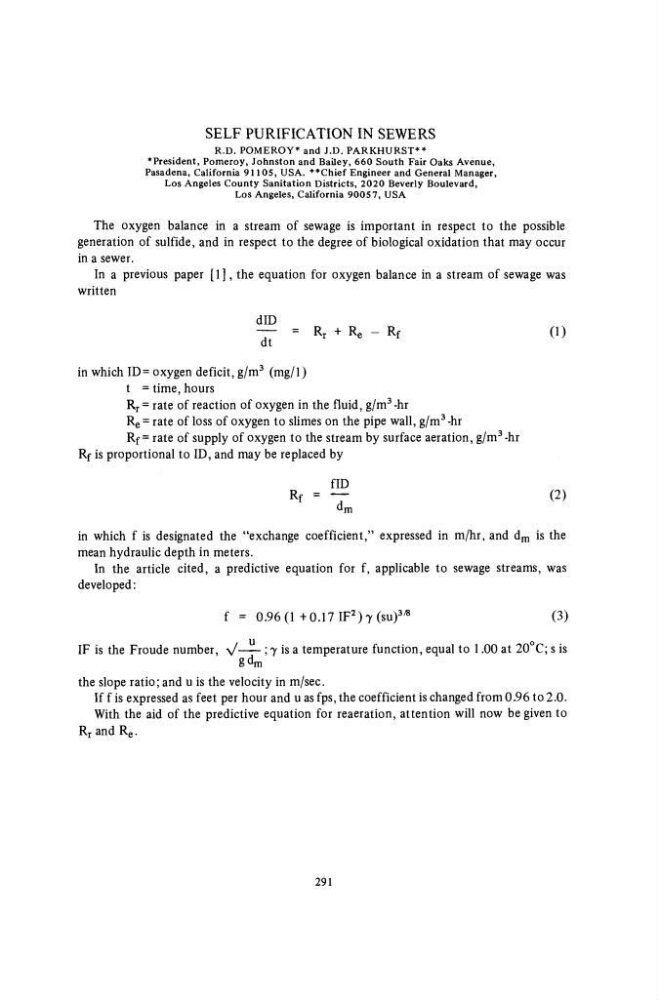
In a previous paper [1], the equation for oxygen balance in a stream of sewage was
written
dID
—
= R r + Re - R f
(1)
dt
in which ID= oxygen deficit, g/m
3 (mg/1)
t = time, hours
R r = rate of reaction of oxygen in the fluid, g/m
3 -hr
Re = rate of loss of oxygen to slimes on the pipe wall, g/m
3 -hr
Rf = rate of supply of oxygen to the stream by surface aeration, g/m
3 -hr
Rf is proportional to ID, and may be replaced by
fID
Rf = —
(2)
dm
in which f is designated the "exchange coefficient," expressed in m/hr, and d m is the
mean hydraulic depth in meters.
In the article cited, a predictive equation for f, applicable to sewage streams, was
developed:
f = 0.96(1 + 0 . 1 7 I F
2 ) T ( S U )
3 / 8
(3)
IF is the Froude number, V
; y is a temperature function, equal to 1.00 at 20°C; s is
gd m
the slope ratio; and u is the velocity in m/sec.
If f is expressed as feet per hour and u as fps, the coefficient is changed from 0.96 to 2.0.
With the aid of the predictive equation for reaeration, attention will now be given to
R r and R e .
291
R.D. POMEROY* and J.D. PARKHURST**
♦President, Pomeroy, Johnston and Bailey, 660 South Fair Oaks Avenue,
Pasadena, California 91105, USA. **Chief Engineer and General Manager,
Los Angeles County Sanitation Districts, 2020 Beverly Boulevard,
Los Angeles, California 90057, USA
The oxygen balance in a stream of sewage is important in respect to the possible
generation of sulfide, and in respect to the degree of biological oxidation that may occur
in a sewer.
In a previous paper [1], the equation for oxygen balance in a stream of sewage was
written
dID
—
= R r + Re - R f
(1)
dt
in which ID= oxygen deficit, g/m
3 (mg/1)
t = time, hours
R r = rate of reaction of oxygen in the fluid, g/m
3 -hr
Re = rate of loss of oxygen to slimes on the pipe wall, g/m
3 -hr
Rf = rate of supply of oxygen to the stream by surface aeration, g/m
3 -hr
Rf is proportional to ID, and may be replaced by
fID
Rf = —
(2)
dm
in which f is designated the "exchange coefficient," expressed in m/hr, and d m is the
mean hydraulic depth in meters.
In the article cited, a predictive equation for f, applicable to sewage streams, was
developed:
f = 0.96(1 + 0 . 1 7 I F
2 ) T ( S U )
3 / 8
(3)
IF is the Froude number, V
; y is a temperature function, equal to 1.00 at 20°C; s is
gd m
the slope ratio; and u is the velocity in m/sec.
If f is expressed as feet per hour and u as fps, the coefficient is changed from 0.96 to 2.0.
With the aid of the predictive equation for reaeration, attention will now be given to
R r and R e .
291