

A Quality Management Model for River and Underground Flow System
263
order to raise the overall accuracy.
(4) Evaluation of reaction of the underflow with materials, including adsorption,
filtration, oxygenation and any biological effect in relation to underground change in the
composition of polluted water.
(5) Positive usage of any internal storage for the comprehensive control of pollution by
applying recharge principles. The underflow structure from the point of view of quality
control will become more obvious at this stage.
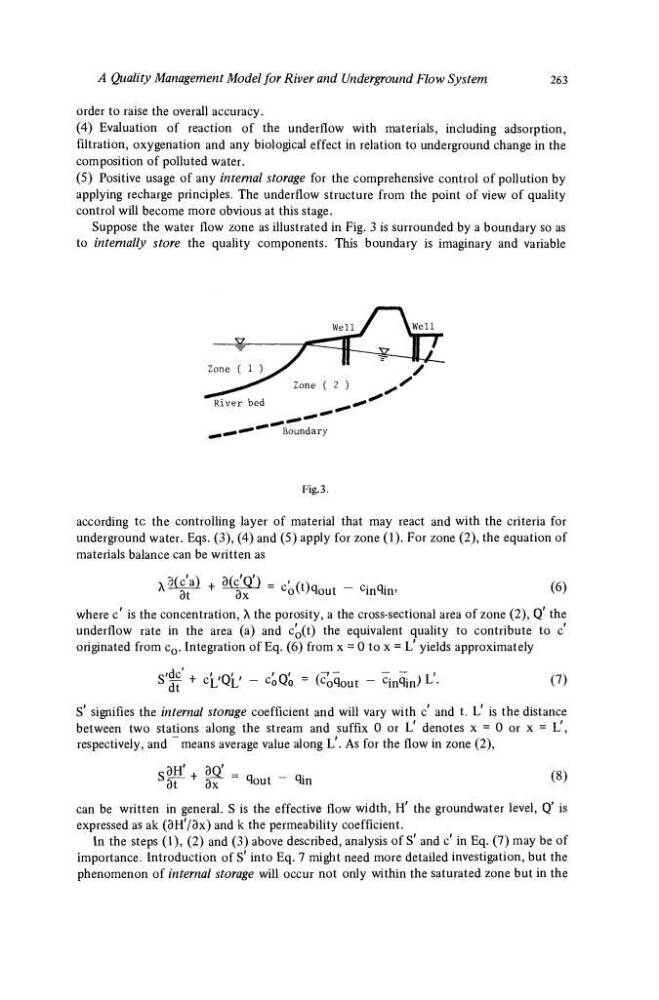
Suppose the water flow zone as illustrated in Fig. 3 is surrounded by a boundary so as
to internally store the quality components. This boundary is imaginary and variable
Fig.3.
according tc the controlling layer of material that may react and with the criteria for
underground water. Eqs. (3), (4) and (5) apply for zone (1). For zone (2), the equation of
materials balance can be written as
λ 3 £ | ^ + Μ | ^ ) = c ^ ( t ) q o u t _ C i n q i n ,
(6)
where c' is the concentration, λ the porosity, a the cross-sectional area of zone (2), Q' the
underflow rate in the area (a) and c' 0 (t) the equivalent quality to contribute to c'
originated from c 0 . Integration of Eq. (6) from x = 0 to x = L' yields approximately
S'jjf' + cL'QL' -
c oQo = (?<Ä>ut " q n q i n ) V.
(7)
S' signifies the internal storage coefficient and will vary with c' and t. L' is the distance
between two stations along the stream and suffix 0 or L' denotes x = 0 or x = L',
respectively, and means average value along L'. AS for the flow in zone (2),
S ! r
+ I ? = «out - *n
<*>
can be written in general. S is the effective flow width, H' the groundwater level, Q' is
expressed as ak (3H'/3x) and k the permeability coefficient.
In the steps (1), (2) and (3) above described, analysis of S' and c' in Eq. (7) may be of
importance. Introduction of S' into Eq. 7 might need more detailed investigation, but the
phenomenon of internal storage will occur not only within the saturated zone but in the
263
order to raise the overall accuracy.
(4) Evaluation of reaction of the underflow with materials, including adsorption,
filtration, oxygenation and any biological effect in relation to underground change in the
composition of polluted water.
(5) Positive usage of any internal storage for the comprehensive control of pollution by
applying recharge principles. The underflow structure from the point of view of quality
control will become more obvious at this stage.
Suppose the water flow zone as illustrated in Fig. 3 is surrounded by a boundary so as
to internally store the quality components. This boundary is imaginary and variable
Fig.3.
according tc the controlling layer of material that may react and with the criteria for
underground water. Eqs. (3), (4) and (5) apply for zone (1). For zone (2), the equation of
materials balance can be written as
λ 3 £ | ^ + Μ | ^ ) = c ^ ( t ) q o u t _ C i n q i n ,
(6)
where c' is the concentration, λ the porosity, a the cross-sectional area of zone (2), Q' the
underflow rate in the area (a) and c' 0 (t) the equivalent quality to contribute to c'
originated from c 0 . Integration of Eq. (6) from x = 0 to x = L' yields approximately
S'jjf' + cL'QL' -
c oQo = (?<Ä>ut " q n q i n ) V.
(7)
S' signifies the internal storage coefficient and will vary with c' and t. L' is the distance
between two stations along the stream and suffix 0 or L' denotes x = 0 or x = L',
respectively, and means average value along L'. AS for the flow in zone (2),
S ! r
+ I ? = «out - *n
<*>
can be written in general. S is the effective flow width, H' the groundwater level, Q' is
expressed as ak (3H'/3x) and k the permeability coefficient.
In the steps (1), (2) and (3) above described, analysis of S' and c' in Eq. (7) may be of
importance. Introduction of S' into Eq. 7 might need more detailed investigation, but the
phenomenon of internal storage will occur not only within the saturated zone but in the