

262
T. Sueishi and W. Yoshikoshi
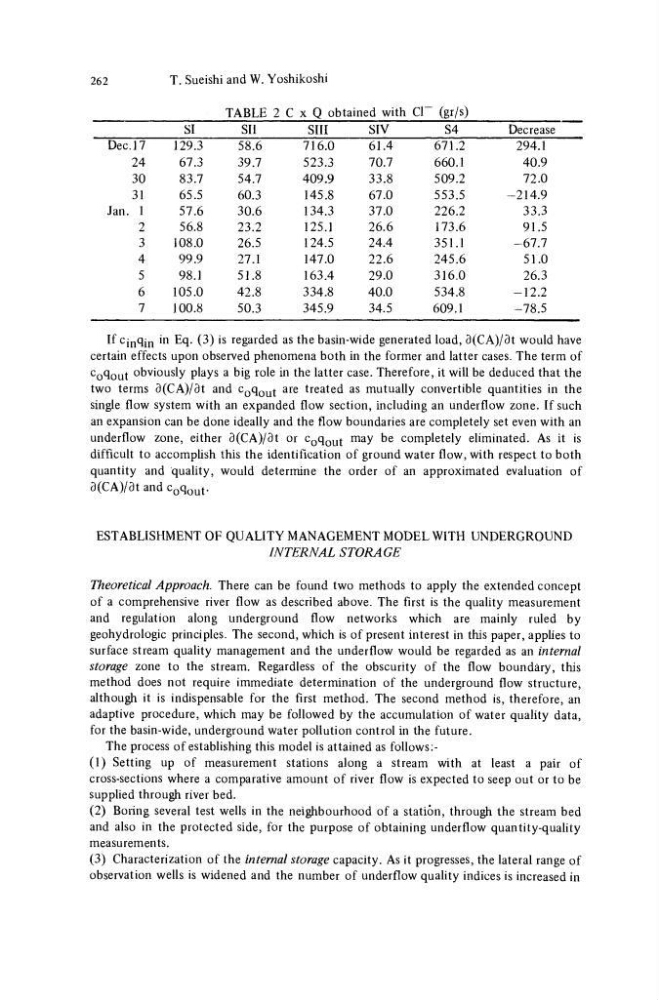
TABLE 2 C x Q obtained with Cl (gr/s)
Dec. 17
24
30
31
Jan. 1
2
3
4
5
6
7
SI
129.3
67.3
83.7
65.5
57.6
56.8
108.0
99.9
98.1
105.0
100.8
SI1
58.6
39.7
54.7
60.3
30.6
23.2
26.5
27.1
51.8
42.8
50.3
SIII
716.0
523.3
409.9
145.8
134.3
125.1
124.5
147.0
163.4
334.8
345.9
SIV
61.4
70.7
33.8
67.0
37.0
26.6
24.4
22.6
29.0
40.0
34.5
S4
671.2
660.1
509.2
553.5
226.2
173.6
351.1
245.6
316.0
534.8
609.1
Decrease
294.1
40.9
72.0
-214.9
33.3
91.5
-67.7
51.0
26.3
-12.2
-78.5
If Cj n qj n in Eq. (3) is regarded as the basin-wide generated load, 3(CA)/3t would have
certain effects upon observed phenomena both in the former and latter cases. The term of
c 0 q o u t obviously plays a big role in the latter case. Therefore, it will be deduced that the
two terms 3(CA)/3t and c 0 q o u t are treated as mutually convertible quantities in the
single flow system with an expanded flow section, including an underflow zone. If such
an expansion can be done ideally and the flow boundaries are completely set even with an
underflow zone, either 3(CA)/3t or c 0 q o u t may be completely eliminated. As it is
difficult to accomplish this the identification of ground water flow, with respect to both
quantity and quality, would determine the order of an approximated evaluation of
3(CA)/at and c 0 q o u t .
ESTABLISHMENT OF QUALITY MANAGEMENT MODEL WITH UNDERGROUND
INTERNAL STORAGE
Theoretical Approach. There can be found two methods to apply the extended concept
of a comprehensive river flow as described above. The first is the quality measurement
and regulation along underground flow networks which are mainly ruled by
geohydrologic principles. The second, which is of present interest in this paper, applies to
surface stream quality management and the underflow would be regarded as an internal
storage zone to the stream. Regardless of the obscurity of the flow boundary, this
method does not require immediate determination of the underground flow structure,
although it is indispensable for the first method. The second method is, therefore, an
adaptive procedure, which may be followed by the accumulation of water quality data,
for the basin-wide, underground water pollution control in the future.
The process of establishing this model is attained as follows:(1) Setting up of measurement stations along a stream with at least a pair of
cross-sections where a comparative amount of river flow is expected to seep out or to be
supplied through river bed.
(2) Boring several test wells in the neighbourhood of a station, through the stream bed
and also in the protected side, for the purpose of obtaining underflow quantity-quality
measurements.
(3) Characterization of the internal storage capacity. As it progresses, the lateral range of
observation wells is widened and the number of underflow quality indices is increased in
T. Sueishi and W. Yoshikoshi
TABLE 2 C x Q obtained with Cl (gr/s)
Dec. 17
24
30
31
Jan. 1
2
3
4
5
6
7
SI
129.3
67.3
83.7
65.5
57.6
56.8
108.0
99.9
98.1
105.0
100.8
SI1
58.6
39.7
54.7
60.3
30.6
23.2
26.5
27.1
51.8
42.8
50.3
SIII
716.0
523.3
409.9
145.8
134.3
125.1
124.5
147.0
163.4
334.8
345.9
SIV
61.4
70.7
33.8
67.0
37.0
26.6
24.4
22.6
29.0
40.0
34.5
S4
671.2
660.1
509.2
553.5
226.2
173.6
351.1
245.6
316.0
534.8
609.1
Decrease
294.1
40.9
72.0
-214.9
33.3
91.5
-67.7
51.0
26.3
-12.2
-78.5
If Cj n qj n in Eq. (3) is regarded as the basin-wide generated load, 3(CA)/3t would have
certain effects upon observed phenomena both in the former and latter cases. The term of
c 0 q o u t obviously plays a big role in the latter case. Therefore, it will be deduced that the
two terms 3(CA)/3t and c 0 q o u t are treated as mutually convertible quantities in the
single flow system with an expanded flow section, including an underflow zone. If such
an expansion can be done ideally and the flow boundaries are completely set even with an
underflow zone, either 3(CA)/3t or c 0 q o u t may be completely eliminated. As it is
difficult to accomplish this the identification of ground water flow, with respect to both
quantity and quality, would determine the order of an approximated evaluation of
3(CA)/at and c 0 q o u t .
ESTABLISHMENT OF QUALITY MANAGEMENT MODEL WITH UNDERGROUND
INTERNAL STORAGE
Theoretical Approach. There can be found two methods to apply the extended concept
of a comprehensive river flow as described above. The first is the quality measurement
and regulation along underground flow networks which are mainly ruled by
geohydrologic principles. The second, which is of present interest in this paper, applies to
surface stream quality management and the underflow would be regarded as an internal
storage zone to the stream. Regardless of the obscurity of the flow boundary, this
method does not require immediate determination of the underground flow structure,
although it is indispensable for the first method. The second method is, therefore, an
adaptive procedure, which may be followed by the accumulation of water quality data,
for the basin-wide, underground water pollution control in the future.
The process of establishing this model is attained as follows:(1) Setting up of measurement stations along a stream with at least a pair of
cross-sections where a comparative amount of river flow is expected to seep out or to be
supplied through river bed.
(2) Boring several test wells in the neighbourhood of a station, through the stream bed
and also in the protected side, for the purpose of obtaining underflow quantity-quality
measurements.
(3) Characterization of the internal storage capacity. As it progresses, the lateral range of
observation wells is widened and the number of underflow quality indices is increased in