

Discussion by H. Pasoli, Italy
9
Attention is drawn to eq.8 which should read
a p C p = K w
from which eq. 10) becomes
KA
observing that eq. 10) is valid only if we put
Qs(l - e - ^ w ^ o
5Qs
Qs (Kw + K A )
KWKA
= 0
8')
10')
and remembering that for the authors also-?—
by k
that means there is no solar radiation both in the air and in the water.
It seems right to criticize also the 5) taken from Harbeck jr and the 7).
Correlation between mass and heat transfer is expressed by the largely corroborated ChiltonColbrurn's formula:
— ^
P r 2/3 = ]L_ S C ^
3
UooPCp
Uoo
where Uoo represents velocity at boundary layer limit and Pr and Sc are respectively the Prandtl's and
Schmidt's numbers. K and h are, according to authors nomenclature respectively heat and mass
transfer.
If Pr = Sc (as in the case of air-water) and if the flow condition is unique, Lewis' equation is
valid:
K.
h
= '
C P
Then it will be written
Q h = K (T s - T A ) (7' and Q e = [λ+ C p (T s - T A )] — (H s - H A )
(5'
where Xis the heat of vaporization and H the humidity. It becomes (ever using author's nomenclature)
K e = Kh so that Qh = Kh (Ts — TA) seems to be computed twice: one in the 5) and once in the 7).
An important question to debate may be the starting mathematical model.
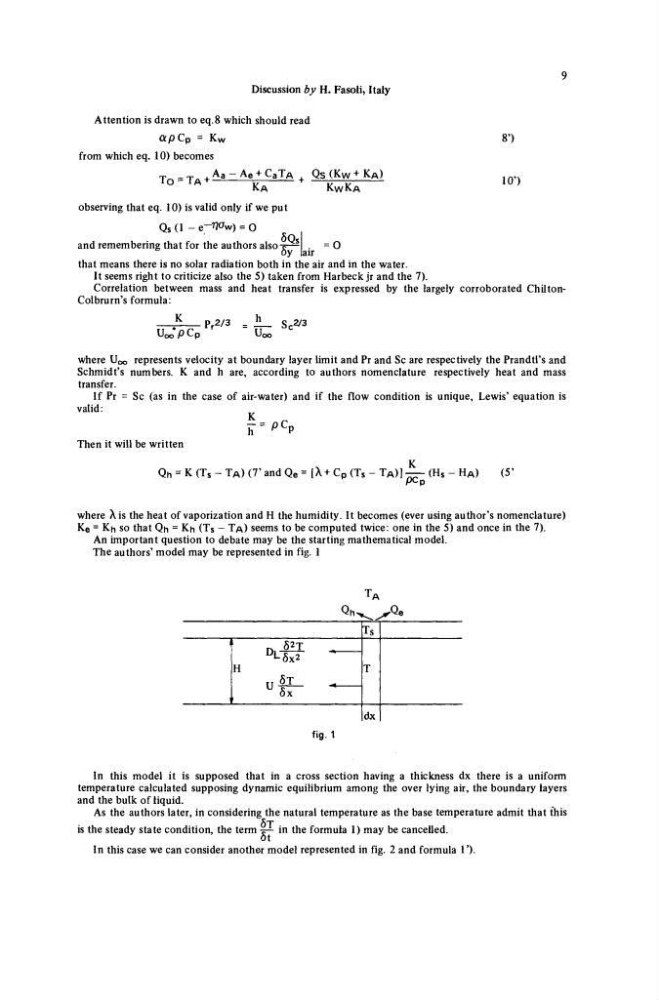
The authors' model may be represented in fig. 1
fig. 1
In this model it is supposed that in a cross section having a thickness dx there is a uniform
temperature calculated supposing dynamic equilibrium among the over lying air, the boundary layers
and the bulk of liquid.
As the authors later, in considering the natural temperature as the base temperature admit that this
is the steady state condition, the term ■=— in the formula 1) may be cancelled.
ot
In this case we can consider another model represented in fig. 2 and formula Γ).
9
Attention is drawn to eq.8 which should read
a p C p = K w
from which eq. 10) becomes
KA
observing that eq. 10) is valid only if we put
Qs(l - e - ^ w ^ o
5Qs
Qs (Kw + K A )
KWKA
= 0
8')
10')
and remembering that for the authors also-?—
by k
that means there is no solar radiation both in the air and in the water.
It seems right to criticize also the 5) taken from Harbeck jr and the 7).
Correlation between mass and heat transfer is expressed by the largely corroborated ChiltonColbrurn's formula:
— ^
P r 2/3 = ]L_ S C ^
3
UooPCp
Uoo
where Uoo represents velocity at boundary layer limit and Pr and Sc are respectively the Prandtl's and
Schmidt's numbers. K and h are, according to authors nomenclature respectively heat and mass
transfer.
If Pr = Sc (as in the case of air-water) and if the flow condition is unique, Lewis' equation is
valid:
K.
h
= '
C P
Then it will be written
Q h = K (T s - T A ) (7' and Q e = [λ+ C p (T s - T A )] — (H s - H A )
(5'
where Xis the heat of vaporization and H the humidity. It becomes (ever using author's nomenclature)
K e = Kh so that Qh = Kh (Ts — TA) seems to be computed twice: one in the 5) and once in the 7).
An important question to debate may be the starting mathematical model.
The authors' model may be represented in fig. 1
fig. 1
In this model it is supposed that in a cross section having a thickness dx there is a uniform
temperature calculated supposing dynamic equilibrium among the over lying air, the boundary layers
and the bulk of liquid.
As the authors later, in considering the natural temperature as the base temperature admit that this
is the steady state condition, the term ■=— in the formula 1) may be cancelled.
ot
In this case we can consider another model represented in fig. 2 and formula Γ).