

10
Discussion
-
H
K h ( T
{
'
D i^X
0 χ δχ2
u
δ τ
u
δ X
- T A ) y = H
1
T
T
D
Ä
D y δγ2
with the limits
♦►T
fig. 2
ϋ δχ
+ Κ χ δ χ '
2
K y ö y
2
n
y = O
y = H
x = O
T = Ti
Kh (T - T A )
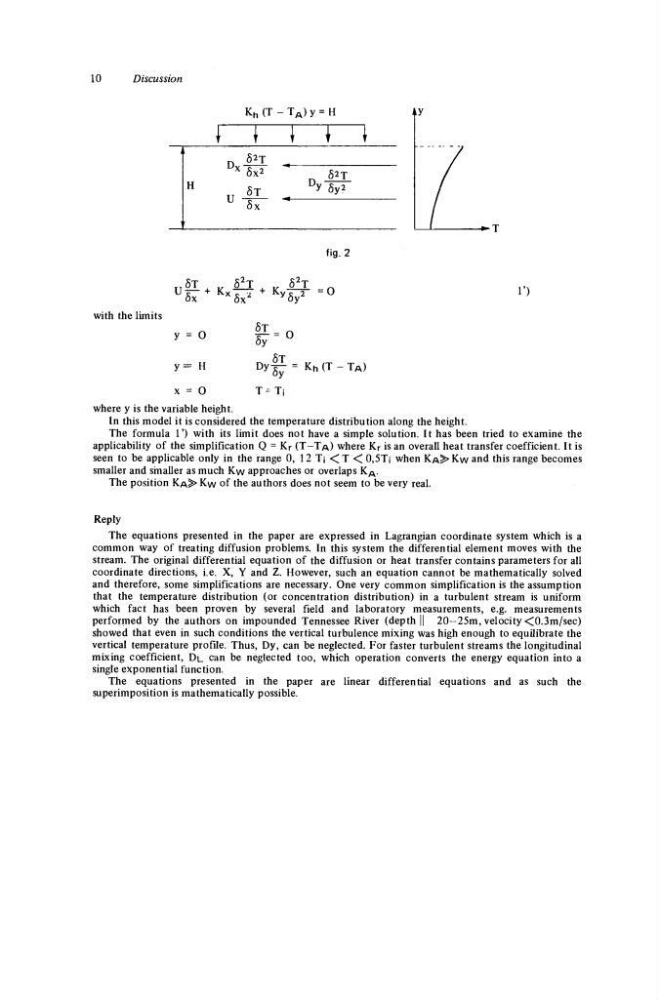
where y is the variable height.
In this model it is considered the temperature distribution along the height.
The formula Γ) with its limit does not have a simple solution. It has been tried to examine the
applicability of the simplification Q = K r ( T - T A ) where K r is an overall heat transfer coefficient. It is
seen to be applicable only in the range 0, 12 Tj < T < 0,5Tj when K A > K W and this range becomes
smaller and smaller as much Kw approaches or overlaps K A .
The position K A ^ " KW of the authors does not seem to be very real.
Reply
The equations presented in the paper are expressed in Lagrangian coordinate system which is a
common way of treating diffusion problems. In this system the differential element moves with the
stream. The original differential equation of the diffusion or heat transfer contains parameters for all
coordinate directions, i.e. X, Y and Z. However, such an equation cannot be mathematically solved
and therefore, some simplifications are necessary. One very common simplification is the assumption
that the temperature distribution (or concentration distribution) in a turbulent stream is uniform
which fact has been proven by several field and laboratory measurements, e.g. measurements
performed by the authors on impounded Tennessee River (depth || 20-25m, velocity <0.3m/sec)
showed that even in such conditions the vertical turbulence mixing was high enough to equilibrate the
vertical temperature profile. Thus, Dy, can be neglected. For faster turbulent streams the longitudinal
mixing coefficient, D L can be neglected too, which operation converts the energy equation into a
single exponential function.
The equations presented in the paper are linear differential equations and as such the
superimposition is mathematically possible.
Discussion
-
H
K h ( T
{
'
D i^X
0 χ δχ2
u
δ τ
u
δ X
- T A ) y = H
1
T
T
D
Ä
D y δγ2
with the limits
♦►T
fig. 2
ϋ δχ
+ Κ χ δ χ '
2
K y ö y
2
n
y = O
y = H
x = O
T = Ti
Kh (T - T A )
where y is the variable height.
In this model it is considered the temperature distribution along the height.
The formula Γ) with its limit does not have a simple solution. It has been tried to examine the
applicability of the simplification Q = K r ( T - T A ) where K r is an overall heat transfer coefficient. It is
seen to be applicable only in the range 0, 12 Tj < T < 0,5Tj when K A > K W and this range becomes
smaller and smaller as much Kw approaches or overlaps K A .
The position K A ^ " KW of the authors does not seem to be very real.
Reply
The equations presented in the paper are expressed in Lagrangian coordinate system which is a
common way of treating diffusion problems. In this system the differential element moves with the
stream. The original differential equation of the diffusion or heat transfer contains parameters for all
coordinate directions, i.e. X, Y and Z. However, such an equation cannot be mathematically solved
and therefore, some simplifications are necessary. One very common simplification is the assumption
that the temperature distribution (or concentration distribution) in a turbulent stream is uniform
which fact has been proven by several field and laboratory measurements, e.g. measurements
performed by the authors on impounded Tennessee River (depth || 20-25m, velocity <0.3m/sec)
showed that even in such conditions the vertical turbulence mixing was high enough to equilibrate the
vertical temperature profile. Thus, Dy, can be neglected. For faster turbulent streams the longitudinal
mixing coefficient, D L can be neglected too, which operation converts the energy equation into a
single exponential function.
The equations presented in the paper are linear differential equations and as such the
superimposition is mathematically possible.