

6
V. Novotny and P.A. Krenkel
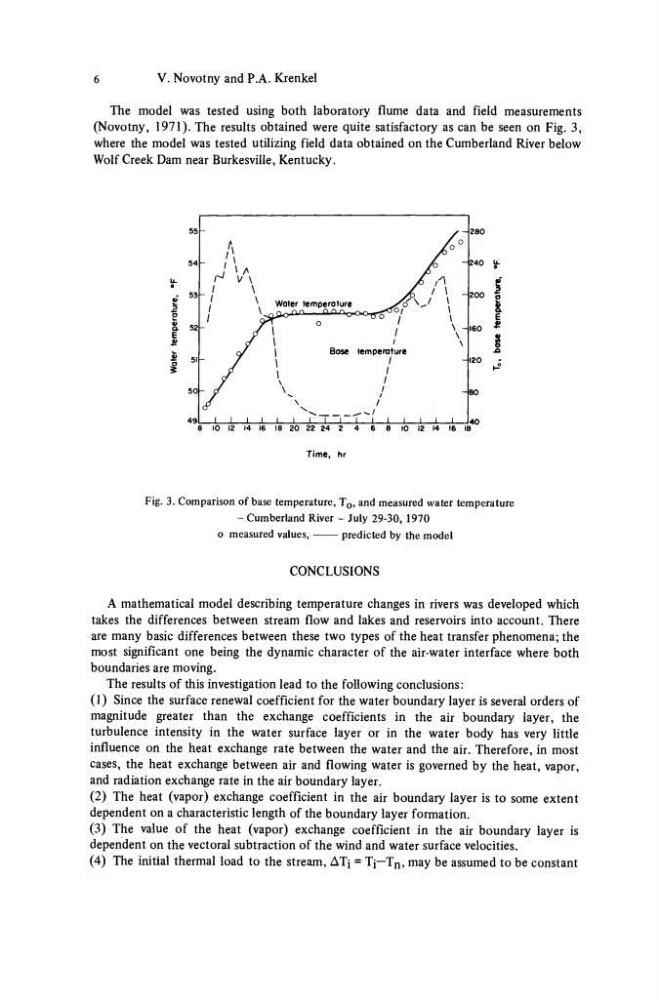
The model was tested using both laboratory flume data and field measurements
(Novotny, 1971). The results obtained were quite satisfactory as can be seen on Fig. 3,
where the model was tested utilizing field data obtained on the Cumberland River below
Wolf Creek Dam near Burkesville, Kentucky.
10 12 14 16 18 20 22 24 2 4 6 8 10 12 14 16 18
Time, hr
Fig. 3. Comparison of base temperature, T 0 , and measured water temperature
- Cumberland River - July 29-30, 1970
o measured values,
predicted by the model
CONCLUSIONS
A mathematical model describing temperature changes in rivers was developed which
takes the differences between stream flow and lakes and reservoirs into account. There
are many basic differences between these two types of the heat transfer phenomena; the
most significant one being the dynamic character of the air-water interface where both
boundaries are moving.
The results of this investigation lead to the following conclusions:
(1) Since the surface renewal coefficient for the water boundary layer is several orders of
magnitude greater than the exchange coefficients in the air boundary layer, the
turbulence intensity in the water surface layer or in the water body has very little
influence on the heat exchange rate between the water and the air. Therefore, in most
cases, the heat exchange between air and flowing water is governed by the heat, vapor,
and radiation exchange rate in the air boundary layer.
(2) The heat (vapor) exchange coefficient in the air boundary layer is to some extent
dependent on a characteristic length of the boundary layer formation.
(3) The value of the heat (vapor) exchange coefficient in the air boundary layer is
dependent on the vectoral subtraction of the wind and water surface velocities.
(4) The initial thermal load to the stream, ΔΤΐ = Ύ[—Τ η , may be assumed to be constant
V. Novotny and P.A. Krenkel
The model was tested using both laboratory flume data and field measurements
(Novotny, 1971). The results obtained were quite satisfactory as can be seen on Fig. 3,
where the model was tested utilizing field data obtained on the Cumberland River below
Wolf Creek Dam near Burkesville, Kentucky.
10 12 14 16 18 20 22 24 2 4 6 8 10 12 14 16 18
Time, hr
Fig. 3. Comparison of base temperature, T 0 , and measured water temperature
- Cumberland River - July 29-30, 1970
o measured values,
predicted by the model
CONCLUSIONS
A mathematical model describing temperature changes in rivers was developed which
takes the differences between stream flow and lakes and reservoirs into account. There
are many basic differences between these two types of the heat transfer phenomena; the
most significant one being the dynamic character of the air-water interface where both
boundaries are moving.
The results of this investigation lead to the following conclusions:
(1) Since the surface renewal coefficient for the water boundary layer is several orders of
magnitude greater than the exchange coefficients in the air boundary layer, the
turbulence intensity in the water surface layer or in the water body has very little
influence on the heat exchange rate between the water and the air. Therefore, in most
cases, the heat exchange between air and flowing water is governed by the heat, vapor,
and radiation exchange rate in the air boundary layer.
(2) The heat (vapor) exchange coefficient in the air boundary layer is to some extent
dependent on a characteristic length of the boundary layer formation.
(3) The value of the heat (vapor) exchange coefficient in the air boundary layer is
dependent on the vectoral subtraction of the wind and water surface velocities.
(4) The initial thermal load to the stream, ΔΤΐ = Ύ[—Τ η , may be assumed to be constant