

184
G. Shelef, M.Schwarz and H. Schechter
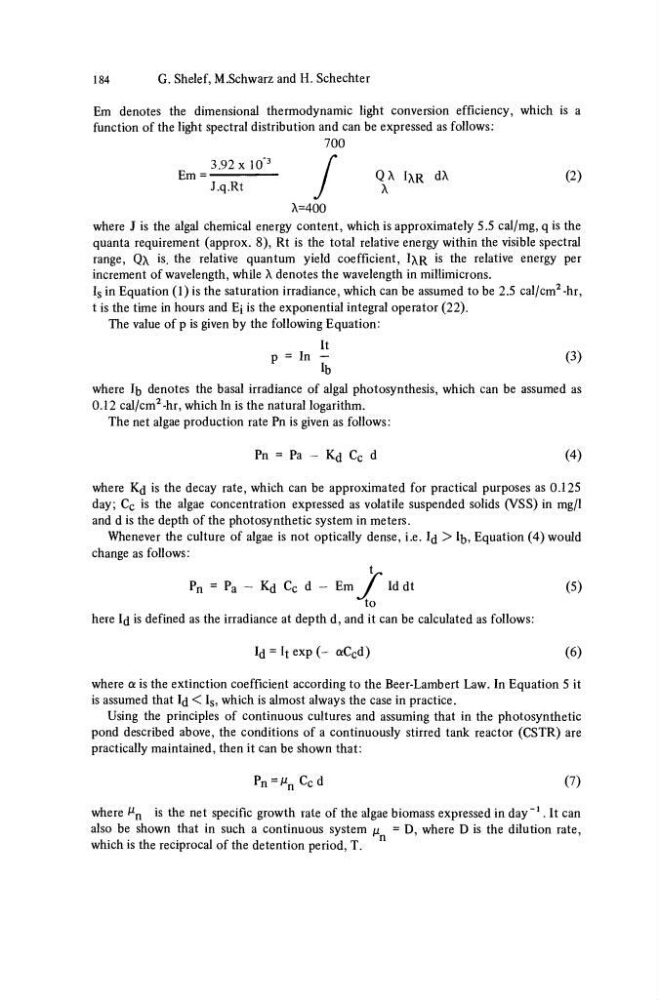
Em denotes the dimensional thermodynamic light conversion efficiency, which is a
function of the light spectral distribution and can be expressed as follows:
700
3.92 xlO"
3
Γ
E m = — —
/
QX I X R dX
(2)
J.q.Rt
J
x
λ=400
where J is the algal chemical energy content, which is approximately 5.5 cal/mg, q is the
quanta requirement (approx. 8), Rt is the total relative energy within the visible spectral
range, Q\ is. the relative quantum yield coefficient, IXR is the relative energy per
increment of wavelength, while λ denotes the wavelength in millimicrons.
I s in Equation (1) is the saturation irradiance, which can be assumed to be 2.5 cal/cm
2 -hr,
t is the time in hours and Ej is the exponential integral operator (22).
The value of p is given by the following Equation:
It
P = In -
(3)
lb
where lb denotes the basal irradiance of algal photosynthesis, which can be assumed as
0.12 cal/cm
2 -hr, which In is the natural logarithm.
The net algae production rate Pn is given as follows:
Pn = Pa - Kd C c d
(4)
where Kd is the decay rate, which can be approximated for practical purposes as 0.125
day; C c is the algae concentration expressed as volatile suspended solids (VSS) in mg/1
and d is the depth of the photosynthetic system in meters.
Whenever the culture of algae is not optically dense, i.e. Id > lb, Equation (4) would
change as follows:
P n = P a - Kd C c d - Em /
Id dt
(5)
here Id is defined as the irradiance at depth d, and it can be calculated as follows:
Id = It exp (- aC c d)
(6)
where a is the extinction coefficient according to the Beer-Lambert Law. In Equation 5 it
is assumed that Id < Is, which is almost always the case in practice.
Using the principles of continuous cultures and assuming that in the photosynthetic
pond described above, the conditions of a continuously stirred tank reactor (CSTR) are
practically maintained, then it can be shown that:
Pn=M n C c d
(7)
where ^ n is the net specific growth rate of the algae biomass expressed in day"
1 . It can
also be shown that in such a continuous system μ = D, where D is the dilution rate,
which is the reciprocal of the detention period, T.
G. Shelef, M.Schwarz and H. Schechter
Em denotes the dimensional thermodynamic light conversion efficiency, which is a
function of the light spectral distribution and can be expressed as follows:
700
3.92 xlO"
3
Γ
E m = — —
/
QX I X R dX
(2)
J.q.Rt
J
x
λ=400
where J is the algal chemical energy content, which is approximately 5.5 cal/mg, q is the
quanta requirement (approx. 8), Rt is the total relative energy within the visible spectral
range, Q\ is. the relative quantum yield coefficient, IXR is the relative energy per
increment of wavelength, while λ denotes the wavelength in millimicrons.
I s in Equation (1) is the saturation irradiance, which can be assumed to be 2.5 cal/cm
2 -hr,
t is the time in hours and Ej is the exponential integral operator (22).
The value of p is given by the following Equation:
It
P = In -
(3)
lb
where lb denotes the basal irradiance of algal photosynthesis, which can be assumed as
0.12 cal/cm
2 -hr, which In is the natural logarithm.
The net algae production rate Pn is given as follows:
Pn = Pa - Kd C c d
(4)
where Kd is the decay rate, which can be approximated for practical purposes as 0.125
day; C c is the algae concentration expressed as volatile suspended solids (VSS) in mg/1
and d is the depth of the photosynthetic system in meters.
Whenever the culture of algae is not optically dense, i.e. Id > lb, Equation (4) would
change as follows:
P n = P a - Kd C c d - Em /
Id dt
(5)
here Id is defined as the irradiance at depth d, and it can be calculated as follows:
Id = It exp (- aC c d)
(6)
where a is the extinction coefficient according to the Beer-Lambert Law. In Equation 5 it
is assumed that Id < Is, which is almost always the case in practice.
Using the principles of continuous cultures and assuming that in the photosynthetic
pond described above, the conditions of a continuously stirred tank reactor (CSTR) are
practically maintained, then it can be shown that:
Pn=M n C c d
(7)
where ^ n is the net specific growth rate of the algae biomass expressed in day"
1 . It can
also be shown that in such a continuous system μ = D, where D is the dilution rate,
which is the reciprocal of the detention period, T.