

Prediction of Photosynthetic Biomass Production
183
The pond was fed with the domestic raw sewage from a residential area near
Jerusalem. Its composition is given in Table 2. This sewage is strong owing to the low
water consumption. It was bar-screened and comminuted before being introduced into
the pond.
A 7.0 m
3 /hr (1750 gal/hr) rectangular flotator was used for separating the algal
biomass from the pond effluent after treatment with alum or ferric chloride. The results
obtained in the flocculation-flotation unit will be described in a future publication.
METHODOLOGY
The analyses given in Table 2 were performed on composite samples using Standard
Methods procedure. Algae concentrations were measured as volatile suspended solids
(VSS) and were correlated to the algal cell-count, which was regularly performed.
Sunlight incident irradiance levels were provided daily by the Climatology Laboratory
at the Hebrew University in Jerusalem, while light penetration and transmittance
measurement were taken in the pond itself. Dissolved oxygen levels were measured by a
Yellow-Spring D.O.-meter, which was checked and calibrated regularly by chemical
analysis.
KINETICS OF ALGAE PRODUCTION RATE
The net algal production rate is proportional to both the rate of photosynthetic
oxygenation and the rate of nutrient incorporation into the biomass. Approximately 1.6
grams of oxygen are produced per gram of algae and between 65 to 90 milligrams of
nitrogen are incorporated into one gram of algae. The rise in pH due to C0 2 utilization
by algae is also proportional to algae net production; thus, the loss of nitrogen by
ammonia evolution from ponds surface can also be attributed to algae net production.
Within the range of algal specific growth rates found in photosynthetic wastewater
systems fed by domestic wastewater, it has been repeatedly shown (13, 14) that the rate
of algae production is determined primarily by the incident solar irradiance, rather than
temperature or nutrient concentration. This is true under most climatic conditions, where
algal wastewater treatment is used, and this excludes extreme conditions where high solar
irradiance levels are coupled with extremely low temperatures.
The relationship between algae production and irradiance has been elucidated and
formulated by many researchers (15, 16, 17). It has been found in previous work by
Shelef, Oswald and Golueke (18, 19) that the exponential function, which was first
proposed by Kok (20) and Van Oorschot (21) can best describe the relationship between
algae growth and incident irradiance.
A summary of the kinetic approach is given herein, while a more detailed description is
given in Reference (18).
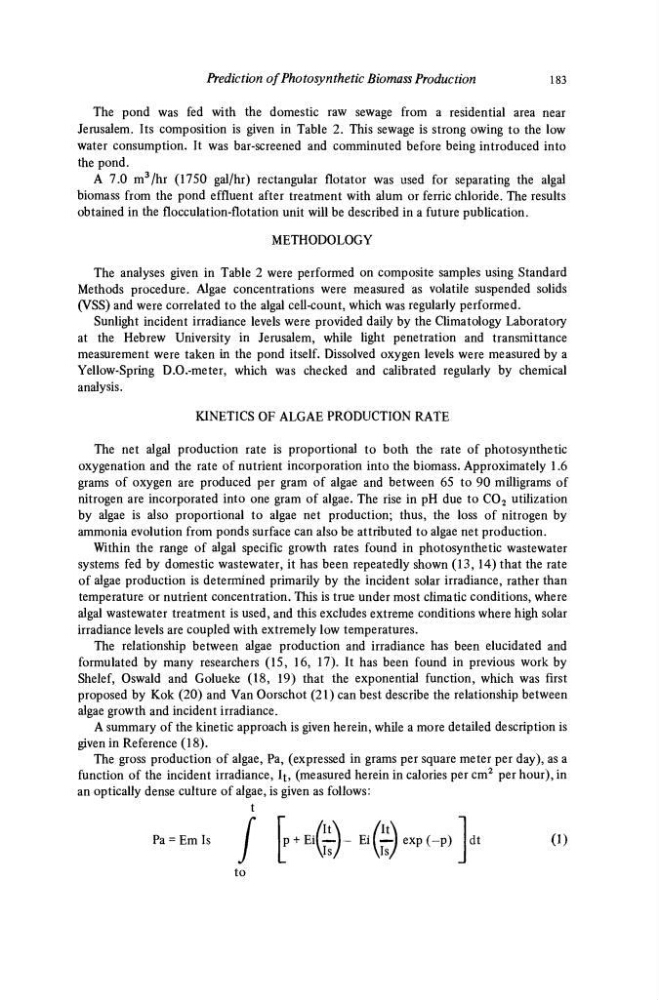
The gross production of algae, Pa, (expressed in grams per square meter per day), as a
function of the incident irradiance, It, (measured herein in calories per cm
2 per hour), in
an optically dense culture of algae, is given as follows:
/ HS)B
©
Pa = EmIs
I
|p + Ei(—J- Ei(-~J exp (-p)
to
dt
(1)
183
The pond was fed with the domestic raw sewage from a residential area near
Jerusalem. Its composition is given in Table 2. This sewage is strong owing to the low
water consumption. It was bar-screened and comminuted before being introduced into
the pond.
A 7.0 m
3 /hr (1750 gal/hr) rectangular flotator was used for separating the algal
biomass from the pond effluent after treatment with alum or ferric chloride. The results
obtained in the flocculation-flotation unit will be described in a future publication.
METHODOLOGY
The analyses given in Table 2 were performed on composite samples using Standard
Methods procedure. Algae concentrations were measured as volatile suspended solids
(VSS) and were correlated to the algal cell-count, which was regularly performed.
Sunlight incident irradiance levels were provided daily by the Climatology Laboratory
at the Hebrew University in Jerusalem, while light penetration and transmittance
measurement were taken in the pond itself. Dissolved oxygen levels were measured by a
Yellow-Spring D.O.-meter, which was checked and calibrated regularly by chemical
analysis.
KINETICS OF ALGAE PRODUCTION RATE
The net algal production rate is proportional to both the rate of photosynthetic
oxygenation and the rate of nutrient incorporation into the biomass. Approximately 1.6
grams of oxygen are produced per gram of algae and between 65 to 90 milligrams of
nitrogen are incorporated into one gram of algae. The rise in pH due to C0 2 utilization
by algae is also proportional to algae net production; thus, the loss of nitrogen by
ammonia evolution from ponds surface can also be attributed to algae net production.
Within the range of algal specific growth rates found in photosynthetic wastewater
systems fed by domestic wastewater, it has been repeatedly shown (13, 14) that the rate
of algae production is determined primarily by the incident solar irradiance, rather than
temperature or nutrient concentration. This is true under most climatic conditions, where
algal wastewater treatment is used, and this excludes extreme conditions where high solar
irradiance levels are coupled with extremely low temperatures.
The relationship between algae production and irradiance has been elucidated and
formulated by many researchers (15, 16, 17). It has been found in previous work by
Shelef, Oswald and Golueke (18, 19) that the exponential function, which was first
proposed by Kok (20) and Van Oorschot (21) can best describe the relationship between
algae growth and incident irradiance.
A summary of the kinetic approach is given herein, while a more detailed description is
given in Reference (18).
The gross production of algae, Pa, (expressed in grams per square meter per day), as a
function of the incident irradiance, It, (measured herein in calories per cm
2 per hour), in
an optically dense culture of algae, is given as follows:
/ HS)B
©
Pa = EmIs
I
|p + Ei(—J- Ei(-~J exp (-p)
to
dt
(1)