

4
V. Novotny and P.A. Krenkel
where:
A a = 695.04 (ß - 0.874)
cal cm"
2 day"
1
B a = 11.42
cal cm"
2 day"
1 0 C
_ 1
C a = 10.18
(ß- 1.123)
cal cm"
2 day"
1 ''C"
1
ß is a coefficient accounting for cloud cover and humidity as defined by Raphael
(Raphael, 1962), and TA is the air temperature.
Evaporation: Knowing the relative humidity, f, and the air temperature, T A , the
evaporative heat flux can be approximated as follws:
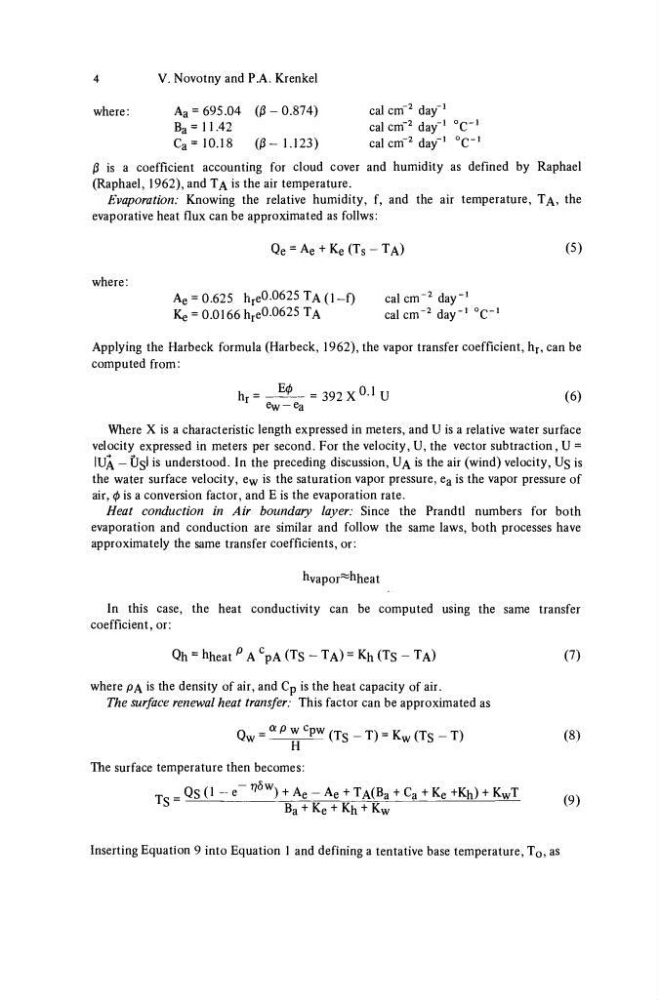
Qe = A e + K e (T s - T A )
(5)
where:
A e = 0.625 h r e0.0625 T A (1-f)
cal cm"
2 day"
1
Ke = 0.0166 h r e0.0625 TA
cal cm"
2 day"
1 °C~
l
Applying the Harbeck formula (Harbeck, 1962), the vapor transfer coefficient, h r , can be
computed from:
h r = - ^ - = 3 9 2 X ° '
1 U
(6)
e w~
e a
Where X is a characteristic length expressed in meters, and U is a relative water surface
velocity expressed in meters per second. For the velocity, U, the vector subtraction, U =
IUA - Us' is understood. In the preceding discussion, UA is the air (wind) velocity, Us is
the water surface velocity, e w is the saturation vapor pressure, e a is the vapor pressure of
air, 0 is a conversion factor, and E is the evaporation rate.
Heat conduction in Air boundary layer: Since the Prandtl numbers for both
evaporation and conduction are similar and follow the same laws, both processes have
approximately the same transfer coefficients, or:
hvapor^hheat
In this case, the heat conductivity can be computed using the same transfer
coefficient, or:
Qh = hheat
P A
C
pA (Ts - T A ) = K h (T S - T A )
(7)
where PA is the density of air, and Cp is the heat capacity of air.
The surface renewal heat transfer: This factor can be approximated as
Q w = a p w C p w ( T s _ T ) = K w ( T s _ T )
( 8 )
H
The surface temperature then becomes:
T s = QS (1 - e~ ^ ) + A e - A e + T A (B a + C a + Ke +K h ) + K W T
( 9 )
B a + Kg + Kft + K w
Inserting Equation 9 into Equation 1 and defining a tentative base temperature, T Q , as
V. Novotny and P.A. Krenkel
where:
A a = 695.04 (ß - 0.874)
cal cm"
2 day"
1
B a = 11.42
cal cm"
2 day"
1 0 C
_ 1
C a = 10.18
(ß- 1.123)
cal cm"
2 day"
1 ''C"
1
ß is a coefficient accounting for cloud cover and humidity as defined by Raphael
(Raphael, 1962), and TA is the air temperature.
Evaporation: Knowing the relative humidity, f, and the air temperature, T A , the
evaporative heat flux can be approximated as follws:
Qe = A e + K e (T s - T A )
(5)
where:
A e = 0.625 h r e0.0625 T A (1-f)
cal cm"
2 day"
1
Ke = 0.0166 h r e0.0625 TA
cal cm"
2 day"
1 °C~
l
Applying the Harbeck formula (Harbeck, 1962), the vapor transfer coefficient, h r , can be
computed from:
h r = - ^ - = 3 9 2 X ° '
1 U
(6)
e w~
e a
Where X is a characteristic length expressed in meters, and U is a relative water surface
velocity expressed in meters per second. For the velocity, U, the vector subtraction, U =
IUA - Us' is understood. In the preceding discussion, UA is the air (wind) velocity, Us is
the water surface velocity, e w is the saturation vapor pressure, e a is the vapor pressure of
air, 0 is a conversion factor, and E is the evaporation rate.
Heat conduction in Air boundary layer: Since the Prandtl numbers for both
evaporation and conduction are similar and follow the same laws, both processes have
approximately the same transfer coefficients, or:
hvapor^hheat
In this case, the heat conductivity can be computed using the same transfer
coefficient, or:
Qh = hheat
P A
C
pA (Ts - T A ) = K h (T S - T A )
(7)
where PA is the density of air, and Cp is the heat capacity of air.
The surface renewal heat transfer: This factor can be approximated as
Q w = a p w C p w ( T s _ T ) = K w ( T s _ T )
( 8 )
H
The surface temperature then becomes:
T s = QS (1 - e~ ^ ) + A e - A e + T A (B a + C a + Ke +K h ) + K W T
( 9 )
B a + Kg + Kft + K w
Inserting Equation 9 into Equation 1 and defining a tentative base temperature, T Q , as