

Stream Temperature Response to Thermal Pollution
3
SURFACE TEMPERATURE COMPUTATIONS
The surface temperature differs from that of the main bulk of the water, the
difference being possibly as much as several tenths degrees celsius. Using an energy budget
approach, the surface temperature can be calculated by assuming that AQ = 0 at the
boundary interface. Then,
Qa - Qra - Qb - Qe - Qh +
3Qs
J
y air
3 air = Q, w + a ^ t
6 w a t
(3)
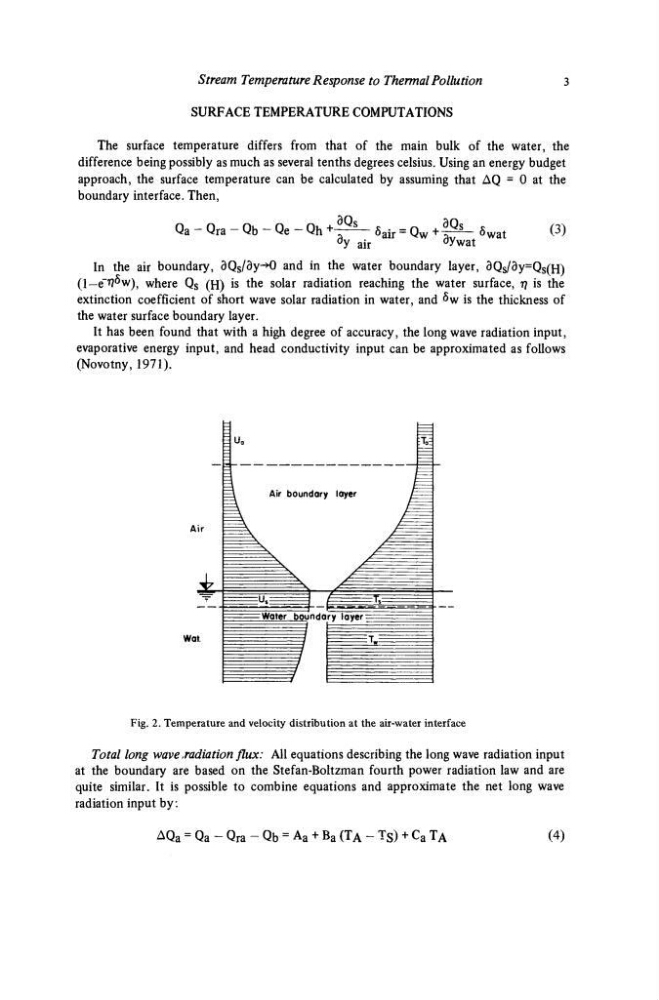
In the air boundary, bQ s /by^O and in the water boundary layer, 3Qs/dy
= Qs(H)
( l - e ' ^ w ) , where Q s (H) is the solar radiation reaching the water surface, η is the
extinction coefficient of short wave solar radiation in water, and ^w is the thickness of
the water surface boundary layer.
It has been found that with a high degree of accuracy, the long wave radiation input,
evaporative energy input, and head conductivity input can be approximated as follows
(Novotny, 1971).
Wat.
Fig. 2. Temperature and velocity distribution at the air-water interface
Total long wave radiation flux: All equations describing the long wave radiation input
at the boundary are based on the Stefan-Boltzman fourth power radiation law and are
quite similar. It is possible to combine equations and approximate the net long wave
radiation input by:
AQ a = Q a - Q r a - Q b = Aa + B a ( T A - T s ) + C a TA
(4)
3
SURFACE TEMPERATURE COMPUTATIONS
The surface temperature differs from that of the main bulk of the water, the
difference being possibly as much as several tenths degrees celsius. Using an energy budget
approach, the surface temperature can be calculated by assuming that AQ = 0 at the
boundary interface. Then,
Qa - Qra - Qb - Qe - Qh +
3Qs
J
y air
3 air = Q, w + a ^ t
6 w a t
(3)
In the air boundary, bQ s /by^O and in the water boundary layer, 3Qs/dy
= Qs(H)
( l - e ' ^ w ) , where Q s (H) is the solar radiation reaching the water surface, η is the
extinction coefficient of short wave solar radiation in water, and ^w is the thickness of
the water surface boundary layer.
It has been found that with a high degree of accuracy, the long wave radiation input,
evaporative energy input, and head conductivity input can be approximated as follows
(Novotny, 1971).
Wat.
Fig. 2. Temperature and velocity distribution at the air-water interface
Total long wave radiation flux: All equations describing the long wave radiation input
at the boundary are based on the Stefan-Boltzman fourth power radiation law and are
quite similar. It is possible to combine equations and approximate the net long wave
radiation input by:
AQ a = Q a - Q r a - Q b = Aa + B a ( T A - T s ) + C a TA
(4)