

2
V. Novotny and P.A. Krenkel
where D L is longitudinal mixing coefficient, H is the depth of the flow, a is a surface
renewal coefficient, U is the velocity of flow, T is the bulk temperature, T s is the surface
temperature, Q s is the short wave radiation input, p w is the density of water, Cp is the
heat capacity at constant pressure, t represents time, and x is distance.
Equation (1) is based on the assumption that energy inputs at the air-water interface
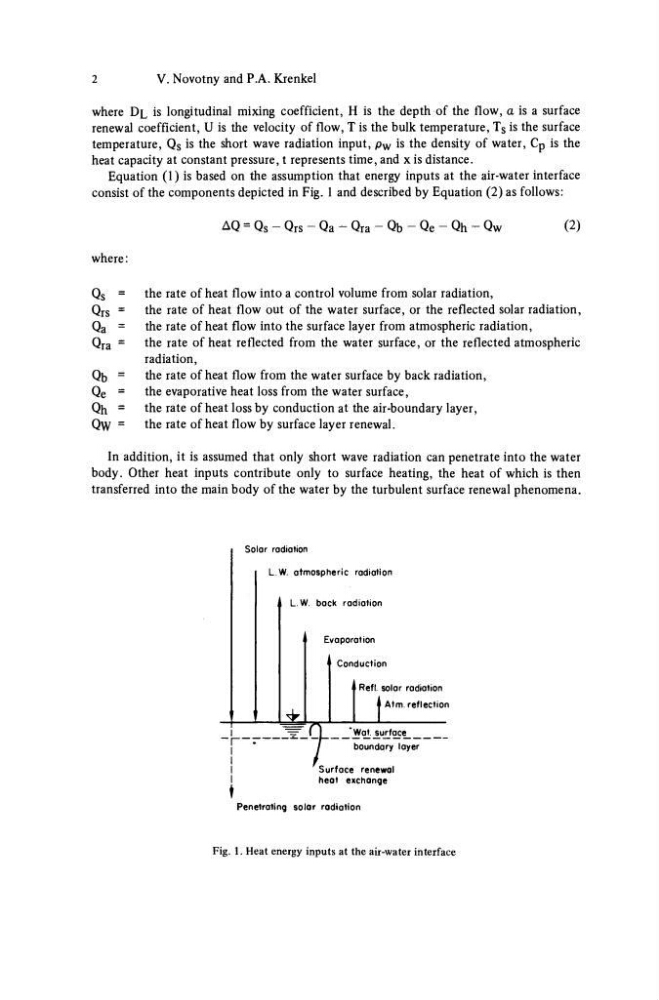
consist of the components depicted in Fig. 1 and described by Equation (2) as follows:
Δ0 = Q s - Q rs - Qa ~ Qra - Qb - Qe - Qh - Q w
(2)
where:
Qs
Qrs
Qa
Qra
Qb
Qe
Qh
Qw
the rate of heat flow into a control volume from solar radiation,
the rate of heat flow out of the water surface, or the reflected solar radiation,
the rate of heat flow into the surface layer from atmospheric radiation,
the rate of heat reflected from the water surface, or the reflected atmospheric
radiation,
the rate of heat flow from the water surface by back radiation,
the evaporative heat loss from the water surface,
the rate of heat loss by conduction at the air-boundary layer,
the rate of heat flow by surface layer renewal.
In addition, it is assumed that only short wave radiation can penetrate into the water
body. Other heat inputs contribute only to surface heating, the heat of which is then
transferred into the main body of the water by the turbulent surface renewal phenomena.
Solar radiation
L.W. atmospheric radiation
1 L.W. back radiation
Evaporation
k Conduction
i±l
Ί
| Refl. solar radiation
4 Atm. reflection
Wat. surface
boundary layer
Surface renewal
heat exchange
Penetrating solar radiation
Fig. 1. Heat energy inputs at the air-water interface
V. Novotny and P.A. Krenkel
where D L is longitudinal mixing coefficient, H is the depth of the flow, a is a surface
renewal coefficient, U is the velocity of flow, T is the bulk temperature, T s is the surface
temperature, Q s is the short wave radiation input, p w is the density of water, Cp is the
heat capacity at constant pressure, t represents time, and x is distance.
Equation (1) is based on the assumption that energy inputs at the air-water interface
consist of the components depicted in Fig. 1 and described by Equation (2) as follows:
Δ0 = Q s - Q rs - Qa ~ Qra - Qb - Qe - Qh - Q w
(2)
where:
Qs
Qrs
Qa
Qra
Qb
Qe
Qh
Qw
the rate of heat flow into a control volume from solar radiation,
the rate of heat flow out of the water surface, or the reflected solar radiation,
the rate of heat flow into the surface layer from atmospheric radiation,
the rate of heat reflected from the water surface, or the reflected atmospheric
radiation,
the rate of heat flow from the water surface by back radiation,
the evaporative heat loss from the water surface,
the rate of heat loss by conduction at the air-boundary layer,
the rate of heat flow by surface layer renewal.
In addition, it is assumed that only short wave radiation can penetrate into the water
body. Other heat inputs contribute only to surface heating, the heat of which is then
transferred into the main body of the water by the turbulent surface renewal phenomena.
Solar radiation
L.W. atmospheric radiation
1 L.W. back radiation
Evaporation
k Conduction
i±l
Ί
| Refl. solar radiation
4 Atm. reflection
Wat. surface
boundary layer
Surface renewal
heat exchange
Penetrating solar radiation
Fig. 1. Heat energy inputs at the air-water interface