

128
Discussion
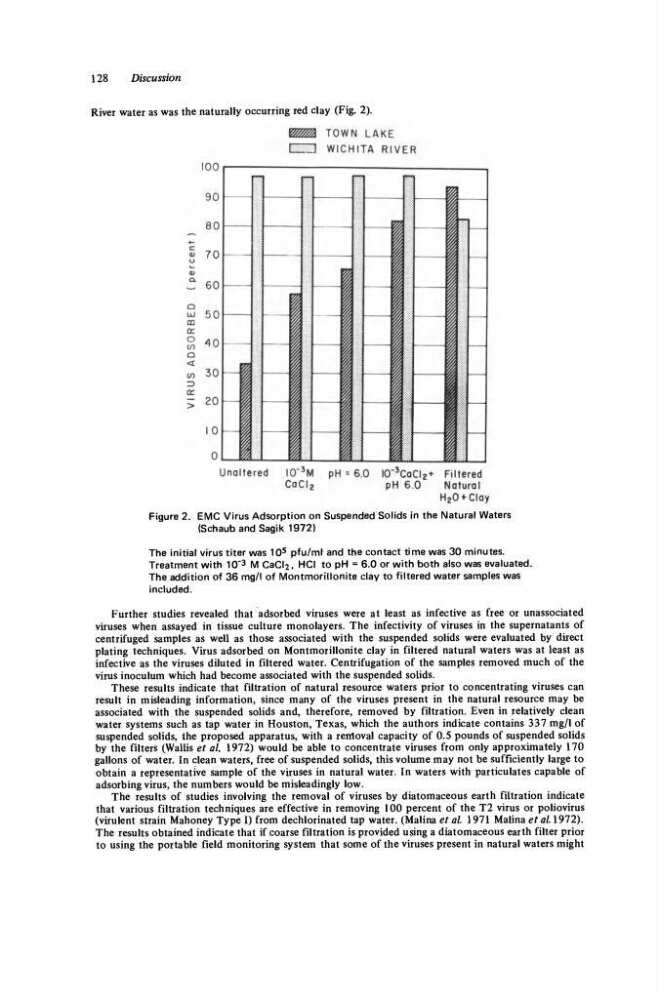
River water as was the naturally occurring red clay (Fig. 2).
WM
TOWN LAKE
E l l ] WICHITA RIVER
100 r
Unaltered
I0'
3 M pH = 6.0 IO"
3
CaCI 2 ^ Filtered
CaCI 2
PH 6.0
Natural
H 2 0*Clay
Figure 2. EMC Virus Adsorption on Suspended Solids in the Natural Waters
(Schaub and Sagik 1972)
The initial virus titer was 10
5 pfu/ml and the contact time was 30 minutes.
Treatment with 10"
3 M CaCI 2 , HCI to pH = 6.0 or with both also was evaluated.
The addition of 36 mg/l of Montmorillonite clay to filtered water samples was
included.
Further studies revealed that adsorbed viruses were at least as infective as free or unassociated
viruses when assayed in tissue culture monolayers. The infectivity of viruses in the supernatants of
centrifuged samples as well as those associated with the suspended solids were evaluated by direct
plating techniques. Virus adsorbed on Montmorillonite clay in filtered natural waters was at least as
infective as the viruses diluted in filtered water. Centrifugation of the samples removed much of the
virus inoculum which had become associated with the suspended solids.
These results indicate that filtration of natural resource waters prior to concentrating viruses can
result in misleading information, since many of the viruses present in the natural resource may be
associated with the suspended solids and, therefore, removed by filtration. Even in relatively clean
water systems such as tap water in Houston, Texas, which the authors indicate contains 337 mg/1 of
suspended solids, the proposed apparatus, with a removal capacity of 0.5 pounds of suspended solids
by the filters (Wallis et ah 1972) would be able to concentrate viruses from only approximately 170
gallons of water. In clean waters, free of suspended solids, this volume may not be sufficiently large to
obtain a representative sample of the viruses in natural water. In waters with particulates capable of
adsorbing virus, the numbers would be misleadingly low.
The results of studies involving the removal of viruses by diatomaceous earth filtration indicate
that various filtration techniques are effective in removing 100 percent of the T2 virus or poliovirus
(virulent strain Mahoney Type I) from dechlorinated tap water. (Malina et al 1971 Malina et al 1972).
The results obtained indicate that if coarse filtration is provided using a diatomaceous earth filter prior
to using the portable field monitoring system that some of the viruses present in natural waters might
Discussion
River water as was the naturally occurring red clay (Fig. 2).
WM
TOWN LAKE
E l l ] WICHITA RIVER
100 r
Unaltered
I0'
3 M pH = 6.0 IO"
3
CaCI 2 ^ Filtered
CaCI 2
PH 6.0
Natural
H 2 0*Clay
Figure 2. EMC Virus Adsorption on Suspended Solids in the Natural Waters
(Schaub and Sagik 1972)
The initial virus titer was 10
5 pfu/ml and the contact time was 30 minutes.
Treatment with 10"
3 M CaCI 2 , HCI to pH = 6.0 or with both also was evaluated.
The addition of 36 mg/l of Montmorillonite clay to filtered water samples was
included.
Further studies revealed that adsorbed viruses were at least as infective as free or unassociated
viruses when assayed in tissue culture monolayers. The infectivity of viruses in the supernatants of
centrifuged samples as well as those associated with the suspended solids were evaluated by direct
plating techniques. Virus adsorbed on Montmorillonite clay in filtered natural waters was at least as
infective as the viruses diluted in filtered water. Centrifugation of the samples removed much of the
virus inoculum which had become associated with the suspended solids.
These results indicate that filtration of natural resource waters prior to concentrating viruses can
result in misleading information, since many of the viruses present in the natural resource may be
associated with the suspended solids and, therefore, removed by filtration. Even in relatively clean
water systems such as tap water in Houston, Texas, which the authors indicate contains 337 mg/1 of
suspended solids, the proposed apparatus, with a removal capacity of 0.5 pounds of suspended solids
by the filters (Wallis et ah 1972) would be able to concentrate viruses from only approximately 170
gallons of water. In clean waters, free of suspended solids, this volume may not be sufficiently large to
obtain a representative sample of the viruses in natural water. In waters with particulates capable of
adsorbing virus, the numbers would be misleadingly low.
The results of studies involving the removal of viruses by diatomaceous earth filtration indicate
that various filtration techniques are effective in removing 100 percent of the T2 virus or poliovirus
(virulent strain Mahoney Type I) from dechlorinated tap water. (Malina et al 1971 Malina et al 1972).
The results obtained indicate that if coarse filtration is provided using a diatomaceous earth filter prior
to using the portable field monitoring system that some of the viruses present in natural waters might