

Discussions by Josephy F. Malina, Jr., P.E., Bernard P. Sagik
Stephen A. Schaub, Charles A. Sorber
The efficiency of the system described is dependent upon relatively clean waters free of suspended
solids. It would not provide an effective means of concentrating or enumerating the enteric viruses
present in natural water containing suspended solids. Sufficient data are available to suggest that
viruses become attached to or adsorbed by the organic and inorganic suspended solids found in natural
waters.
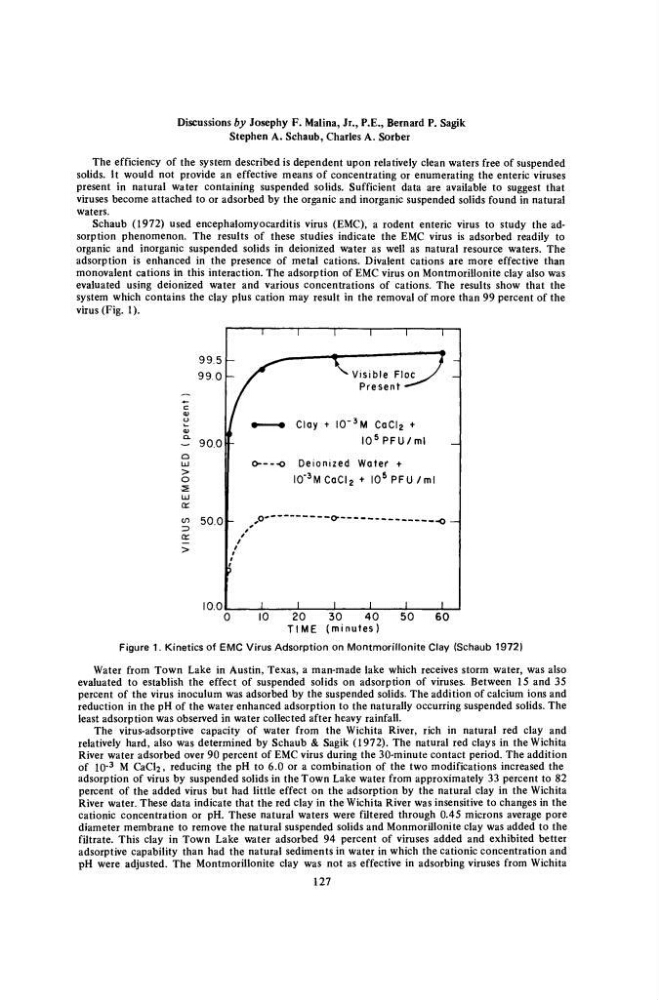
Schaub (1972) used encephalomyocarditis virus (EMC), a rodent enteric virus to study the adsorption phenomenon. The results of these studies indicate the EMC virus is adsorbed readily to
organic and inorganic suspended solids in deionized water as well as natural resource waters. The
adsorption is enhanced in the presence of metal cations. Divalent cations are more effective than
monovalent cations in this interaction. The adsorption of EMC virus on Montmorillonite clay also was
evaluated using deionized water and various concentrations of cations. The results show that the
system which contains the clay plus cation may result in the removal of more than 99 percent of the
virus (Fig. 1).
>
o
1x1
or
cr
99.5
99.0
90.0
50.0
10.0
"T
L
f
f
/ _
©-*
/
/
/
ι
1
?
1
*
--o
1
1
Ί
1
1 1
-
+
^ V i s i b l e F l o e /
J
Present ~*^^
Clay t I0
_ 3 M CaCI 2 +
l0
5 PFU/ml
J
Deionized Water +
IO'
3 MCaCI 2 + 10
s PFU/ml
.1
i
L
J
I 1
10
20
30
40
TIME (minutes)
50
60
Figure 1. Kinetics of EMC Virus Adsorption on Montmorillonite Clay (Schaub 1972)
Water from Town Lake in Austin, Texas, a man-made lake which receives storm water, was also
evaluated to establish the effect of suspended solids on adsorption of viruses. Between 15 and 35
percent of the virus inoculum was adsorbed by the suspended solids. The addition of calcium ions and
reduction in the pH of the water enhanced adsorption to the naturally occurring suspended solids. The
least adsorption was observed in water collected after heavy rainfall.
The virus-adsorptive capacity of water from the Wichita River, rich in natural red clay and
relatively hard, also was determined by Schaub & Sagik (1972). The natural red clays in the Wichita
River water adsorbed over 90 percent of EMC virus during the 30-minute contact period. The addition
of 10"
3 M CaCl2, reducing the pH to 6.0 or a combination of the two modifications increased the
adsorption of virus by suspended solids in the Town Lake water from approximately 33 percent to 82
percent of the added virus but had little effect on the adsorption by the natural clay in the Wichita
River water. These data indicate that the red clay in the Wichita River was insensitive to changes in the
cationic concentration or pH. These natural waters were filtered through 0.45 microns average pore
diameter membrane to remove the natural suspended solids and Monmorillonite clay was added to the
filtrate. This clay in Town Lake water adsorbed 94 percent of viruses added and exhibited better
adsorptive capability than had the natural sediments in water in which the cationic concentration and
pH were adjusted. The Montmorillonite clay was not as effective in adsorbing viruses from Wichita
127
Stephen A. Schaub, Charles A. Sorber
The efficiency of the system described is dependent upon relatively clean waters free of suspended
solids. It would not provide an effective means of concentrating or enumerating the enteric viruses
present in natural water containing suspended solids. Sufficient data are available to suggest that
viruses become attached to or adsorbed by the organic and inorganic suspended solids found in natural
waters.
Schaub (1972) used encephalomyocarditis virus (EMC), a rodent enteric virus to study the adsorption phenomenon. The results of these studies indicate the EMC virus is adsorbed readily to
organic and inorganic suspended solids in deionized water as well as natural resource waters. The
adsorption is enhanced in the presence of metal cations. Divalent cations are more effective than
monovalent cations in this interaction. The adsorption of EMC virus on Montmorillonite clay also was
evaluated using deionized water and various concentrations of cations. The results show that the
system which contains the clay plus cation may result in the removal of more than 99 percent of the
virus (Fig. 1).
>
o
1x1
or
cr
99.5
99.0
90.0
50.0
10.0
"T
L
f
f
/ _
©-*
/
/
/
ι
1
?
1
*
--o
1
1
Ί
1
1 1
-
+
^ V i s i b l e F l o e /
J
Present ~*^^
Clay t I0
_ 3 M CaCI 2 +
l0
5 PFU/ml
J
Deionized Water +
IO'
3 MCaCI 2 + 10
s PFU/ml
.1
i
L
J
I 1
10
20
30
40
TIME (minutes)
50
60
Figure 1. Kinetics of EMC Virus Adsorption on Montmorillonite Clay (Schaub 1972)
Water from Town Lake in Austin, Texas, a man-made lake which receives storm water, was also
evaluated to establish the effect of suspended solids on adsorption of viruses. Between 15 and 35
percent of the virus inoculum was adsorbed by the suspended solids. The addition of calcium ions and
reduction in the pH of the water enhanced adsorption to the naturally occurring suspended solids. The
least adsorption was observed in water collected after heavy rainfall.
The virus-adsorptive capacity of water from the Wichita River, rich in natural red clay and
relatively hard, also was determined by Schaub & Sagik (1972). The natural red clays in the Wichita
River water adsorbed over 90 percent of EMC virus during the 30-minute contact period. The addition
of 10"
3 M CaCl2, reducing the pH to 6.0 or a combination of the two modifications increased the
adsorption of virus by suspended solids in the Town Lake water from approximately 33 percent to 82
percent of the added virus but had little effect on the adsorption by the natural clay in the Wichita
River water. These data indicate that the red clay in the Wichita River was insensitive to changes in the
cationic concentration or pH. These natural waters were filtered through 0.45 microns average pore
diameter membrane to remove the natural suspended solids and Monmorillonite clay was added to the
filtrate. This clay in Town Lake water adsorbed 94 percent of viruses added and exhibited better
adsorptive capability than had the natural sediments in water in which the cationic concentration and
pH were adjusted. The Montmorillonite clay was not as effective in adsorbing viruses from Wichita
127