

Discussion
129
be removed by adsorption to diatomaceous earth and lead to erroneous conclusions.
The application of the insoluble polyelectrolyte PE 60 technique for concentrating viruses has been
shown to be sensitive to pH, type of water system used and virus. With minor modification of the
technique orginally reported by (Wallis et al 1969), this methodology has been used effectively in
monitoring low levels of coliphage and poliovirus in natural waters (Sorber et al 1971). This method
also has been used in combination with other techniques to recover quantitatively encephalomyocarditis virus from polluted waters. (Schaub & Sagik 1972). These studies do not confirm the reports
by (Wallis et al. 1969) that one can expect one hundred percent viral recovery over a broad pH range.
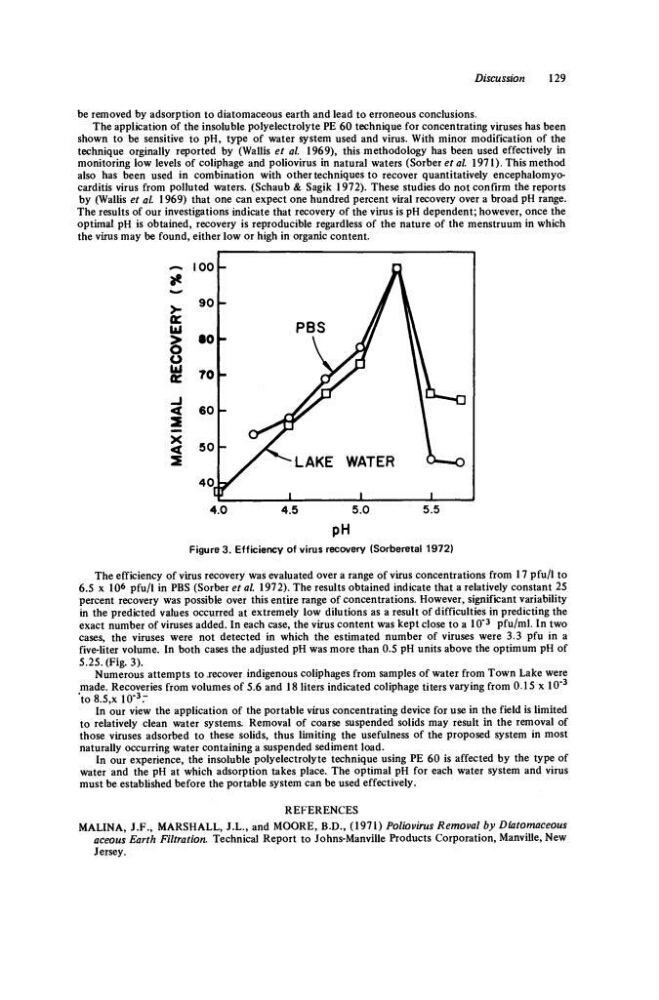
The results of our investigations indicate that recovery of the virus is pH dependent; however, once the
optimal pH is obtained, recovery is reproducible regardless of the nature of the menstruum in which
the virus may be found, either low or high in organic content.
>fit
UJ
s
o
<
X
<
pH
Figure 3. Efficiency of virus recovery (Sorberetal 1972)
The efficiency of virus recovery was evaluated over a range of virus concentrations from 17 pfu/1 to
6.5 x 10
6 pfu/1 in PBS (Sorber et al 1972). The results obtained indicate that a relatively constant 25
percent recovery was possible over this entire range of concentrations. However, significant variability
in the predicted values occurred at extremely low dilutions as a result of difficulties in predicting the
exact number of viruses added. In each case, the virus content was kept close to a 10"
3 pfu/ml. In two
cases, the viruses were not detected in which the estimated number of viruses were 3.3 pfu in a
five-liter volume. In both cases the adjusted pH was more than 0.5 pH units above the optimum pH of
5.25. (Fig. 3).
Numerous attempts to .recover indigenous coliphages from samples of water from Town Lake were
made. Recoveries from volumes of 5.6 and 18 liters indicated coliphage titers varying from 0.15 x 10"
3
'to 8.5,x 10"
3 r
In our view the application of the portable virus concentrating device for use in the field is limited
to relatively clean water systems. Removal of coarse suspended solids may result in the removal of
those viruses adsorbed to these solids, thus limiting the usefulness of the proposed system in most
naturally occurring water containing a suspended sediment load.
In our experience, the insoluble polyelectrolyte technique using PE 60 is affected by the type of
water and the pH at which adsorption takes place. The optimal pH for each water system and virus
must be established before the portable system can be used effectively.
REFERENCES
MALINA, J.F., MARSHALL, J.L., and MOORE, B.D., (1971) Poliovirus Removal by Diatomaceous
aceous Earth Filtration. Technical Report to Johns-Manville Products Corporation, Manville, New
Jersey.
129
be removed by adsorption to diatomaceous earth and lead to erroneous conclusions.
The application of the insoluble polyelectrolyte PE 60 technique for concentrating viruses has been
shown to be sensitive to pH, type of water system used and virus. With minor modification of the
technique orginally reported by (Wallis et al 1969), this methodology has been used effectively in
monitoring low levels of coliphage and poliovirus in natural waters (Sorber et al 1971). This method
also has been used in combination with other techniques to recover quantitatively encephalomyocarditis virus from polluted waters. (Schaub & Sagik 1972). These studies do not confirm the reports
by (Wallis et al. 1969) that one can expect one hundred percent viral recovery over a broad pH range.
The results of our investigations indicate that recovery of the virus is pH dependent; however, once the
optimal pH is obtained, recovery is reproducible regardless of the nature of the menstruum in which
the virus may be found, either low or high in organic content.
>fit
UJ
s
o
<
X
<
pH
Figure 3. Efficiency of virus recovery (Sorberetal 1972)
The efficiency of virus recovery was evaluated over a range of virus concentrations from 17 pfu/1 to
6.5 x 10
6 pfu/1 in PBS (Sorber et al 1972). The results obtained indicate that a relatively constant 25
percent recovery was possible over this entire range of concentrations. However, significant variability
in the predicted values occurred at extremely low dilutions as a result of difficulties in predicting the
exact number of viruses added. In each case, the virus content was kept close to a 10"
3 pfu/ml. In two
cases, the viruses were not detected in which the estimated number of viruses were 3.3 pfu in a
five-liter volume. In both cases the adjusted pH was more than 0.5 pH units above the optimum pH of
5.25. (Fig. 3).
Numerous attempts to .recover indigenous coliphages from samples of water from Town Lake were
made. Recoveries from volumes of 5.6 and 18 liters indicated coliphage titers varying from 0.15 x 10"
3
'to 8.5,x 10"
3 r
In our view the application of the portable virus concentrating device for use in the field is limited
to relatively clean water systems. Removal of coarse suspended solids may result in the removal of
those viruses adsorbed to these solids, thus limiting the usefulness of the proposed system in most
naturally occurring water containing a suspended sediment load.
In our experience, the insoluble polyelectrolyte technique using PE 60 is affected by the type of
water and the pH at which adsorption takes place. The optimal pH for each water system and virus
must be established before the portable system can be used effectively.
REFERENCES
MALINA, J.F., MARSHALL, J.L., and MOORE, B.D., (1971) Poliovirus Removal by Diatomaceous
aceous Earth Filtration. Technical Report to Johns-Manville Products Corporation, Manville, New
Jersey.