

water convection and cascading recorded in the western MS between
2005 and 2013 (Houpert, 2013; Puig et al., 2013; Schroeder et al.,
2008) could have influenced C
ant
concentrations in the AB during the
SOMBA cruise. The inflowing Atlantic waters may also be a potential
source of C
ant
in the AB (Huertas et al., 2009).
The vertical distribution of AOU (Fig. 8c) shows that the mesoscale
structures observed during the SOMBA cruise are characterized by less
oxygenated waters and lower C
ant
concentrations. This is probably
caused by anticyclonic eddies that trap older intermediate waters and
entrain them to depth. According to Moutin and Prieur (2012), these
structures function as closed systems and their vortex barrier prevents
large-scale mixing, water advection, and renewal through deep-water
formation. Nevertheless, an anomaly with high C
ant
concentrations can
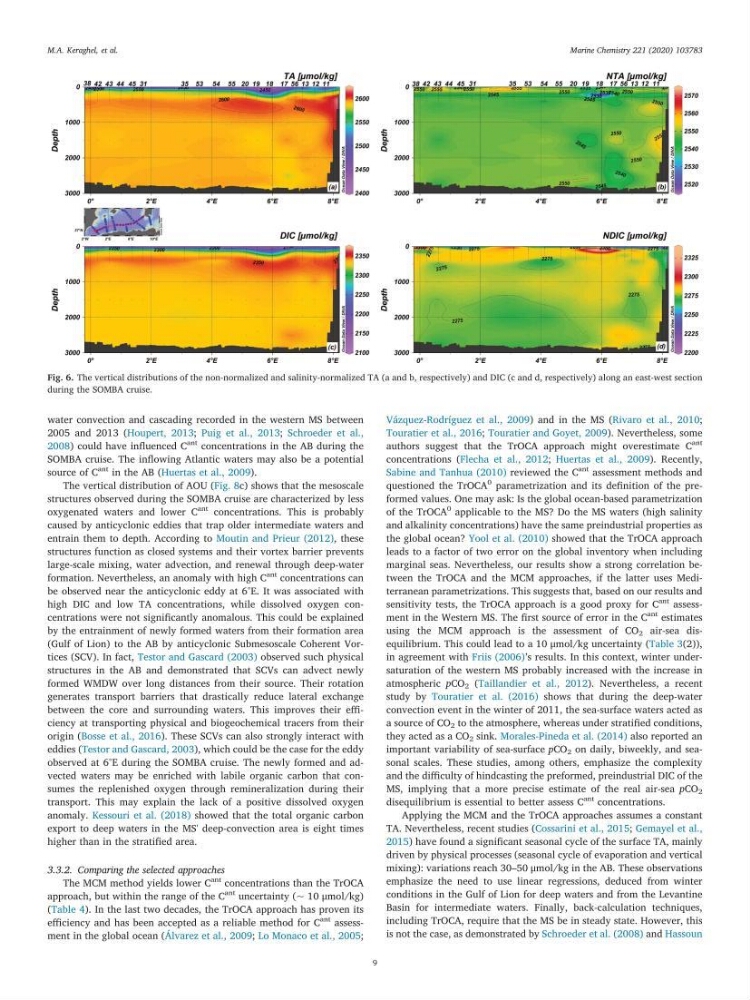
be observed near the anticyclonic eddy at 6°E. It was associated with
high DIC and low TA concentrations, while dissolved oxygen concentrations were not significantly anomalous. This could be explained
by the entrainment of newly formed waters from their formation area
(Gulf of Lion) to the AB by anticyclonic Submesoscale Coherent Vortices (SCV). In fact, Testor and Gascard (2003) observed such physical
structures in the AB and demonstrated that SCVs can advect newly
formed WMDW over long distances from their source. Their rotation
generates transport barriers that drastically reduce lateral exchange
between the core and surrounding waters. This improves their efficiency at transporting physical and biogeochemical tracers from their
origin (Bosse et al., 2016). These SCVs can also strongly interact with
eddies (Testor and Gascard, 2003), which could be the case for the eddy
observed at 6°E during the SOMBA cruise. The newly formed and advected waters may be enriched with labile organic carbon that consumes the replenished oxygen through remineralization during their
transport. This may explain the lack of a positive dissolved oxygen
anomaly. Kessouri et al. (2018) showed that the total organic carbon
export to deep waters in the MS' deep-convection area is eight times
higher than in the stratified area.
3.3.2. Comparing the selected approaches
The MCM method yields lower C
ant
concentrations than the TrOCA
approach, but within the range of the C
ant
uncertainty (~ 10 μmol/kg)
(Table 4). In the last two decades, the TrOCA approach has proven its
efficiency and has been accepted as a reliable method for C
ant
assessment in the global ocean (Álvarez et al., 2009; Lo Monaco et al., 2005;
Vázquez-Rodríguez et al., 2009) and in the MS (Rivaro et al., 2010;
Touratier et al., 2016; Touratier and Goyet, 2009). Nevertheless, some
authors suggest that the TrOCA approach might overestimate C
ant
concentrations (Flecha et al., 2012; Huertas et al., 2009). Recently,
Sabine and Tanhua (2010) reviewed the C
ant
assessment methods and
questioned the TrOCA
0
parametrization and its definition of the preformed values. One may ask: Is the global ocean-based parametrization
of the TrOCA
0
applicable to the MS? Do the MS waters (high salinity
and alkalinity concentrations) have the same preindustrial properties as
the global ocean? Yool et al. (2010) showed that the TrOCA approach
leads to a factor of two error on the global inventory when including
marginal seas. Nevertheless, our results show a strong correlation between the TrOCA and the MCM approaches, if the latter uses Mediterranean parametrizations. This suggests that, based on our results and
sensitivity tests, the TrOCA approach is a good proxy for C
ant
assessment in the Western MS. The first source of error in the C
ant
estimates
using the MCM approach is the assessment of CO 2 air-sea disequilibrium. This could lead to a 10 μmol/kg uncertainty (Table 3(2)),
in agreement with Friis (2006)’s results. In this context, winter undersaturation of the western MS probably increased with the increase in
atmospheric pCO 2 (Taillandier et al., 2012). Nevertheless, a recent
study by Touratier et al. (2016) shows that during the deep-water
convection event in the winter of 2011, the sea-surface waters acted as
a source of CO 2 to the atmosphere, whereas under stratified conditions,
they acted as a CO 2 sink. Morales-Pineda et al. (2014) also reported an
important variability of sea-surface pCO 2 on daily, biweekly, and seasonal scales. These studies, among others, emphasize the complexity
and the difficulty of hindcasting the preformed, preindustrial DIC of the
MS, implying that a more precise estimate of the real air-sea pCO 2
disequilibrium is essential to better assess C
ant
concentrations.
Applying the MCM and the TrOCA approaches assumes a constant
TA. Nevertheless, recent studies (Cossarini et al., 2015; Gemayel et al.,
2015) have found a significant seasonal cycle of the surface TA, mainly
driven by physical processes (seasonal cycle of evaporation and vertical
mixing): variations reach 30–50 μmol/kg in the AB. These observations
emphasize the need to use linear regressions, deduced from winter
conditions in the Gulf of Lion for deep waters and from the Levantine
Basin for intermediate waters. Finally, back-calculation techniques,
including TrOCA, require that the MS be in steady state. However, this
is not the case, as demonstrated by Schroeder et al. (2008) and Hassoun
Fig. 6. The vertical distributions of the non-normalized and salinity-normalized TA (a and b, respectively) and DIC (c and d, respectively) along an east-west section
during the SOMBA cruise.
M.A. Keraghel, et al.
Marine Chemistry 221 (2020) 103783
9
2005 and 2013 (Houpert, 2013; Puig et al., 2013; Schroeder et al.,
2008) could have influenced C
ant
concentrations in the AB during the
SOMBA cruise. The inflowing Atlantic waters may also be a potential
source of C
ant
in the AB (Huertas et al., 2009).
The vertical distribution of AOU (Fig. 8c) shows that the mesoscale
structures observed during the SOMBA cruise are characterized by less
oxygenated waters and lower C
ant
concentrations. This is probably
caused by anticyclonic eddies that trap older intermediate waters and
entrain them to depth. According to Moutin and Prieur (2012), these
structures function as closed systems and their vortex barrier prevents
large-scale mixing, water advection, and renewal through deep-water
formation. Nevertheless, an anomaly with high C
ant
concentrations can
be observed near the anticyclonic eddy at 6°E. It was associated with
high DIC and low TA concentrations, while dissolved oxygen concentrations were not significantly anomalous. This could be explained
by the entrainment of newly formed waters from their formation area
(Gulf of Lion) to the AB by anticyclonic Submesoscale Coherent Vortices (SCV). In fact, Testor and Gascard (2003) observed such physical
structures in the AB and demonstrated that SCVs can advect newly
formed WMDW over long distances from their source. Their rotation
generates transport barriers that drastically reduce lateral exchange
between the core and surrounding waters. This improves their efficiency at transporting physical and biogeochemical tracers from their
origin (Bosse et al., 2016). These SCVs can also strongly interact with
eddies (Testor and Gascard, 2003), which could be the case for the eddy
observed at 6°E during the SOMBA cruise. The newly formed and advected waters may be enriched with labile organic carbon that consumes the replenished oxygen through remineralization during their
transport. This may explain the lack of a positive dissolved oxygen
anomaly. Kessouri et al. (2018) showed that the total organic carbon
export to deep waters in the MS' deep-convection area is eight times
higher than in the stratified area.
3.3.2. Comparing the selected approaches
The MCM method yields lower C
ant
concentrations than the TrOCA
approach, but within the range of the C
ant
uncertainty (~ 10 μmol/kg)
(Table 4). In the last two decades, the TrOCA approach has proven its
efficiency and has been accepted as a reliable method for C
ant
assessment in the global ocean (Álvarez et al., 2009; Lo Monaco et al., 2005;
Vázquez-Rodríguez et al., 2009) and in the MS (Rivaro et al., 2010;
Touratier et al., 2016; Touratier and Goyet, 2009). Nevertheless, some
authors suggest that the TrOCA approach might overestimate C
ant
concentrations (Flecha et al., 2012; Huertas et al., 2009). Recently,
Sabine and Tanhua (2010) reviewed the C
ant
assessment methods and
questioned the TrOCA
0
parametrization and its definition of the preformed values. One may ask: Is the global ocean-based parametrization
of the TrOCA
0
applicable to the MS? Do the MS waters (high salinity
and alkalinity concentrations) have the same preindustrial properties as
the global ocean? Yool et al. (2010) showed that the TrOCA approach
leads to a factor of two error on the global inventory when including
marginal seas. Nevertheless, our results show a strong correlation between the TrOCA and the MCM approaches, if the latter uses Mediterranean parametrizations. This suggests that, based on our results and
sensitivity tests, the TrOCA approach is a good proxy for C
ant
assessment in the Western MS. The first source of error in the C
ant
estimates
using the MCM approach is the assessment of CO 2 air-sea disequilibrium. This could lead to a 10 μmol/kg uncertainty (Table 3(2)),
in agreement with Friis (2006)’s results. In this context, winter undersaturation of the western MS probably increased with the increase in
atmospheric pCO 2 (Taillandier et al., 2012). Nevertheless, a recent
study by Touratier et al. (2016) shows that during the deep-water
convection event in the winter of 2011, the sea-surface waters acted as
a source of CO 2 to the atmosphere, whereas under stratified conditions,
they acted as a CO 2 sink. Morales-Pineda et al. (2014) also reported an
important variability of sea-surface pCO 2 on daily, biweekly, and seasonal scales. These studies, among others, emphasize the complexity
and the difficulty of hindcasting the preformed, preindustrial DIC of the
MS, implying that a more precise estimate of the real air-sea pCO 2
disequilibrium is essential to better assess C
ant
concentrations.
Applying the MCM and the TrOCA approaches assumes a constant
TA. Nevertheless, recent studies (Cossarini et al., 2015; Gemayel et al.,
2015) have found a significant seasonal cycle of the surface TA, mainly
driven by physical processes (seasonal cycle of evaporation and vertical
mixing): variations reach 30–50 μmol/kg in the AB. These observations
emphasize the need to use linear regressions, deduced from winter
conditions in the Gulf of Lion for deep waters and from the Levantine
Basin for intermediate waters. Finally, back-calculation techniques,
including TrOCA, require that the MS be in steady state. However, this
is not the case, as demonstrated by Schroeder et al. (2008) and Hassoun
Fig. 6. The vertical distributions of the non-normalized and salinity-normalized TA (a and b, respectively) and DIC (c and d, respectively) along an east-west section
during the SOMBA cruise.
M.A. Keraghel, et al.
Marine Chemistry 221 (2020) 103783
9