

Thermal Time in Relation To Other Environmental Variables
33
dimensionless and represent the rate of development relative to the rate
under optimal conditions. If time is considered as advancing at the rate
of 1 pday per 0.74 day (or phour per hour) under optimum conditions
(calculated at 33" C from Fig. 2.7), then time advances under suboptimal
conditions at a rate less than 1.35 pdaylday (remember, pday is a physiological day). The summation of these, possibly suboptimal pdayslday
(as determined by temperature), is a direct measure of the accumulation of calendar time toward completion of a process. If maturity of
some organism requires 50 days under optimal conditions (50 pdays,
therefore), then, if the temperature is such that the organism accumulates
only 0.4 pdayslday (for example 18" C in Fig. 2.7), maturity will require
5010.4 = 125 calendar days. This normalization of thermal time so that
the response is dimensionless and ranges from 0 to 1 allows the generalization of the thermal time concept to other environmental variables.
This generalization can be an extremely powefil tool for modeling the
response of organisms to their environment.
2.11 Thermal Time in elation To Other
Environmental Variables
The development rate concept can be extended to other environmental
variables which alter the relationship between development and temperature. For example, the rate of completion of budburst in a number of
northern temperate tree species depends on winter chilling (Cannell and
Smith, 1983). Other examples are the vernalization requirement for reproductive growth of winter wheat (Porter, 1983; Weir et al., 1984) and
photoperiod requirements for development in many species. Temperature
and leaf wetness both affect the development of foliar diseases of plants,
so a thermal time modified by a leaf wetness factor determines the rate
of development.
To predict development when two or more environmental variables
affect development rate, we need to determine rate curves for each combination of conditions. This is sometimes quite simple. For example, in
the infection of a plant by organisms which can only grow when the leaf
surface is wet, development rate is zero when leaves are dry, and progresses at the temperature-determined rate when the leaf surface is wet.
For photoperiod and chill requirements, the calculations are somewhat
more involved, since the development rate is dependent on the chill or
photoperiod.
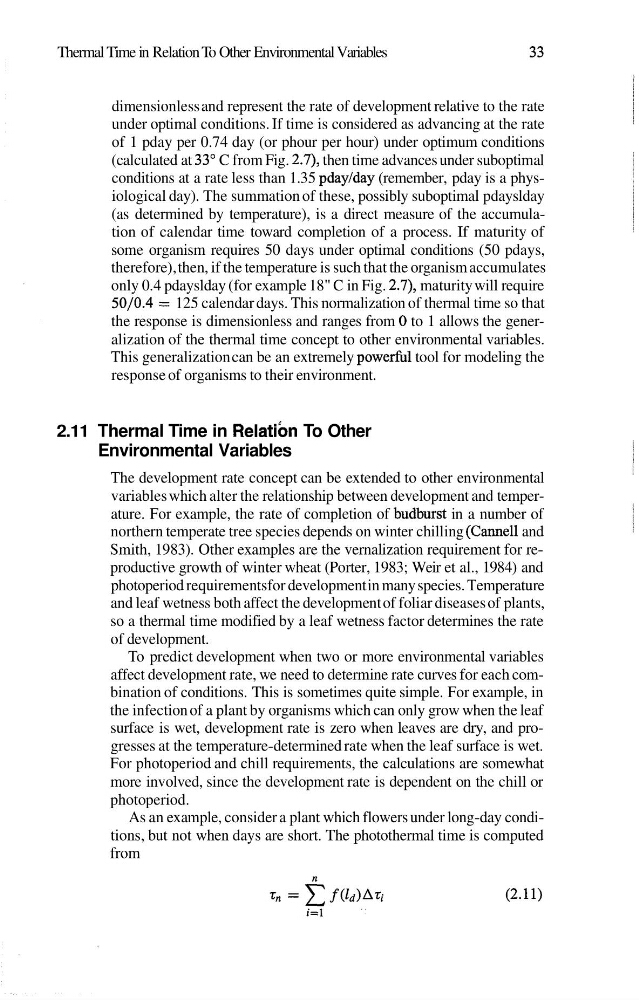
As an example, consider a plant which flowers under long-day conditions, but not when days are short. The photothermal time is computed
from
33
dimensionless and represent the rate of development relative to the rate
under optimal conditions. If time is considered as advancing at the rate
of 1 pday per 0.74 day (or phour per hour) under optimum conditions
(calculated at 33" C from Fig. 2.7), then time advances under suboptimal
conditions at a rate less than 1.35 pdaylday (remember, pday is a physiological day). The summation of these, possibly suboptimal pdayslday
(as determined by temperature), is a direct measure of the accumulation of calendar time toward completion of a process. If maturity of
some organism requires 50 days under optimal conditions (50 pdays,
therefore), then, if the temperature is such that the organism accumulates
only 0.4 pdayslday (for example 18" C in Fig. 2.7), maturity will require
5010.4 = 125 calendar days. This normalization of thermal time so that
the response is dimensionless and ranges from 0 to 1 allows the generalization of the thermal time concept to other environmental variables.
This generalization can be an extremely powefil tool for modeling the
response of organisms to their environment.
2.11 Thermal Time in elation To Other
Environmental Variables
The development rate concept can be extended to other environmental
variables which alter the relationship between development and temperature. For example, the rate of completion of budburst in a number of
northern temperate tree species depends on winter chilling (Cannell and
Smith, 1983). Other examples are the vernalization requirement for reproductive growth of winter wheat (Porter, 1983; Weir et al., 1984) and
photoperiod requirements for development in many species. Temperature
and leaf wetness both affect the development of foliar diseases of plants,
so a thermal time modified by a leaf wetness factor determines the rate
of development.
To predict development when two or more environmental variables
affect development rate, we need to determine rate curves for each combination of conditions. This is sometimes quite simple. For example, in
the infection of a plant by organisms which can only grow when the leaf
surface is wet, development rate is zero when leaves are dry, and progresses at the temperature-determined rate when the leaf surface is wet.
For photoperiod and chill requirements, the calculations are somewhat
more involved, since the development rate is dependent on the chill or
photoperiod.
As an example, consider a plant which flowers under long-day conditions, but not when days are short. The photothermal time is computed
from