

Temperature
2.9 Temperature Extremes and the
Computation of Thermal Time
Equation (2.9) uses the daily mean temperature to compute the thermal
time increment for a given day. The temperature during the diurnal cycle
has varied, however, and may have been outside the linear portion of the
temperature response function, even though the mean temperature for the
day was within that range. The correct estimate of thermal time would
be obtained by shortening At to one hour, and summing hour-degrees to
determine thermal time for the day. This is often done with insect models,
where development times are short and good precision is required. Even
when only daily maximum and minimum temperatures are known, the
hourly values can be estimated using the interpolation method discussed
earlier.
Another problem arises when temperatures are high. The computations of thermal time which have just been considered apply only for
temperatures below Tm, the temperature where the development rate is
maximum. At temperatures above Tm, Eq. (2.9) predicts that the development rate will continue to increase, while Fig. 2.7 shows that, in fact,
it decreases. Equation (2.6), however, is very general, and includes any
possible function of temperature. Therefore, a high temperature cutoff
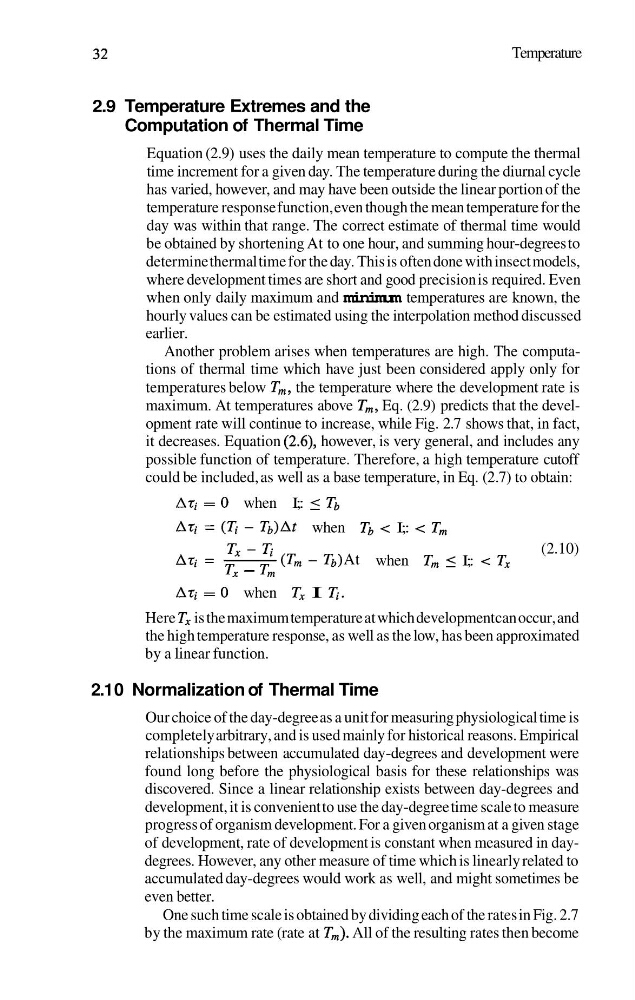
could be included, as well as a base temperature, in Eq. (2.7) to obtain:
Ati = 0 when I;: I Tb
Ati = ( Z - Tb)At when Tb < I;: < Tm
Tx - Ti
(2.10)
Ati = - (T, - Tb) At when Tm I I;: < Tx
Tx - T m
Ati = 0 when Tx I Z .
Here Tx is the maximum temperature at which development can occur, and
the high temperature response, as well as the low, has been approximated
by a linear function.
2.1 0 Normalization of Thermal Time
Our choice of the day-degree as a unit for measuring physiological time is
completely arbitrary, and is used mainly for historical reasons. Empirical
relationships between accumulated day-degrees and development were
found long before the physiological basis for these relationships was
discovered. Since a linear relationship exists between day-degrees and
development, it is convenient to use the day-degree time scale to measure
progress of organism development. For a given organism at a given stage
of development, rate of development is constant when measured in daydegrees. However, any other measure of time which is linearly related to
accumulated day-degrees would work as well, and might sometimes be
even better.
One such time scale is obtained by dividing each of the rates in Fig. 2.7
by the maximum rate (rate at T,). All of the resulting rates then become
2.9 Temperature Extremes and the
Computation of Thermal Time
Equation (2.9) uses the daily mean temperature to compute the thermal
time increment for a given day. The temperature during the diurnal cycle
has varied, however, and may have been outside the linear portion of the
temperature response function, even though the mean temperature for the
day was within that range. The correct estimate of thermal time would
be obtained by shortening At to one hour, and summing hour-degrees to
determine thermal time for the day. This is often done with insect models,
where development times are short and good precision is required. Even
when only daily maximum and minimum temperatures are known, the
hourly values can be estimated using the interpolation method discussed
earlier.
Another problem arises when temperatures are high. The computations of thermal time which have just been considered apply only for
temperatures below Tm, the temperature where the development rate is
maximum. At temperatures above Tm, Eq. (2.9) predicts that the development rate will continue to increase, while Fig. 2.7 shows that, in fact,
it decreases. Equation (2.6), however, is very general, and includes any
possible function of temperature. Therefore, a high temperature cutoff
could be included, as well as a base temperature, in Eq. (2.7) to obtain:
Ati = 0 when I;: I Tb
Ati = ( Z - Tb)At when Tb < I;: < Tm
Tx - Ti
(2.10)
Ati = - (T, - Tb) At when Tm I I;: < Tx
Tx - T m
Ati = 0 when Tx I Z .
Here Tx is the maximum temperature at which development can occur, and
the high temperature response, as well as the low, has been approximated
by a linear function.
2.1 0 Normalization of Thermal Time
Our choice of the day-degree as a unit for measuring physiological time is
completely arbitrary, and is used mainly for historical reasons. Empirical
relationships between accumulated day-degrees and development were
found long before the physiological basis for these relationships was
discovered. Since a linear relationship exists between day-degrees and
development, it is convenient to use the day-degree time scale to measure
progress of organism development. For a given organism at a given stage
of development, rate of development is constant when measured in daydegrees. However, any other measure of time which is linearly related to
accumulated day-degrees would work as well, and might sometimes be
even better.
One such time scale is obtained by dividing each of the rates in Fig. 2.7
by the maximum rate (rate at T,). All of the resulting rates then become