

Calculating Thermal Time from Weather Data
3 1
TABLE 2.1. Base temperature and thermal time requirement
for emergence of selected temperate and tropical crops (from
Angus et al. 1980).
Species Tb (C) day-deg
Species
Tb (C) day-deg
wheat
2.6
78
maize
9.8
61
barley
2.6
79
pearl
11.8
40
millet
oats
2.2
91
sorghum
10.6
48
field pea 1.4
110
peanut
13.3
76
lentil
1.4
90
cowpea
11.0
43
rape
2.6
79
pigeon pea 12.8
58
ists. This variability is very useful in fitting specific genotypes to specific
environments.
The thermal time concept has been useful in applications where one
wishes to predict harvest dates or emergence dates from planting dates, for
finding varieties (with known thermal time requirements) which are best
suited to a given climate, and for predicting disease or insect development.
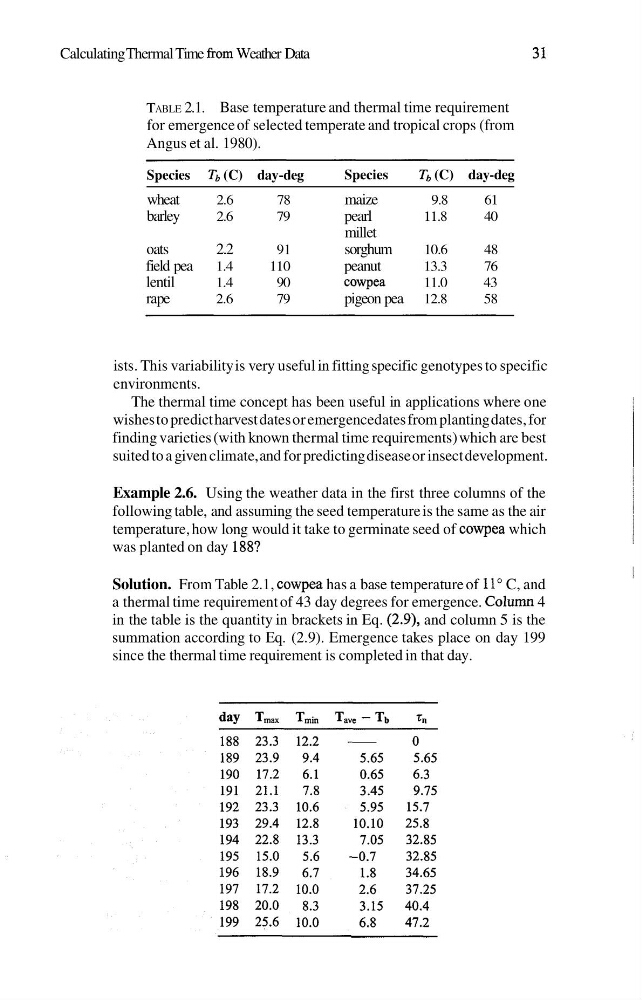
Example 2.6. Using the weather data in the first three columns of the
following table, and assuming the seed temperature is the same as the air
temperature, how long would it take to germinate seed of cowpea which
was planted on day 188?
Solution. From Table 2.1, cowpea has a base temperature of 1 lo C, and
a thermal time requirement of 43 day degrees for emergence. Column 4
in the table is the quantity in brackets in Eq. (2.9), and column 5 is the
summation according to Eq. (2.9). Emergence takes place on day 199
since the thermal time requirement is completed in that day.
3 1
TABLE 2.1. Base temperature and thermal time requirement
for emergence of selected temperate and tropical crops (from
Angus et al. 1980).
Species Tb (C) day-deg
Species
Tb (C) day-deg
wheat
2.6
78
maize
9.8
61
barley
2.6
79
pearl
11.8
40
millet
oats
2.2
91
sorghum
10.6
48
field pea 1.4
110
peanut
13.3
76
lentil
1.4
90
cowpea
11.0
43
rape
2.6
79
pigeon pea 12.8
58
ists. This variability is very useful in fitting specific genotypes to specific
environments.
The thermal time concept has been useful in applications where one
wishes to predict harvest dates or emergence dates from planting dates, for
finding varieties (with known thermal time requirements) which are best
suited to a given climate, and for predicting disease or insect development.
Example 2.6. Using the weather data in the first three columns of the
following table, and assuming the seed temperature is the same as the air
temperature, how long would it take to germinate seed of cowpea which
was planted on day 188?
Solution. From Table 2.1, cowpea has a base temperature of 1 lo C, and
a thermal time requirement of 43 day degrees for emergence. Column 4
in the table is the quantity in brackets in Eq. (2.9), and column 5 is the
summation according to Eq. (2.9). Emergence takes place on day 199
since the thermal time requirement is completed in that day.