

Temperature
table at z, = 17.0 day-degrees and find how many calendar days were
required to reach that value.
The term heat unit has been used in connection with the day-degree,
but this is clearly inappropriate. The unit has nothing to do with heat
or its accumulation, but defines a quantity which bears a simple linear
relationship to biological time.
2.8 Calculating Thermal Time from Weather Data
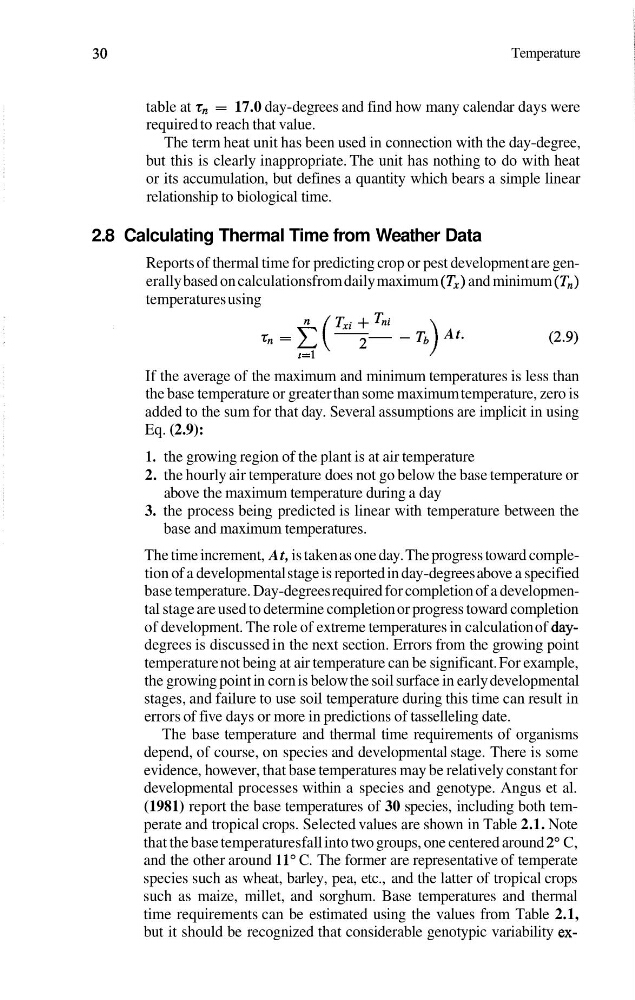
Reports of thermal time for predicting crop or pest development are generally based on calculations from daily maximum (T,) and minimum (T,)
temperatures using
h =
(Txi: Tni -Tb At.
)
If the average of the maximum and minimum temperatures is less than
the base temperature or greater than some maximum temperature, zero is
added to the sum for that day. Several assumptions are implicit in using
Eq. (2.9):
1. the growing region of the plant is at air temperature
2. the hourly air temperature does not go below the base temperature or
above the maximum temperature during a day
3. the process being predicted is linear with temperature between the
base and maximum temperatures.
The time increment, At, is taken as one day. The progress toward completion of a developmental stage is reported in day-degrees above a specified
base temperature. Day-degrees required for completion of a developmental stage are used to determine completion or progress toward completion
of development. The role of extreme temperatures in calculation of daydegrees is discussed in the next section. Errors from the growing point
temperature not being at air temperature can be significant. For example,
the growing point in corn is below the soil surface in early developmental
stages, and failure to use soil temperature during this time can result in
errors of five days or more in predictions of tasselleling date.
The base temperature and thermal time requirements of organisms
depend, of course, on species and developmental stage. There is some
evidence, however, that base temperatures may be relatively constant for
developmental processes within a species and genotype. Angus et al.
(1981) report the base temperatures of 30 species, including both temperate and tropical crops. Selected values are shown in Table 2.1. Note
that the base temperatures fall into two groups, one centered around 2" C,
and the other around 1 l o C. The former are representative of temperate
species such as wheat, barley, pea, etc., and the latter of tropical crops
such as maize, millet, and sorghum. Base temperatures and thermal
time requirements can be estimated using the values from Table 2.1,
but it should be recognized that considerable genotypic variability ex-
table at z, = 17.0 day-degrees and find how many calendar days were
required to reach that value.
The term heat unit has been used in connection with the day-degree,
but this is clearly inappropriate. The unit has nothing to do with heat
or its accumulation, but defines a quantity which bears a simple linear
relationship to biological time.
2.8 Calculating Thermal Time from Weather Data
Reports of thermal time for predicting crop or pest development are generally based on calculations from daily maximum (T,) and minimum (T,)
temperatures using
h =
(Txi: Tni -Tb At.
)
If the average of the maximum and minimum temperatures is less than
the base temperature or greater than some maximum temperature, zero is
added to the sum for that day. Several assumptions are implicit in using
Eq. (2.9):
1. the growing region of the plant is at air temperature
2. the hourly air temperature does not go below the base temperature or
above the maximum temperature during a day
3. the process being predicted is linear with temperature between the
base and maximum temperatures.
The time increment, At, is taken as one day. The progress toward completion of a developmental stage is reported in day-degrees above a specified
base temperature. Day-degrees required for completion of a developmental stage are used to determine completion or progress toward completion
of development. The role of extreme temperatures in calculation of daydegrees is discussed in the next section. Errors from the growing point
temperature not being at air temperature can be significant. For example,
the growing point in corn is below the soil surface in early developmental
stages, and failure to use soil temperature during this time can result in
errors of five days or more in predictions of tasselleling date.
The base temperature and thermal time requirements of organisms
depend, of course, on species and developmental stage. There is some
evidence, however, that base temperatures may be relatively constant for
developmental processes within a species and genotype. Angus et al.
(1981) report the base temperatures of 30 species, including both temperate and tropical crops. Selected values are shown in Table 2.1. Note
that the base temperatures fall into two groups, one centered around 2" C,
and the other around 1 l o C. The former are representative of temperate
species such as wheat, barley, pea, etc., and the latter of tropical crops
such as maize, millet, and sorghum. Base temperatures and thermal
time requirements can be estimated using the values from Table 2.1,
but it should be recognized that considerable genotypic variability ex-