

Detailed Models of Light Interception by Canopies
25 1
resulting canopy would have a spherical angle distribution. There would
be more vertical area than horizontal area, because more of the surface
area of a sphere is vertical than horizontal, but leaves of all inclinations
would be present in the canopy. A spherical angle distribution is a good
approximation to real plant canopies.
An extinction coefficient for a conical leaf distribution could also be
derived, but the most useful distribution is ellipsoidal. The ellipsoidal
distribution generalizes the spherical, but allows the sphere to be flattened
or elongated. The ratio of projected area to hemi-surface area for an
ellipsoid is (Campbell, 1986):
Here, the parameter x is the ratio of average projected areas of canopy
elements on horizontal and vertical surfaces. For a spherical leaf angle
distribution, x = 1 ; for a vertical distribution, x = 0; and for a horizontal
leaf canopy, x approaches infinity. Equation (1 5.4) therefore gives all of
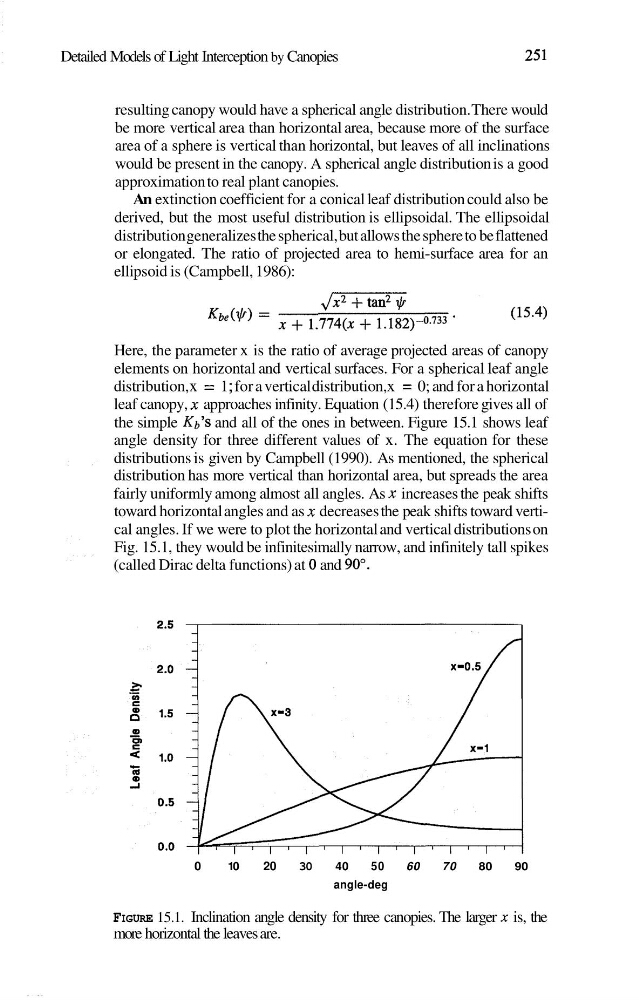
the simple Kb ' S and all of the ones in between. Figure 15.1 shows leaf
angle density for three different values of x. The equation for these
distributions is given by Campbell (1990). As mentioned, the spherical
distribution has more vertical than horizontal area, but spreads the area
fairly uniformly among almost all angles. As x increases the peak shifts
toward horizontal angles and as x decreases the peak shifts toward vertical angles. If we were to plot the horizontal and vertical distributions on
Fig. 15.1, they would be infinitesimally narrow, and infinitely tall spikes
(called Dirac delta functions) at 0 and 90".
0
10
20
30
40
50
60
70
80
90
angle-deg
FIGURE 15.1. Inclination angle density for three canopies. The larger x is, the
more horizontal the leaves are.
25 1
resulting canopy would have a spherical angle distribution. There would
be more vertical area than horizontal area, because more of the surface
area of a sphere is vertical than horizontal, but leaves of all inclinations
would be present in the canopy. A spherical angle distribution is a good
approximation to real plant canopies.
An extinction coefficient for a conical leaf distribution could also be
derived, but the most useful distribution is ellipsoidal. The ellipsoidal
distribution generalizes the spherical, but allows the sphere to be flattened
or elongated. The ratio of projected area to hemi-surface area for an
ellipsoid is (Campbell, 1986):
Here, the parameter x is the ratio of average projected areas of canopy
elements on horizontal and vertical surfaces. For a spherical leaf angle
distribution, x = 1 ; for a vertical distribution, x = 0; and for a horizontal
leaf canopy, x approaches infinity. Equation (1 5.4) therefore gives all of
the simple Kb ' S and all of the ones in between. Figure 15.1 shows leaf
angle density for three different values of x. The equation for these
distributions is given by Campbell (1990). As mentioned, the spherical
distribution has more vertical than horizontal area, but spreads the area
fairly uniformly among almost all angles. As x increases the peak shifts
toward horizontal angles and as x decreases the peak shifts toward vertical angles. If we were to plot the horizontal and vertical distributions on
Fig. 15.1, they would be infinitesimally narrow, and infinitely tall spikes
(called Dirac delta functions) at 0 and 90".
0
10
20
30
40
50
60
70
80
90
angle-deg
FIGURE 15.1. Inclination angle density for three canopies. The larger x is, the
more horizontal the leaves are.