

252
The Light Environment of Plant Canopies
Beam Zenith Angle (degrees)
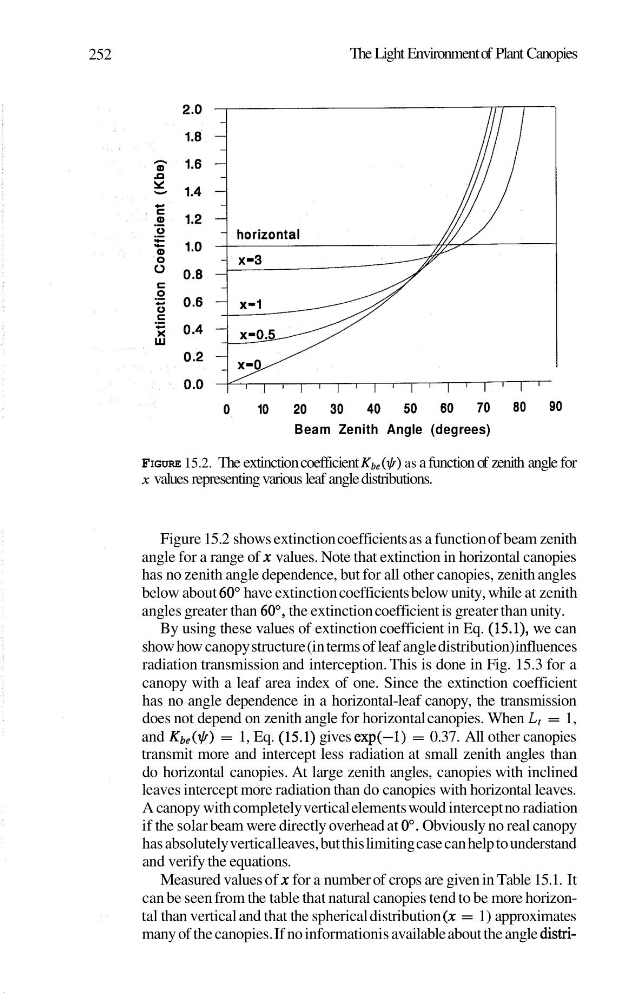
FIGURE 15.2. The extinction coefficient Kbe($) as a function of zenith angle for
x values representing various leaf angle distributions.
Figure 15.2 shows extinction coefficients as a function of beam zenith
angle for a range of x values. Note that extinction in horizontal canopies
has no zenith angle dependence, but for all other canopies, zenith angles
below about 60" have extinction coefficients below unity, while at zenith
angles greater than 60°, the extinction coefficient is greater than unity.
By using these values of extinction coefficient in Eq. (15.1), we can
show how canopy structure (in terms of leaf angle distribution) influences
radiation transmission and interception. This is done in Fig. 15.3 for a
canopy with a leaf area index of one. Since the extinction coefficient
has no angle dependence in a horizontal-leaf canopy, the transmission
does not depend on zenith angle for horizontal canopies. When L, = 1,
and Kbe(@) = 1, Eq. (15.1) gives exp(- 1) = 0.37. All other canopies
transmit more and intercept less radiation at small zenith angles than
do horizontal canopies. At large zenith angles, canopies with inclined
leaves intercept more radiation than do canopies with horizontal leaves.
A canopy with completely vertical elements would intercept no radiation
if the solar beam were directly overhead at 0". Obviously no real canopy
has absolutely vertical leaves, but this limiting case can help to understand
and verify the equations.
Measured values of x for a number of crops are given in Table 15.1. It
can be seen from the table that natural canopies tend to be more horizontal than vertical and that the spherical distribution (x = 1) approximates
many of the canopies. If no information is available about the angle distri-
The Light Environment of Plant Canopies
Beam Zenith Angle (degrees)
FIGURE 15.2. The extinction coefficient Kbe($) as a function of zenith angle for
x values representing various leaf angle distributions.
Figure 15.2 shows extinction coefficients as a function of beam zenith
angle for a range of x values. Note that extinction in horizontal canopies
has no zenith angle dependence, but for all other canopies, zenith angles
below about 60" have extinction coefficients below unity, while at zenith
angles greater than 60°, the extinction coefficient is greater than unity.
By using these values of extinction coefficient in Eq. (15.1), we can
show how canopy structure (in terms of leaf angle distribution) influences
radiation transmission and interception. This is done in Fig. 15.3 for a
canopy with a leaf area index of one. Since the extinction coefficient
has no angle dependence in a horizontal-leaf canopy, the transmission
does not depend on zenith angle for horizontal canopies. When L, = 1,
and Kbe(@) = 1, Eq. (15.1) gives exp(- 1) = 0.37. All other canopies
transmit more and intercept less radiation at small zenith angles than
do horizontal canopies. At large zenith angles, canopies with inclined
leaves intercept more radiation than do canopies with horizontal leaves.
A canopy with completely vertical elements would intercept no radiation
if the solar beam were directly overhead at 0". Obviously no real canopy
has absolutely vertical leaves, but this limiting case can help to understand
and verify the equations.
Measured values of x for a number of crops are given in Table 15.1. It
can be seen from the table that natural canopies tend to be more horizontal than vertical and that the spherical distribution (x = 1) approximates
many of the canopies. If no information is available about the angle distri-