

250
The Light Environment of Plant Canopies
for evaporating water from the soil. A simple way to partition potential
evapotranspiration (PET) between potential transpiration and potential
soil evaporation uses t. Potential transpiration is 1 - t times PET, and
potential evaporation is t times PET. A canopy that covers the ground reasonably well has a leaf area index of perhaps three. If K (@) = 0.6, then,
from Eq. (15. I), t (@) = exp(-0.6 x 3) = 0.17; so 17 percent of the
radiation is intercepted by the soil surface and 83 percent is intercepted by
the canopy. If both canopy and soil surface were wet, so that evapotranspiration were at the potential rate, then 83 percent of the evapotranspiration
would come from the canopy and 17 percent from the soil.
15.2 Detailed Models of Light Interception by
Canopies
Our purpose here is to find equations that allow us to account for the
major variations in PAR and near-infrared (NIR) fluxes on leaves in a
canopy. The most obvious variations result from shading of some leaves
by others. We therefore consider two classes of leaves, those that are
shaded, and those that are sunlit. Average PAR or NIR flux densities for
each of these classes can be derived. More detailed models subdivide each
of these classes to account for the leaf angle distribution and position in
the canopy of leaves, but we do not consider those now. Goudriaan (1988)
shows how to derive a model with more radiation classes.
The calculation of an extinction coefficient requires calculating the
area of an average projection from some direction @ onto the horizontal,
and this is not an easy thing, except by some geometrical reasoning. If
all of the leaves in a canopy were vertical, but with random azimuthal
orientations, then the distribution function for leaf area in the canopy
would be the same as the distribution function for area on the vertical
surface of a vertical cylinder. The ratio of the area projected onto the
horizontal from the direction @ to the hemi-surface area of a cylinder
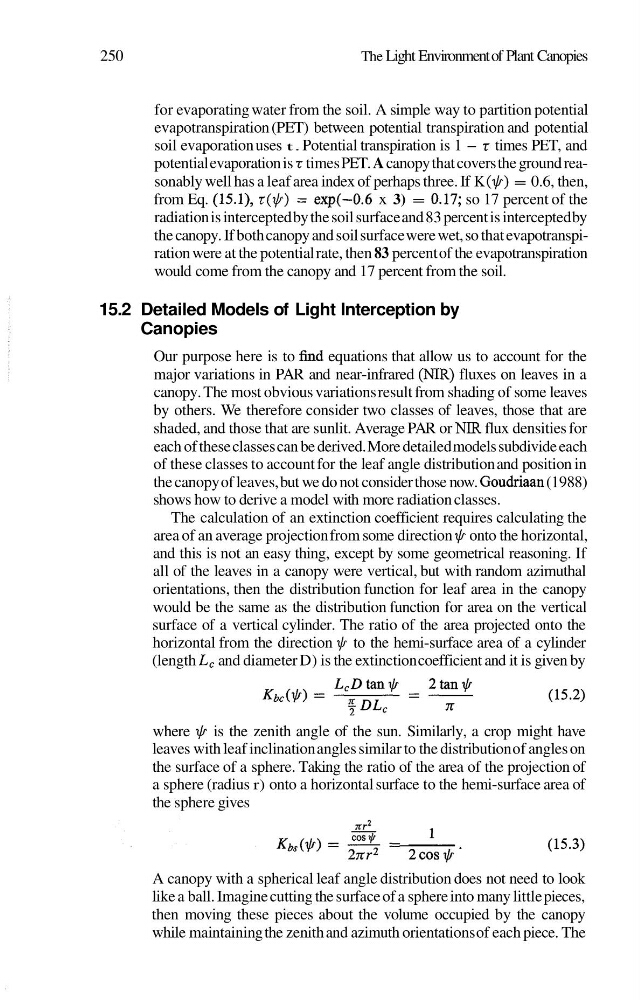
(length LC and diameter D) is the extinction coefficient and it is given by
where @ is the zenith angle of the sun. Similarly, a crop might have
leaves with leaf inclination angles similar to the distribution of angles on
the surface of a sphere. Taking the ratio of the area of the projection of
a sphere (radius r) onto a horizontal surface to the hemi-surface area of
the sphere gives
A canopy with a spherical leaf angle distribution does not need to look
like a ball. Imagine cutting the surface of a sphere into many little pieces,
then moving these pieces about the volume occupied by the canopy
while maintaining the zenith and azimuth orientations of each piece. The
The Light Environment of Plant Canopies
for evaporating water from the soil. A simple way to partition potential
evapotranspiration (PET) between potential transpiration and potential
soil evaporation uses t. Potential transpiration is 1 - t times PET, and
potential evaporation is t times PET. A canopy that covers the ground reasonably well has a leaf area index of perhaps three. If K (@) = 0.6, then,
from Eq. (15. I), t (@) = exp(-0.6 x 3) = 0.17; so 17 percent of the
radiation is intercepted by the soil surface and 83 percent is intercepted by
the canopy. If both canopy and soil surface were wet, so that evapotranspiration were at the potential rate, then 83 percent of the evapotranspiration
would come from the canopy and 17 percent from the soil.
15.2 Detailed Models of Light Interception by
Canopies
Our purpose here is to find equations that allow us to account for the
major variations in PAR and near-infrared (NIR) fluxes on leaves in a
canopy. The most obvious variations result from shading of some leaves
by others. We therefore consider two classes of leaves, those that are
shaded, and those that are sunlit. Average PAR or NIR flux densities for
each of these classes can be derived. More detailed models subdivide each
of these classes to account for the leaf angle distribution and position in
the canopy of leaves, but we do not consider those now. Goudriaan (1988)
shows how to derive a model with more radiation classes.
The calculation of an extinction coefficient requires calculating the
area of an average projection from some direction @ onto the horizontal,
and this is not an easy thing, except by some geometrical reasoning. If
all of the leaves in a canopy were vertical, but with random azimuthal
orientations, then the distribution function for leaf area in the canopy
would be the same as the distribution function for area on the vertical
surface of a vertical cylinder. The ratio of the area projected onto the
horizontal from the direction @ to the hemi-surface area of a cylinder
(length LC and diameter D) is the extinction coefficient and it is given by
where @ is the zenith angle of the sun. Similarly, a crop might have
leaves with leaf inclination angles similar to the distribution of angles on
the surface of a sphere. Taking the ratio of the area of the projection of
a sphere (radius r) onto a horizontal surface to the hemi-surface area of
the sphere gives
A canopy with a spherical leaf angle distribution does not need to look
like a ball. Imagine cutting the surface of a sphere into many little pieces,
then moving these pieces about the volume occupied by the canopy
while maintaining the zenith and azimuth orientations of each piece. The