

Biochemical Models for Assimilation
239
14.8 Biochemical Models for Assimilation
To investigate more detailed questions related to response of assimilation
to the leaf environment a more detailed model is needed that addresses
temperature sensitivity of enzymes and limitations by light, C02, and the
export of products of photosynthesis. The model we present here is from
Collatz et al. (1991). The model considers the gross assimilation rate A,
in units of pmol m-2 s-I, to be the minimum of three potential capacities:
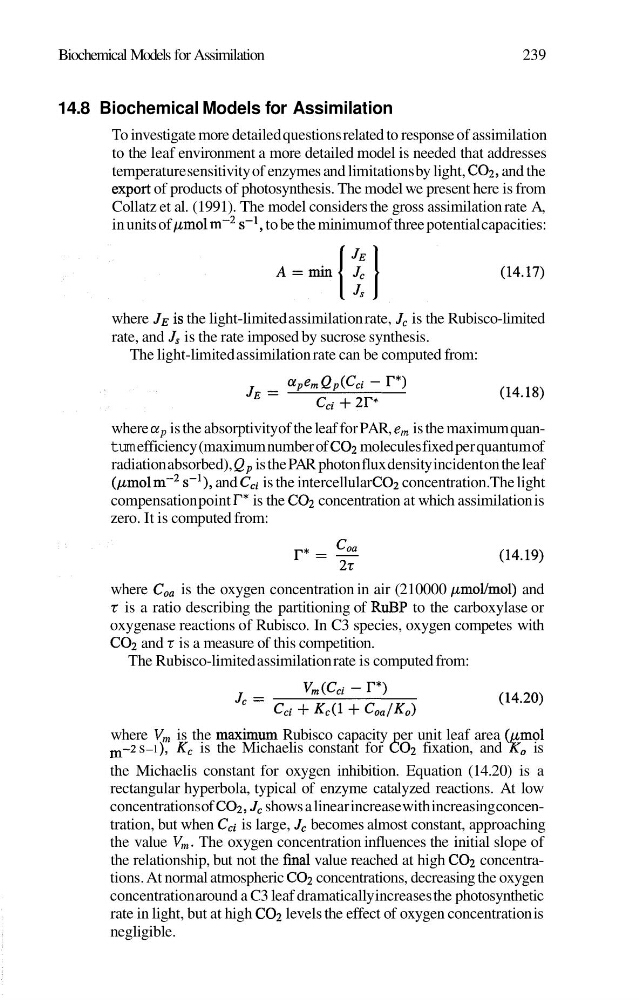
where JE is the light-limited assimilation rate, Jc is the Rubisco-limited
rate, and J, is the rate imposed by sucrose synthesis.
The light-limited assimilation rate can be computed from:
where a, is the absorptivity of the leaf for PAR, e, is the maximum quantum efficiency (maximum number of C02 molecules fixed per quantum of
radiation absorbed), Q p is the PAR photon flux density incident on the leaf
(pmol m-2 s-I), and Cci is the intercellular C02 concentration. The light
compensation point r* is the C02 concentration at which assimilation is
zero. It is computed from:
where Coo is the oxygen concentration in air (210000 pmol/mol) and
t is a ratio describing the partitioning of RuBP to the carboxylase or
oxygenase reactions of Rubisco. In C3 species, oxygen competes with
C02 and t is a measure of this competition.
The Rubisco-limited assimilation rate is computed from:
where V, is the maximum Rubisco capacity per unit leaf area (pmol
m-2 s -1 ), Kc is the Michaelis constant for C02 fixation, and KO is
the Michaelis constant for oxygen inhibition. Equation (14.20) is a
rectangular hyperbola, typical of enzyme catalyzed reactions. At low
concentrations of CO2, Jc shows a linear increase with increasing concentration, but when Cci is large, Jc becomes almost constant, approaching
the value Vm. The oxygen concentration influences the initial slope of
the relationship, but not the h a 1 value reached at high COz concentrations. At normal atmospheric C02 concentrations, decreasing the oxygen
concentration around a C3 leaf dramatically increases the photosynthetic
rate in light, but at high C02 levels the effect of oxygen concentration is
negligible.
239
14.8 Biochemical Models for Assimilation
To investigate more detailed questions related to response of assimilation
to the leaf environment a more detailed model is needed that addresses
temperature sensitivity of enzymes and limitations by light, C02, and the
export of products of photosynthesis. The model we present here is from
Collatz et al. (1991). The model considers the gross assimilation rate A,
in units of pmol m-2 s-I, to be the minimum of three potential capacities:
where JE is the light-limited assimilation rate, Jc is the Rubisco-limited
rate, and J, is the rate imposed by sucrose synthesis.
The light-limited assimilation rate can be computed from:
where a, is the absorptivity of the leaf for PAR, e, is the maximum quantum efficiency (maximum number of C02 molecules fixed per quantum of
radiation absorbed), Q p is the PAR photon flux density incident on the leaf
(pmol m-2 s-I), and Cci is the intercellular C02 concentration. The light
compensation point r* is the C02 concentration at which assimilation is
zero. It is computed from:
where Coo is the oxygen concentration in air (210000 pmol/mol) and
t is a ratio describing the partitioning of RuBP to the carboxylase or
oxygenase reactions of Rubisco. In C3 species, oxygen competes with
C02 and t is a measure of this competition.
The Rubisco-limited assimilation rate is computed from:
where V, is the maximum Rubisco capacity per unit leaf area (pmol
m-2 s -1 ), Kc is the Michaelis constant for C02 fixation, and KO is
the Michaelis constant for oxygen inhibition. Equation (14.20) is a
rectangular hyperbola, typical of enzyme catalyzed reactions. At low
concentrations of CO2, Jc shows a linear increase with increasing concentration, but when Cci is large, Jc becomes almost constant, approaching
the value Vm. The oxygen concentration influences the initial slope of
the relationship, but not the h a 1 value reached at high COz concentrations. At normal atmospheric C02 concentrations, decreasing the oxygen
concentration around a C3 leaf dramatically increases the photosynthetic
rate in light, but at high C02 levels the effect of oxygen concentration is
negligible.