

Plants and Plant Communities
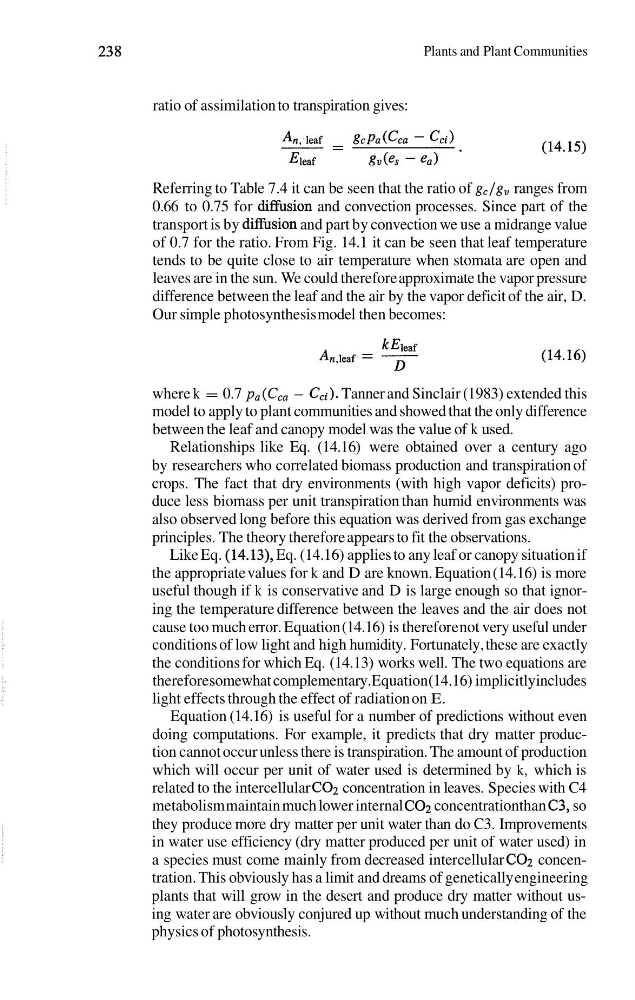
ratio of assimilation to transpiration gives:
Referring to Table 7.4 it can be seen that the ratio of gc/g, ranges from
0.66 to 0.75 for diffusion and convection processes. Since part of the
transport is by diffusion and part by convection we use a midrange value
of 0.7 for the ratio. From Fig. 14.1 it can be seen that leaf temperature
tends to be quite close to air temperature when stomata are open and
leaves are in the sun. We could therefore approximate the vapor pressure
difference between the leaf and the air by the vapor deficit of the air, D.
Our simple photosynthesis model then becomes:
where k = 0.7 pa(Cca - CCi). Tanner and Sinclair (1983) extended this
model to apply to plant communities and showed that the only difference
between the leaf and canopy model was the value of k used.
Relationships like Eq. (14.16) were obtained over a century ago
by researchers who correlated biomass production and transpiration of
crops. The fact that dry environments (with high vapor deficits) produce less biomass per unit transpiration than humid environments was
also observed long before this equation was derived from gas exchange
principles. The theory therefore appears to fit the observations.
Like Eq. (14.13), Eq. (14.16) applies to any leaf or canopy situation if
the appropriate values for k and D are known. Equation (14.16) is more
useful though if k is conservative and D is large enough so that ignoring the temperature difference between the leaves and the air does not
cause too much error. Equation (14.16) is therefore not very useful under
conditions of low light and high humidity. Fortunately, these are exactly
the conditions for which Eq. (14.13) works well. The two equations are
therefore somewhat complementary. Equation (14.16) implicitly includes
light effects through the effect of radiation on E.
Equation (14.16) is useful for a number of predictions without even
doing computations. For example, it predicts that dry matter production cannot occur unless there is transpiration. The amount of production
which will occur per unit of water used is determined by k, which is
related to the intercellular C02 concentration in leaves. Species with C4
metabolism maintain much lower internal COz concentration than C3, so
they produce more dry matter per unit water than do C3. Improvements
in water use efficiency (dry matter produced per unit of water used) in
a species must come mainly from decreased intercellular C02 concentration. This obviously has a limit and dreams of genetically engineering
plants that will grow in the desert and produce dry matter without using water are obviously conjured up without much understanding of the
physics of photosynthesis.
ratio of assimilation to transpiration gives:
Referring to Table 7.4 it can be seen that the ratio of gc/g, ranges from
0.66 to 0.75 for diffusion and convection processes. Since part of the
transport is by diffusion and part by convection we use a midrange value
of 0.7 for the ratio. From Fig. 14.1 it can be seen that leaf temperature
tends to be quite close to air temperature when stomata are open and
leaves are in the sun. We could therefore approximate the vapor pressure
difference between the leaf and the air by the vapor deficit of the air, D.
Our simple photosynthesis model then becomes:
where k = 0.7 pa(Cca - CCi). Tanner and Sinclair (1983) extended this
model to apply to plant communities and showed that the only difference
between the leaf and canopy model was the value of k used.
Relationships like Eq. (14.16) were obtained over a century ago
by researchers who correlated biomass production and transpiration of
crops. The fact that dry environments (with high vapor deficits) produce less biomass per unit transpiration than humid environments was
also observed long before this equation was derived from gas exchange
principles. The theory therefore appears to fit the observations.
Like Eq. (14.13), Eq. (14.16) applies to any leaf or canopy situation if
the appropriate values for k and D are known. Equation (14.16) is more
useful though if k is conservative and D is large enough so that ignoring the temperature difference between the leaves and the air does not
cause too much error. Equation (14.16) is therefore not very useful under
conditions of low light and high humidity. Fortunately, these are exactly
the conditions for which Eq. (14.13) works well. The two equations are
therefore somewhat complementary. Equation (14.16) implicitly includes
light effects through the effect of radiation on E.
Equation (14.16) is useful for a number of predictions without even
doing computations. For example, it predicts that dry matter production cannot occur unless there is transpiration. The amount of production
which will occur per unit of water used is determined by k, which is
related to the intercellular C02 concentration in leaves. Species with C4
metabolism maintain much lower internal COz concentration than C3, so
they produce more dry matter per unit water than do C3. Improvements
in water use efficiency (dry matter produced per unit of water used) in
a species must come mainly from decreased intercellular C02 concentration. This obviously has a limit and dreams of genetically engineering
plants that will grow in the desert and produce dry matter without using water are obviously conjured up without much understanding of the
physics of photosynthesis.