

240
Plants and Plant Communities
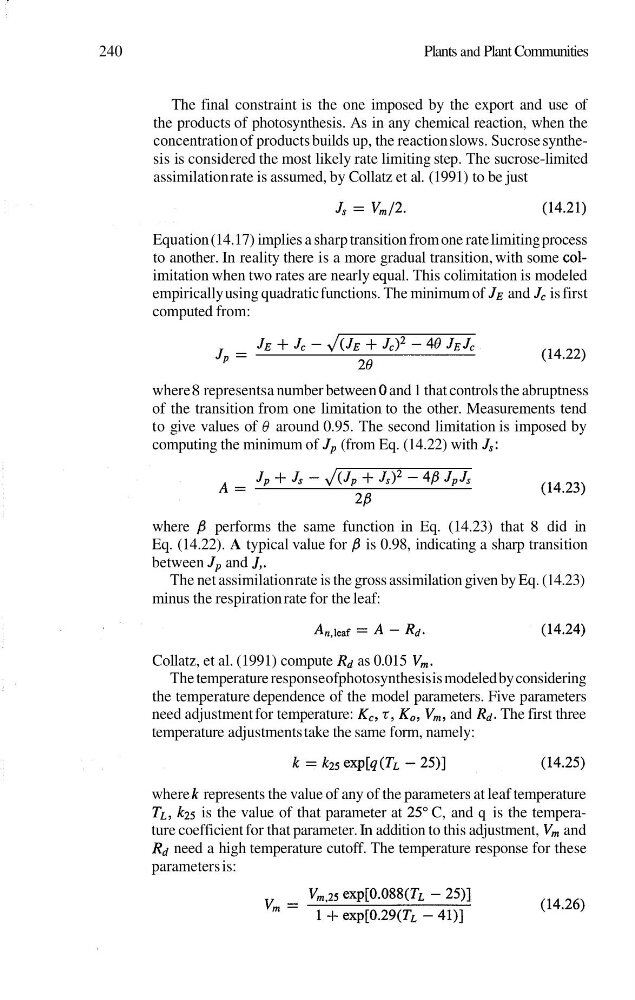
The final constraint is the one imposed by the export and use of
the products of photosynthesis. As in any chemical reaction, when the
concentration of products builds up, the reaction slows. Sucrose synthesis is considered the most likely rate limiting step. The sucrose-limited
assimilation rate is assumed, by Collatz et al. (1991) to be just
Equation (14.17) implies a sharp transition from one rate limiting process
to another. In reality there is a more gradual transition, with some colimitation when two rates are nearly equal. This colimitation is modeled
empirically using quadratic functions. The minimum of JE and Jc is first
computed from:
where 8 represents a number between 0 and 1 that controls the abruptness
of the transition from one limitation to the other. Measurements tend
to give values of 8 around 0.95. The second limitation is imposed by
computing the minimum of J p (from Eq. (14.22) with J,:
where / 3 performs the same function in Eq. (14.23) that 8 did in
Eq. (14.22). A typical value for B is 0.98, indicating a sharp transition
between Jp and J,.
The net assimilation rate is the gross assimilation given by Eq. (14.23)
minus the respiration rate for the leaf:
Collatz, et al. (1991) compute Rd as 0.015 Vm.
The temperature response ofphotosynthesis is modeled by considering
the temperature dependence of the model parameters. Five parameters
need adjustment for temperature: Kc, z, KO, Vm, and Rd. The first three
temperature adjustments take the same form, namely:
where k represents the value of any of the parameters at leaf temperature
TL, k25 is the value of that parameter at 25" C, and q is the temperature coefficient for that parameter. In addition to this adjustment, Vm and
Rd need a high temperature cutoff. The temperature response for these
parameters is:
Plants and Plant Communities
The final constraint is the one imposed by the export and use of
the products of photosynthesis. As in any chemical reaction, when the
concentration of products builds up, the reaction slows. Sucrose synthesis is considered the most likely rate limiting step. The sucrose-limited
assimilation rate is assumed, by Collatz et al. (1991) to be just
Equation (14.17) implies a sharp transition from one rate limiting process
to another. In reality there is a more gradual transition, with some colimitation when two rates are nearly equal. This colimitation is modeled
empirically using quadratic functions. The minimum of JE and Jc is first
computed from:
where 8 represents a number between 0 and 1 that controls the abruptness
of the transition from one limitation to the other. Measurements tend
to give values of 8 around 0.95. The second limitation is imposed by
computing the minimum of J p (from Eq. (14.22) with J,:
where / 3 performs the same function in Eq. (14.23) that 8 did in
Eq. (14.22). A typical value for B is 0.98, indicating a sharp transition
between Jp and J,.
The net assimilation rate is the gross assimilation given by Eq. (14.23)
minus the respiration rate for the leaf:
Collatz, et al. (1991) compute Rd as 0.015 Vm.
The temperature response ofphotosynthesis is modeled by considering
the temperature dependence of the model parameters. Five parameters
need adjustment for temperature: Kc, z, KO, Vm, and Rd. The first three
temperature adjustments take the same form, namely:
where k represents the value of any of the parameters at leaf temperature
TL, k25 is the value of that parameter at 25" C, and q is the temperature coefficient for that parameter. In addition to this adjustment, Vm and
Rd need a high temperature cutoff. The temperature response for these
parameters is: