

Plants and Plant Communities
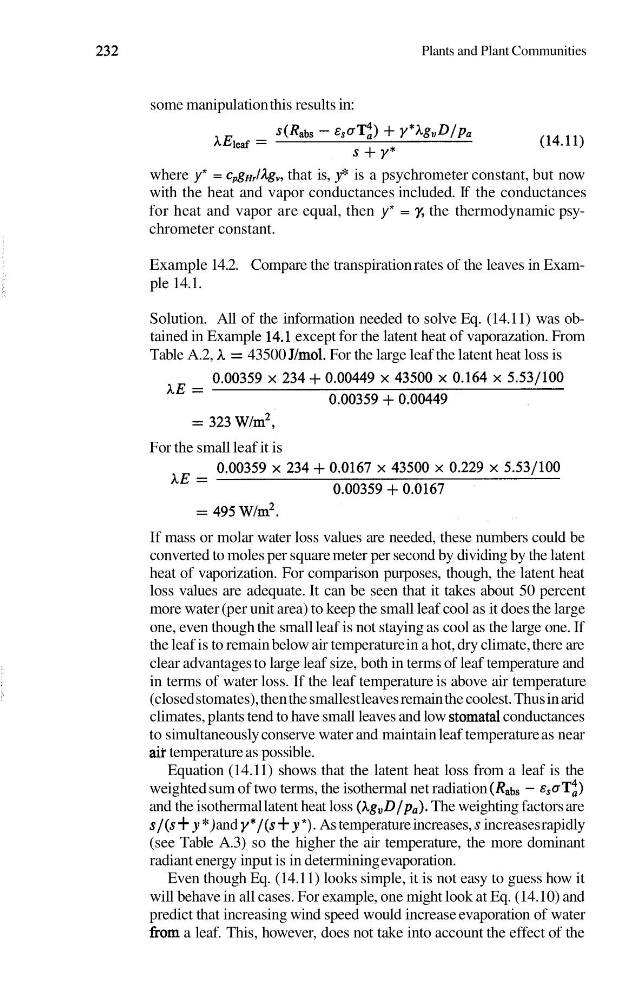
some manipulation this results in:
where y* = c,g,,lAg,,, that is, y* is a psychrometer constant, but now
with the heat and vapor conductances included. If the conductances
for heat and vapor are equal, then y* = y, the thermodynamic psychrometer constant.
Example 14.2. Compare the transpiration rates of the leaves in Example 14.1.
Solution. All of the information needed to solve Eq. (14.11) was obtained in Example 14.1 except for the latent heat of vaporazation. From
Table A.2, h = 43500 Jlmol. For the large leaf the latent heat loss is
For the small leaf it is
If mass or molar water loss values are needed, these numbers could be
converted to moles per square meter per second by dividing by the latent
heat of vaporization. For comparison purposes, though, the latent heat
loss values are adequate. It can be seen that it takes about 50 percent
more water (per unit area) to keep the small leaf cool as it does the large
one, even though the small leaf is not staying as cool as the large one. If
the leaf is to remain below air temperature in a hot, dry climate, there are
clear advantages to large leaf size, both in terms of leaf temperature and
in terms of water loss. If the leaf temperature is above air temperature
(closed stomates), then the smallest leaves remain the coolest. Thus in arid
climates, plants tend to have small leaves and low stornatal conductances
to simultaneously conserve water and maintain leaf temperature as near
air temperature as possible.
Equation (14.1 1) shows that the latent heat loss from a leaf is the
weighted sum of two terms, the isothermal net radiation (Rabs - E ~ O T ~ )
and the isothermal latent heat loss (hg, Dlp,). The weighting factors are
s / ( s + y*) and y * / ( s + y *). As temperature increases, s increases rapidly
(see Table A.3) so the higher the air temperature, the more dominant
radiant energy input is in determining evaporation.
Even though Eq. (14.1 1) looks simple, it is not easy to guess how it
will behave in all cases. For example, one might look at Eq. (14.10) and
predict that increasing wind speed would increase evaporation of water
from a leaf. This, however, does not take into account the effect of the
some manipulation this results in:
where y* = c,g,,lAg,,, that is, y* is a psychrometer constant, but now
with the heat and vapor conductances included. If the conductances
for heat and vapor are equal, then y* = y, the thermodynamic psychrometer constant.
Example 14.2. Compare the transpiration rates of the leaves in Example 14.1.
Solution. All of the information needed to solve Eq. (14.11) was obtained in Example 14.1 except for the latent heat of vaporazation. From
Table A.2, h = 43500 Jlmol. For the large leaf the latent heat loss is
For the small leaf it is
If mass or molar water loss values are needed, these numbers could be
converted to moles per square meter per second by dividing by the latent
heat of vaporization. For comparison purposes, though, the latent heat
loss values are adequate. It can be seen that it takes about 50 percent
more water (per unit area) to keep the small leaf cool as it does the large
one, even though the small leaf is not staying as cool as the large one. If
the leaf is to remain below air temperature in a hot, dry climate, there are
clear advantages to large leaf size, both in terms of leaf temperature and
in terms of water loss. If the leaf temperature is above air temperature
(closed stomates), then the smallest leaves remain the coolest. Thus in arid
climates, plants tend to have small leaves and low stornatal conductances
to simultaneously conserve water and maintain leaf temperature as near
air temperature as possible.
Equation (14.1 1) shows that the latent heat loss from a leaf is the
weighted sum of two terms, the isothermal net radiation (Rabs - E ~ O T ~ )
and the isothermal latent heat loss (hg, Dlp,). The weighting factors are
s / ( s + y*) and y * / ( s + y *). As temperature increases, s increases rapidly
(see Table A.3) so the higher the air temperature, the more dominant
radiant energy input is in determining evaporation.
Even though Eq. (14.1 1) looks simple, it is not easy to guess how it
will behave in all cases. For example, one might look at Eq. (14.10) and
predict that increasing wind speed would increase evaporation of water
from a leaf. This, however, does not take into account the effect of the